Why Does Everyone Look the Same?
Why Is Natural Appearance Being Lost with Dermal Fillers?
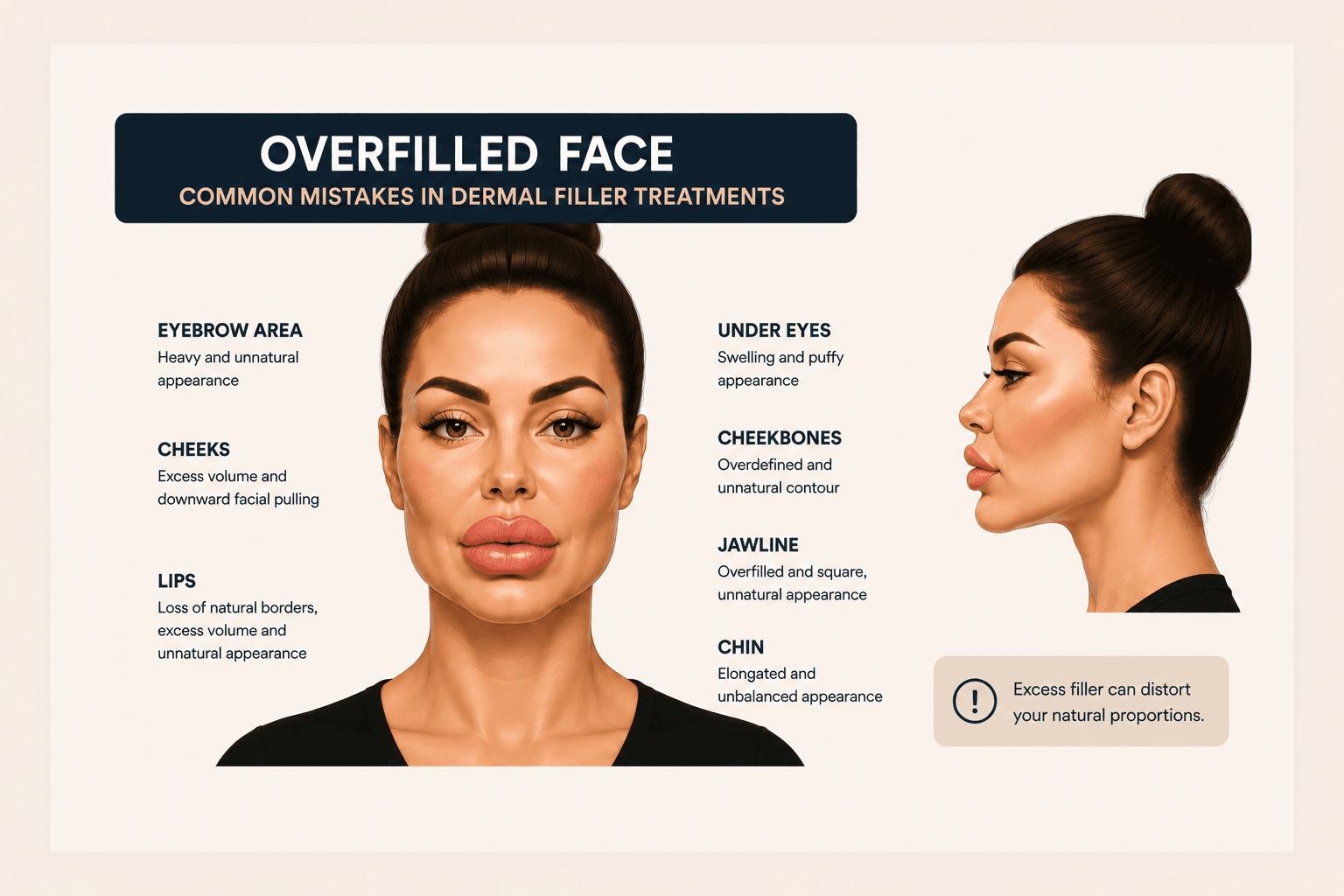
In recent years, many people who undergo facial filler treatments have started to look increasingly alike. Prominent cheekbones, hollow-looking cheeks, a sharply defined jawline, and lips enlarged beyond their natural boundaries have become the hallmark of a one-size-fits-all aesthetic trend.
When properly planned, however, dermal fillers are not intended to change a person’s face. Their purpose is to restore age-related volume loss, support facial structures, and create a fresher, more youthful appearance. The problem is usually not the filler itself, but its use in the wrong patients, for the wrong indications, or in excessive amounts.
As a result, unique facial expressions, subtle asymmetries, and the natural transitions that give every face its individual character gradually disappear. Ironically, while people seek to look younger, they may end up looking remarkably similar to one another.
Facial Aging Is More Than Volume Loss
One of the biggest misconceptions is that every sign of facial aging can be corrected simply by adding filler.
In reality, facial aging is a complex process involving several changes that occur simultaneously, including:
- Loss of facial bone support over time
- Thinning of the skin and reduced elasticity
- Redistribution and loss of facial fat
- Loosening of muscles and retaining ligaments
Dermal fillers can address only part of this process.
When Are Dermal Fillers Enough?
When placed in the right areas, in the right amounts, and for the right indications, dermal fillers can successfully restore facial support, replace lost volume, and create a naturally refreshed appearance.
They are particularly effective for patients with mild volume loss and early signs of facial aging.
However, fillers cannot eliminate significant skin laxity or facial sagging.
Attempting to camouflage sagging by repeatedly adding more filler often results in a heavier face, distorted facial proportions, and the overfilled or “same-face” appearance that has become increasingly common on social media.
When Are Fillers Not Enough?
For patients with significant skin laxity and tissue descent, other treatment options may provide better results. Depending on the individual, these may include energy-based skin tightening devices, minimally invasive procedures, or facial rejuvenation surgery such as a facelift.
The most natural outcomes are rarely achieved by using a single treatment for everyone. Instead, successful facial rejuvenation requires a personalized treatment plan based on the patient’s age, facial anatomy, skin quality, degree of aging, and aesthetic goals.
Dermal fillers, wrinkle treatments, energy-based devices, and surgical procedures should not be viewed as competing treatments. When appropriately selected, they can complement one another.
Our Approach
Dermal fillers are among the most commonly performed non-surgical procedures in our clinic. However, we do not believe in creating excessive volume, altering a person’s facial identity, or following trends that make everyone look the same.
Our philosophy is based on carefully analyzing each patient’s facial anatomy, expressions, and aging process. When appropriate, filler treatments may be combined with minimally invasive procedures or other facial rejuvenation techniques to achieve balanced, natural-looking results.
The true measure of successful aesthetic treatment is not that people notice you have had a procedure.
It is when they simply say:
“You look well rested.”
“You look great.”
without being able to tell exactly why.
Our goal is not to transform someone’s face into a different one, but to help them look like the best, younger version of themselves.
Because, in our opinion, aesthetic medicine should never erase the story written on a face. It should simply help turn back the clock while preserving the individuality that makes every face unique.
For more detailed information about when dermal fillers are appropriate and how they can be planned for natural-looking results, you can visit our Dermal Fillers page. For patients with more significant tissue sagging, you can also learn more about surgical options on our Facelift and Neck Lift page.