
Exosome Treatment in Turkey: Skin, Hair and Scar Applications
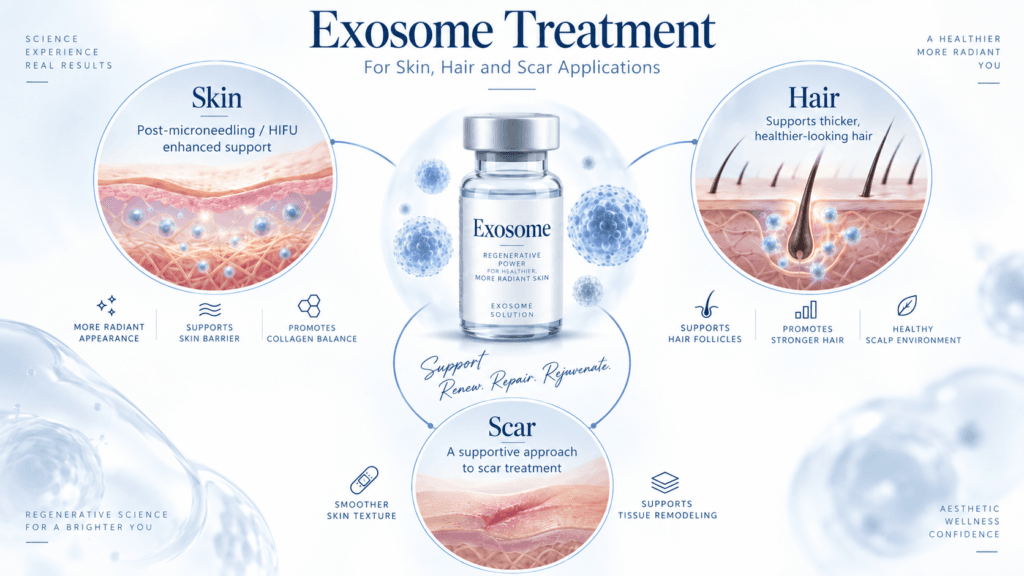
Exosomes are very small extracellular vesicles that carry biological signals between cells. They contain different biological molecules, including proteins, lipids and gene-regulating molecules, and play a role in intercellular communication.
In recent years, exosome-containing products have attracted increasing interest in aesthetic and regenerative medicine, particularly for supporting skin quality, regenerative scalp treatments and selected scar therapies.
I do not regard exosome applications as a standalone filler, mesotherapy treatment or “youth product”. In my practice, I usually create a controlled tissue stimulus first and then apply an exosome-containing product to support the healing response.
For the skin, I most commonly use exosomes after microneedling or 3 mm HIFU. On the scalp, I combine them with microneedling. In selected patients, I may also use exosomes as part of scar treatment, particularly after surgical scar revision.
What Are Exosomes?
Exosomes are nanometre-sized extracellular vesicles released by cells.
They are not cells and they cannot reproduce. Through the biological molecules they carry, they can influence the behaviour of surrounding cells.
Research suggests that exosomes may play a role in:
- intercellular communication,
- regulation of inflammation,
- tissue repair,
- cell migration,
- extracellular matrix regulation.
These signalling mechanisms are one of the main reasons exosomes have attracted interest in aesthetic and regenerative medicine.
What Is Exosome Treatment?
“Exosome treatment” does not refer to one single standardised procedure.
The source of the product, manufacturing process, composition and method of application may vary. In skin and hair treatments, exosome-containing products are commonly used after microneedling, HIFU or other controlled tissue-stimulation procedures.
The aim is to support the healing and remodelling response initiated in the tissue.
Although current human studies have reported encouraging findings regarding skin quality and hair density, larger and more standardised studies are still needed because products and treatment protocols vary considerably.
Which Exosome Product Do I Use?
In my clinic, I use Rejubeau exosome products, which have separate formulations for skin and hair applications.
When selecting a product, I do not focus only on whether it is labelled as an “exosome” product. I also consider manufacturing standards, whether the contents are clearly defined and whether the formulation is appropriate for the tissue being treated.
I do not prefer to use the same formulation for both skin and hair, as these tissues have different biological characteristics and treatment goals.
Are the Exosomes I Use Plant-Based or Human-Derived?
The source of exosome products varies according to the product.
Some commercially available products are plant-derived, while others are obtained from human cell cultures.
The Rejubeau products I use are not plant-derived. According to the manufacturer’s technical information, they contain exosomes derived from human cell culture.
This is not a live stem cell treatment. The product contains purified extracellular vesicles released by cells.
Exosome Treatment for the Skin
For skin rejuvenation, I do not usually use exosomes on their own.
I prefer to create a controlled biological stimulus in the skin first. The methods I most commonly use are:
- microneedling
- dermal treatment with a 3 mm HIFU cartridge
The exosome-containing product is then applied to the skin.
The aim is to support the healing response initiated by the mechanical or energy-based treatment and to make use of the skin’s remodelling process.
Exosomes with Microneedling
Microneedling creates controlled microchannels in the skin and initiates a natural wound-healing response. This process is associated with fibroblast activation and collagen remodelling.
Applying an exosome-containing product after microneedling may have two theoretical advantages:
- the microchannels may facilitate passage of the product through the skin surface,
- the biological signals carried by exosomes may interact with cells within the healing environment.
Recent human studies have reported that the combination of microneedling and exosomes may have positive effects on skin texture, elasticity, hydration and fine lines. However, the number of studies remains limited.
Exosome Application After HIFU
In selected patients, I use a 3 mm HIFU cartridge to create a controlled tissue stimulus.
This depth is intended to produce thermal stimulation at the dermal and superficial subdermal level. After HIFU, I may apply an exosome-containing product to support the wound-healing and remodelling process.
The evidence for combining exosomes with HIFU is not as extensive as the evidence for microneedling. For this reason, I do not present this as a standard treatment with definitively proven efficacy, but as a combined regenerative approach that I use in selected patients.
What Are Exosomes Used for in the Skin?
The main goal of exosome treatment is not to add facial volume or alter facial expression.
Exosome applications may be considered for:
- supporting skin texture,
- reducing the appearance of fine lines,
- supporting elasticity,
- improving surface homogeneity,
- supporting recovery after treatment.
For this reason, exosome applications belong to a different treatment category from dermal fillers and botulinum toxin.
Do Exosomes Increase Collagen Production?
Experimental studies suggest that exosomes may influence biological pathways related to collagen synthesis through fibroblast activity and extracellular matrix regulation.
Human studies have also reported positive changes in skin elasticity, wrinkles and dermal quality. However, standardised clinical data showing exactly how much collagen is produced by exosome treatment alone are still insufficient.
For this reason, I do not use exosomes as a product that “guarantees collagen production”. I consider them a supportive regenerative treatment following controlled tissue stimulation.
Exosome Treatment for Hair
Exosome applications to the scalp are being investigated particularly in relation to androgenetic hair loss.
In my practice, I use exosomes together with microneedling. I first create controlled microchannels in the scalp and then apply an exosome formulation specifically designed for hair applications.
The aim is to support the biological environment around the hair follicles and create a regenerative stimulus in the scalp.
Do Exosomes Regrow Hair?
It would not be appropriate to make a definite claim.
Small clinical studies have reported increases in hair density and hair shaft thickness following combinations of exosome treatment and microneedling in androgenetic alopecia. However, patient numbers are limited and different products and protocols have been used.
For this reason, I regard exosome hair treatment not as:
“a treatment that definitely regrows hair”
but rather as:
a regenerative approach intended to support the existing biological activity of hair follicles.
It would not be realistic to claim that exosomes can recreate follicles that have been completely lost or inactive for a long period of time.
Which Types of Hair Loss May Be Suitable?
Exosome treatments may be considered in some types of hair loss where the follicles are still present and thinning is the main problem.
Androgenetic alopecia is one of the most widely studied areas.
However, hair loss can have many causes, including:
- iron deficiency,
- thyroid disease,
- hormonal disorders,
- autoimmune conditions,
- medications,
- stress,
- nutritional problems.
For this reason, applying exosomes without first investigating the cause of hair loss is not appropriate.
Exosomes in Scar Treatment
I do not use exosomes only for skin rejuvenation and scalp applications.
In selected patients, I also consider them as part of a scar treatment plan.
In particular, after surgical scar revision, I may use exosome treatment to support the new wound-healing process.
Exosomes After Scar Revision
In an old or prominent scar, the problem is sometimes not limited to the skin surface.
The shape of the scar, mechanical relationships between tissues or underlying fibrosis may be more important. In such cases, trying to treat the scar with superficial treatment alone may not be sufficient.
In suitable patients, I first perform surgical scar revision. After the scar is excised and the wound is closed again in a more controlled manner, I may consider exosomes as one of the supportive treatments during the appropriate stage of healing.
The goal is not to eliminate the scar completely, but to support the new wound-healing process under the best possible conditions.
Can Exosomes Be Used for Acne Scars?
In acne scars, the problem is often not limited to skin quality.
Depressed scars may involve dermal volume loss, fibrotic bands or surface irregularities. For this reason, exosomes alone do not treat every type of acne scar.
After microneedling, subcision, fractional treatments or other scar procedures, exosomes may be considered as a supportive option during the healing process.
The primary treatment should always be selected according to the type of scar.
When Can Exosomes Be Used on Surgical Scars?
Exosome products should not be applied randomly to an open or infected wound.
The wound should first be appropriately closed and the stage of healing should be assessed.
The timing of treatment depends on:
- the type of surgery,
- the condition of the wound,
- the location of the scar,
- other scar treatments being used.
Are Exosomes the Same as PRP?
No.
PRP is platelet-rich plasma prepared from the patient’s own blood. Exosomes are a different group of biological products containing extracellular vesicles released by cells.
PRP is prepared directly from the patient’s own blood, whereas the source and manufacturing process of exosome products depend on the specific product.
Are Exosomes Stem Cells?
No.
Exosomes are not cells. They are microscopic vesicles released by cells and carry biological signals between cells. They cannot divide or create new tissue on their own.
For this reason, stem cell treatment and exosome application are not the same thing.
Are Exosomes Injected?
In my treatment protocol, I most commonly use exosome products topically after procedures such as microneedling or HIFU that create controlled pathways and a healing response in the skin.
On the scalp, I also apply them after microneedling.
The aim is to make use of the controlled microchannels and treated surface rather than injecting the product directly into deeper tissues.
While there are encouraging data for topical and microneedling-assisted applications, there is greater uncertainty regarding standardisation and safety when exosome products are used by injection.
How Many Exosome Treatment Sessions Are Needed?
There is no single standard number of sessions.
The number of treatments depends on:
- the treatment goal,
- the current condition of the skin or scalp,
- the combination treatment being used,
- the patient’s response.
For this reason, I prefer to plan treatment according to the clinical response rather than using a fixed protocol for every patient.
Recovery After Exosome Treatment
Recovery usually depends more on the treatment performed together with the exosome product than on the exosome itself.
After microneedling, temporary:
- redness,
- tenderness,
- mild burning,
- swelling
may occur.
After HIFU, mild tenderness or redness may be seen. Following scalp microneedling, mild sensitivity may persist for a few days.
Are There Side Effects of Exosome Treatment?
In small clinical studies, serious adverse effects have not been commonly reported after topical or post-microneedling exosome applications.
However, this does not mean that all exosome products have the same safety profile.
Products may differ substantially in terms of:
- source,
- manufacturing method,
- purification,
- composition,
- sterility,
- dose.
Systematic reviews also emphasise that, despite encouraging early results, standardised manufacturing and long-term safety data remain insufficient.
For this reason, both product selection and method of application are important.
Who May Not Be Suitable for Exosome Treatment?
Treatment may be postponed in patients with active skin infection, an open wound in the treatment area, uncontrolled dermatological disease or a medical condition that prevents the accompanying procedure from being performed.
In patients with rapidly progressing hair loss of unknown cause, the underlying condition should be investigated first.
Elective aesthetic treatments are generally postponed during pregnancy and breastfeeding.
Exosome Treatment Cost
The cost of exosome treatment may vary depending on the product used, the treatment area and whether it is combined with another procedure such as microneedling or HIFU.
Because the protocols used for skin, hair and scar treatment are not the same, it is not appropriate to give one standard price.
Following assessment, the most suitable treatment area and combination can be determined and an individual treatment plan can be created.
My Approach to Exosome Treatment
I do not view exosomes as a standalone miracle product.
In my approach, a controlled procedure is first used to stimulate the tissue’s own repair mechanisms, and exosomes are then applied to support that biological environment.
For skin treatments, I most commonly use microneedling or 3 mm HIFU. On the scalp, I prefer microneedling.
For scar treatment, I may use exosomes in selected patients as part of the healing process, particularly after scar revision.
I prefer Rejubeau products with separate formulations for skin and hair.
My aim is not to promise “rejuvenation in one session” or “definite hair regrowth”, but to try to support the healing and remodelling response created by the primary treatment with a regenerative adjunct.
Conclusion
Exosome applications are increasingly being investigated in skin rejuvenation, scalp treatments and scar management.
Early clinical results, particularly when exosomes are combined with microneedling, are encouraging in terms of skin quality and hair density. However, there are substantial differences between products and protocols, and stronger evidence is still needed regarding long-term efficacy and safety.
In my practice, exosomes are not used as a standalone “youth product”, but as a supportive regenerative treatment following controlled tissue stimulation such as microneedling, HIFU or scar revision.