
Cleft Lip and Palate in Adults: Secondary and Reconstructive Surgery
Cleft lip and palate are congenital conditions that can affect the lip, nose, gum line and palate to varying degrees.
A cleft may be:
- unilateral or bilateral,
- complete or incomplete,
- limited to the lip or palate,
- or involve both structures together.
Primary cleft treatment begins in infancy. Cleft lip repair is commonly performed at around 3 months of age, while cleft palate repair is usually planned later in infancy, often around 9 to 12 months, depending on the child and the treatment protocol of the cleft team.
However, primary cleft care requires a multidisciplinary paediatric cleft team and continues through childhood.
At Anka Plastic Surgery, this page focuses primarily on adolescents and adults who have already completed their primary cleft treatment and are seeking correction of residual or secondary deformities.
Secondary Cleft Lip Surgery in Adults
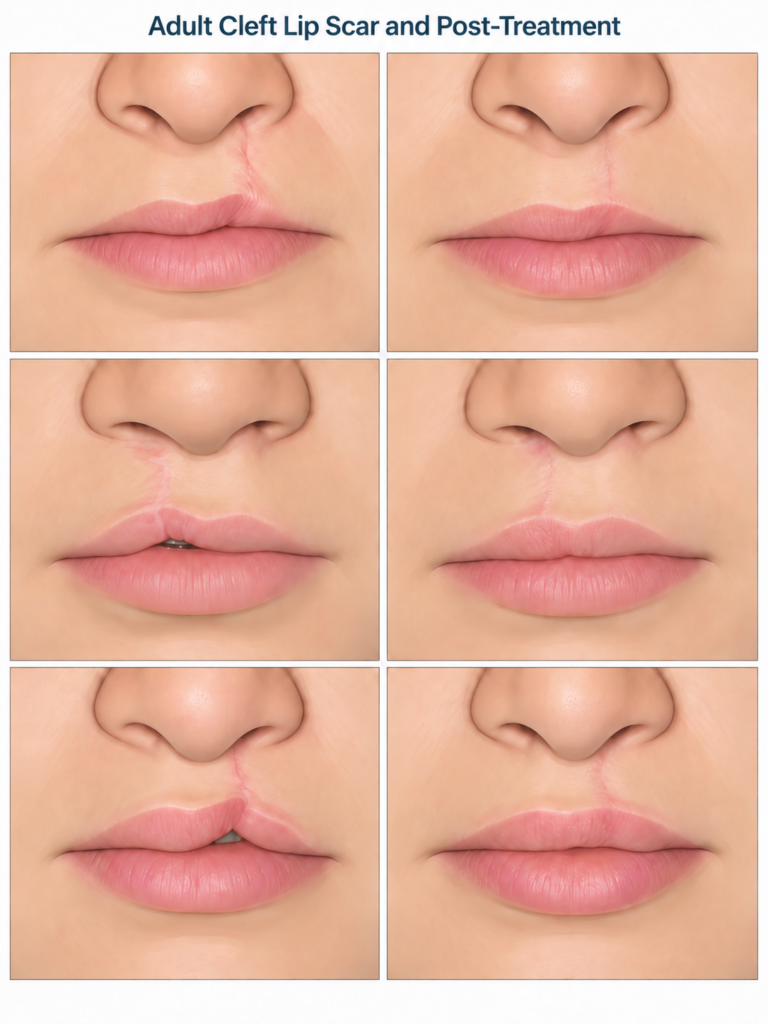
Even after successful childhood surgery, some adults may continue to have visible differences in the lip.
These may include:
- a wide or depressed cleft lip scar,
- asymmetry of the Cupid’s bow,
- irregularity of the vermilion border,
- differences in lip thickness,
- asymmetry between the lip and nasal base,
- or distortion caused by the underlying muscle repair.
In these patients, the problem is not always limited to the visible scar.
The position and continuity of the orbicularis oris muscle can also influence the shape and movement of the upper lip.
For this reason, secondary cleft lip revision may involve more than simply removing the old scar.
Can a Cleft Lip Scar Be Improved?
A cleft lip scar cannot be made completely invisible, but its appearance may often be improved.
Depending on the individual deformity, treatment may include:
- scar revision,
- realignment of the vermilion border,
- correction of lip asymmetry,
- muscle revision,
- fat grafting for selected volume deficiencies,
- or scar treatments such as laser in appropriate cases.
If the main problem is an underlying structural or muscular deformity, laser treatment alone is unlikely to correct it.
In these situations, surgical scar revision may be more appropriate.
Adult Cleft Rhinoplasty
The nose is commonly affected in patients born with a cleft lip.
Even after childhood treatment, adults may have persistent:
- nasal tip asymmetry,
- flattening of one nostril,
- differences in nostril shape,
- asymmetry of the nasal base,
- septal deviation,
- or insufficient cartilage support.
These deformities are particularly common in unilateral cleft lip, although bilateral clefts produce their own characteristic nasal changes.
Adult cleft rhinoplasty is therefore often more reconstructive than a standard cosmetic rhinoplasty.
The operation may involve repositioning existing cartilage and, in some cases, adding cartilage grafts to rebuild structural support.
The goal is not necessarily perfect mathematical symmetry. Congenital differences in bone, cartilage and soft tissue mean that complete symmetry may not always be achievable.
The aim is to improve balance, support and nasal function within the patient’s existing anatomy.
Rhinoplasty for Cleft Lip Patients
In cleft rhinoplasty, the nose should not be considered separately from the upper lip and nasal base.
The relationship between the nostrils, alar base, upper lip and septum may all be affected by the original cleft.
For this reason, secondary surgery sometimes needs to address several structures together rather than simply changing the nasal bridge or tip.
Patients requiring complex cartilage reconstruction may also be evaluated within our Complex and Reconstructive Rhinoplasty pathway.
Nasal Base and Lip Asymmetry
A cleft can affect the three-dimensional relationship between the upper lip and the base of the nose.
In unilateral clefts, one nostril may appear wider, flatter or positioned differently from the opposite side.
The alar base may also sit at a different level.
In selected adult patients, secondary surgery may therefore address both the cleft lip scar and the nasal base at the same operation.
The surgical plan depends on which anatomical differences remain after previous treatment.
Lip Volume Deficiency After Cleft Repair
Some adults notice that the cleft side of the upper lip is thinner than the opposite side.
This may result from:
- scar tissue,
- differences in muscle anatomy,
- previous surgery,
- or loss of soft-tissue volume.
Small volume deficiencies may sometimes be treated with fat grafting using the patient’s own tissue.
However, adding volume alone does not correct every cleft lip deformity.
If there is significant scar contracture or muscle malposition, these structures may also need to be addressed.
Palatal Fistula in Adults
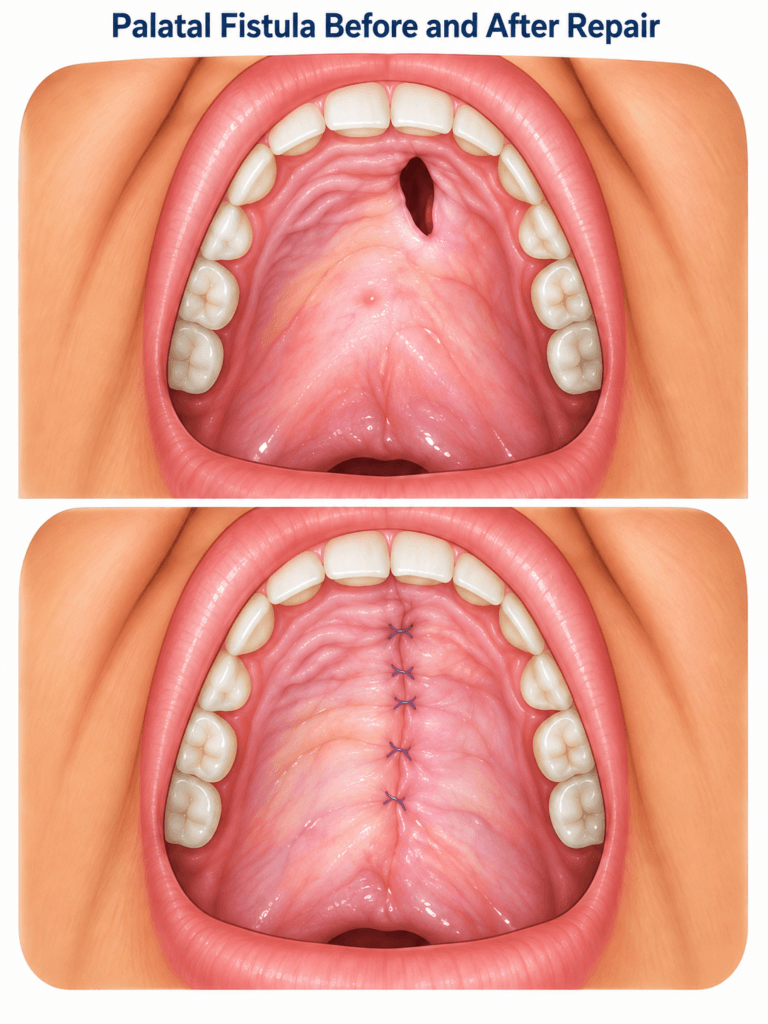
Following cleft palate surgery, some patients are left with a persistent opening between the mouth and nasal cavity.
This is known as an oronasal or palatal fistula.
Depending on its size and location, a fistula may cause:
- liquids passing into the nose,
- air leakage,
- speech difficulties,
- food trapping,
- or local irritation.
Not every small fistula requires surgery.
However, symptomatic fistulas can be considered for secondary repair.
Palatal Fistula Repair
Palatal fistula surgery is not simply a matter of closing a visible hole.
The palate separates the oral and nasal cavities, so successful reconstruction usually aims to create separate tissue layers between these spaces.
The surgical method depends on:
- the size of the fistula,
- its location,
- the amount and quality of surrounding tissue,
- and how many previous operations have been performed.
Small fistulas and large recurrent fistulas therefore require different approaches.
In more complex cases, local flaps or other reconstructive techniques may be necessary.
Speech Problems After Cleft Palate Repair
Some adults continue to experience speech problems even after childhood cleft palate repair.
One example is hypernasal speech, which may be associated with inadequate velopharyngeal closure.
However, not every speech problem should be treated surgically.
A proper speech assessment is important before considering an operation.
In selected cases, speech therapy and surgical treatment may need to be considered together.
Alveolar Cleft and Residual Bone Deficiency
Some clefts also involve the alveolar bone where the teeth develop.
Alveolar bone grafting is usually part of the multidisciplinary cleft treatment pathway during childhood or adolescence.
However, some adults may present with residual bone deficiency, missing teeth or inadequate support around the nasal base.
In these patients, treatment planning depends on the existing bone, dental status and the reconstructive goal.
When orthodontic or dental treatment is required, appropriate specialists should be involved.
Which Secondary Procedures May Be Considered in Adults?
Adult cleft patients may require very different types of secondary correction.
Depending on the individual anatomy, these may include:
- cleft lip scar revision,
- correction of lip muscle or vermilion asymmetry,
- fat grafting for selected lip deficiencies,
- nasal base correction,
- secondary cleft rhinoplasty,
- cartilage grafting for nasal reconstruction,
- or palatal fistula repair.
Not every adult cleft patient requires all of these procedures.
Treatment is based on the residual problems that remain after childhood care, rather than on the original diagnosis alone.
How Is Adult Cleft Surgery Planned?
When assessing an adult who has previously undergone cleft surgery, we look at the current anatomy rather than simply the number of previous operations.
Assessment may include:
- the cleft lip scar,
- lip muscle continuity,
- nasal shape and support,
- symmetry of the nasal base,
- the palate,
- any palatal fistula,
- speech-related concerns,
- alveolar bone support,
- and previous surgical history.
Some patients may need correction of only one small residual deformity.
Others may benefit from staged reconstruction involving more than one anatomical area.
The treatment plan is therefore individualised.
Primary Cleft Treatment and Adult Secondary Surgery Are Different
Primary cleft lip and palate treatment begins in infancy and requires long-term multidisciplinary follow-up.
This may involve professionals in:
- paediatric care,
- plastic surgery,
- feeding support,
- ENT,
- hearing,
- speech therapy,
- orthodontics,
- and dentistry.
Our focus at Anka Plastic Surgery is different.
We primarily assess adolescents and adults who have completed their childhood cleft pathway but continue to have residual aesthetic or reconstructive concerns.
Families seeking primary treatment for babies or young children are better served by a dedicated multidisciplinary paediatric cleft centre.
Adult Cleft Lip and Palate Surgery in Istanbul
International adult patients can begin with an online preliminary assessment before travelling to Istanbul.
Clear photographs, information about previous cleft operations and details of the remaining concerns help us understand whether secondary reconstructive surgery may be appropriate.
For complex cases, previous operative reports or relevant medical records can also be useful.
The final surgical plan is made after examination and depends on which structures require correction.
Conclusion
Cleft lip and palate treatment begins in childhood, but residual differences may remain into adult life.
These may include a cleft lip scar, lip asymmetry, cleft nasal deformity, nasal base asymmetry or palatal fistula.
Secondary surgery in adults is not simply a repeat of childhood treatment.
The aim is to identify the specific anatomical or functional problems that remain and correct only what is necessary.
At Anka Plastic Surgery, our focus in this area is on secondary and reconstructive treatment for adolescent and adult cleft patients, rather than primary cleft care in infancy.