
Stem Cell and Regenerative Applications in Plastic Surgery
Stem cells and regenerative medicine have become increasingly important areas in plastic, reconstructive and aesthetic surgery. However, the term “stem cell treatment” is often used very broadly in everyday language, and biologically different approaches such as SVF, fat grafting, fibroblast culture, PRP and exosomes are sometimes grouped together under the same heading.
At Anka Plastic Surgery, regenerative medicine is an area of both clinical and academic interest. Both of our surgeons have completed postgraduate Master’s degrees in Stem Cell and Tissue Engineering, and we believe regenerative treatments should be evaluated in the context of cell biology, tissue healing and the current scientific evidence.
In our practice, regenerative treatments are centred primarily around stromal cell-rich fractions derived from the patient’s own adipose tissue and fat grafting. We use these approaches particularly to support the biological environment of fat grafts and, in selected patients, to take advantage of regenerative effects in the skin and soft tissues.
What Are Stem Cells, SVF and Regenerative Medicine?
Stem cells are cells with the ability to self-renew and, under appropriate biological conditions, differentiate into different cell types.
However, not every biological product used for regenerative purposes is a purified or cultured stem cell product.
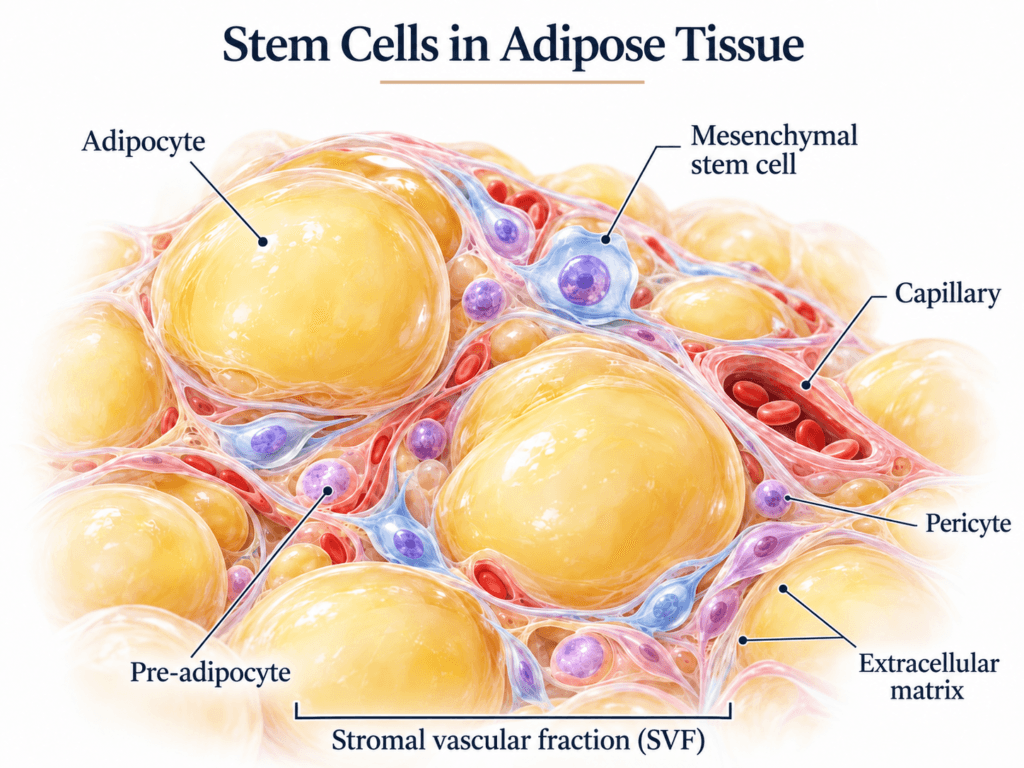
Stromal vascular fraction, or SVF, derived from adipose tissue, is not a single cell population. It may contain varying proportions of:
- adipose-derived stromal/stem cells,
- endothelial cells,
- pericytes,
- haematopoietic cells,
- immune cells,
- fibroblast-like stromal cells.
For this reason, describing SVF as a “pure stem cell injection” is not scientifically accurate.
A more appropriate description is that SVF is a biological fraction derived from the patient’s own adipose tissue and contains different cellular and stromal components.
Why Is Adipose Tissue Important in Regenerative Medicine?
Adipose tissue is not simply a passive tissue that stores energy or provides volume. In addition to adipocytes, it contains many different biological structures, including blood vessels, stromal cells, pericytes, immune cells and the extracellular matrix.
One of the important features of adipose tissue is that it is also rich in stem and progenitor cells. In particular, adipose-derived stromal/stem cells found within the stromal vascular fraction have biological properties that may contribute to tissue repair, new blood vessel formation and healing processes. For this reason, adipose tissue is valued in plastic surgery not only for volume restoration, but also for its regenerative potential.
This is also important in fat grafting. When fat is transferred, we are not simply adding volume to another area; we are transferring a living tissue graft to a new anatomical site. For that graft to survive, it must establish new vascular connections with the surrounding tissues.
How Is SVF Obtained?
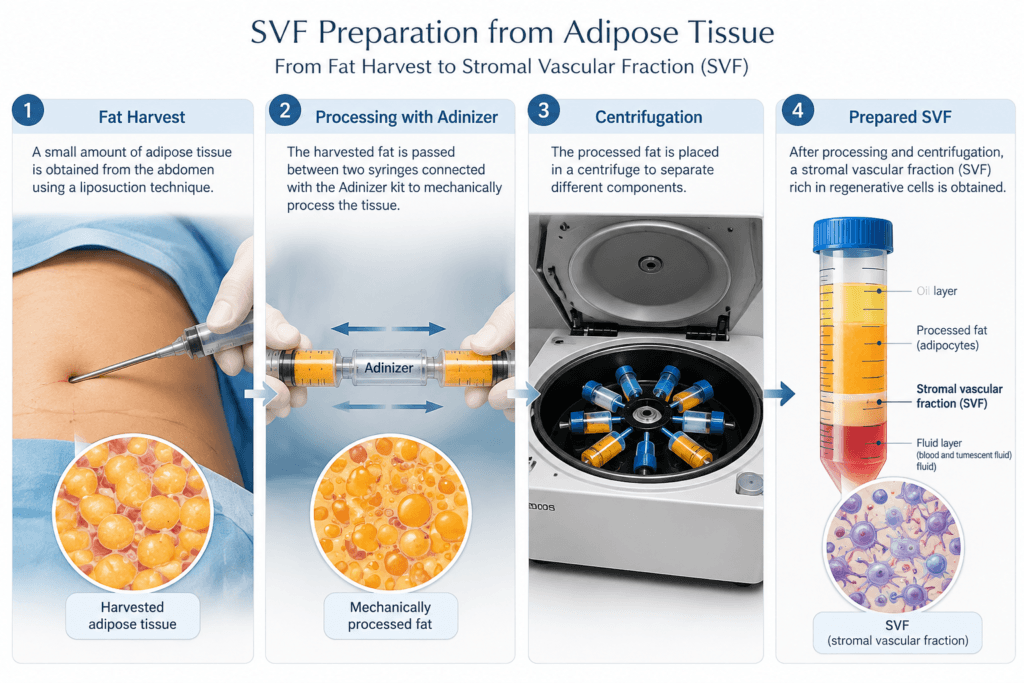
SVF and other stromal cell-rich fractions are prepared from the patient’s own adipose tissue.
A small amount of fat is first obtained using liposuction. The tissue is then processed to obtain a fraction enriched in stromal and cellular components.
In the past, we used laboratory-based preparation methods and sent the harvested adipose tissue to a laboratory for cellular processing.
Today, in our clinical practice, we use a stromal cell-rich fraction obtained from adipose tissue that has been mechanically processed with the Adinizer system.
An important distinction should be made here. The cellular composition of products prepared by mechanical methods may vary depending on the system and processing technique used. Different SVF preparation methods should therefore not be assumed to produce identical biological products.
SVF-Enriched Fat Grafting
In our practice, SVF is most commonly used together with fat grafting.
During fat grafting, the patient’s own adipose tissue is harvested, appropriately prepared and injected into areas where volume restoration is needed.
However, not all of the transferred fat survives permanently. During the early period after transfer, the fat graft depends on the surrounding tissue for nutrition and must gradually establish new vascular connections. Fat cells that do not receive sufficient blood supply may be lost.
For this reason, methods that may support fat graft survival have been investigated for many years.
The theoretical and biological aims of SVF-enriched fat grafting include:
- supporting new blood vessel formation,
- improving the cellular healing environment,
- increasing the survival potential of the fat graft,
- supporting the regenerative response of the surrounding soft tissues.
During the procedure, one portion of the harvested fat can be prepared for volume restoration, while another portion can be processed to obtain a stromal cell-rich fraction. This fraction can then be used together with the fat graft.
The aim is to view transferred fat not simply as a passive filler, but as a biologically supported tissue graft.
Does SVF Improve Fat Graft Retention?
Clinical studies in this area are encouraging.
Existing studies have reported higher volume retention with SVF-enriched fat grafts compared with conventional fat grafting. However, there are significant differences between studies in terms of preparation methods, cellular composition and outcome measurements.
For this reason, we consider SVF a method that may support fat graft retention, rather than a technique that guarantees a specific result.
It would not be scientifically accurate to claim that all transferred fat will survive simply because SVF has been added.
SVF Applications for Skin and Soft Tissue
SVF does not have to be used only as an adjunct to fat grafting.
In selected patients, the prepared cellular and stromal fraction may also be applied to the skin or subcutaneous tissues. In this setting, the main aim is not direct volume replacement, but rather to support the regenerative environment of the skin and soft tissues.
This approach may be considered in selected cases involving:
- reduced skin quality,
- thin or atrophic skin,
- certain scar problems,
- age-related soft tissue thinning.
Studies investigating SVF for skin rejuvenation are available, but the results are not as standardised as the evidence regarding fat graft retention.
For this reason, we do not consider statements such as “stem cells completely renew the skin” to be scientifically appropriate.
Facial Applications of SVF and Fat Grafting
Facial ageing does not occur only at the surface of the skin.
With ageing, several changes can occur together, including:
- loss of facial fat volume,
- thinning of the subcutaneous tissues,
- reduced skin elasticity,
- changes in skeletal support.
For this reason, injecting a regenerative product into the skin alone may not be sufficient in patients with significant volume loss.
In selected patients, SVF-enriched fat grafting may allow volume restoration and regenerative support to be combined within the same procedure.
Depending on the patient’s anatomy and pattern of volume loss, fat grafting may be used in areas such as:
- the midface,
- cheeks,
- temples,
- the periocular area,
- nasolabial region,
- jawline,
- selected scarred areas with soft tissue deficiency.
The goal is not to fill every part of the face, but to restore lost volume in anatomically appropriate areas and in appropriate amounts.
How Do Regenerative Treatments Differ From One Another?
The term “stem cell treatment” is often used online for very different procedures. In reality, these biological products differ in their source, composition and intended use.
SVF
SVF is a cellular and stromal fraction derived from adipose tissue and may contain several different cell populations.
Hyaluronic Acid Fillers
Hyaluronic acid fillers are used to provide direct volume and structural support to a specific area.
The primary purpose of SVF is not to act as a filler.
PRP
PRP is prepared from the patient’s own blood and contains platelet-rich plasma.
SVF, in contrast, is obtained from adipose tissue. Their source and biological composition are therefore different.
Exosomes
Exosomes are very small extracellular vesicles released by cells and involved in cell-to-cell communication.
An exosome is not a cell.
Therefore, exosomes, stem cells and SVF should not be considered the same biological concept.
Fibroblast Culture
Fibroblasts are connective tissue cells that play an important role in the production of collagen and other components of the extracellular matrix.
In autologous fibroblast culture, cells obtained from the patient are expanded in a laboratory and later re-injected.
Why We No Longer Use Fibroblast Culture Routinely
We have previously performed autologous cultured fibroblast treatments in our clinical practice. The method has a scientific basis, and some clinical studies have reported improvements in wrinkles, skin elasticity and skin structure.
However, the technique requires tissue biopsy, laboratory cell culture, expansion of the cells and later re-administration to the patient. This makes the process longer, more complex logistically and more costly. The injection technique required to preserve cell viability may also reduce treatment comfort.
Today, we find the combination of a stromal cell-rich fraction prepared from the patient’s own adipose tissue and fat grafting within the same session more practical in our clinical approach.
This does not mean that fibroblast culture is ineffective. It reflects our current treatment strategy and the regenerative techniques we prefer to use.
Who May Be Suitable for Stem Cell and Regenerative Applications?
These treatments are not suitable for every patient.
Treatment planning should not begin simply because a patient requests a “stem cell treatment”. The problem being treated should first be clearly identified.
For example, SVF-supported fat grafting may be relevant in a patient with significant facial volume loss.
In contrast, wrinkle treatments that reduce excessive muscle activity may be more appropriate in a patient whose main concern is dynamic wrinkles.
Similarly, regenerative and cellular treatments do not replace facelift surgery in patients with advanced facial sagging.
Understanding the limitations of regenerative medicine is just as important as knowing when it may be useful.
Are Stem Cell and Regenerative Applications Permanent?
There is no single answer to this question.
SVF and fat grafts are not materials with a fixed lifespan in the same way as an implant or temporary filler.
Fat cells that successfully survive after transfer may remain for many years. However, ageing, weight fluctuations and ongoing tissue changes can influence the result over time.
There is currently no universally defined duration for the regenerative effects of SVF on skin quality.
How Many Sessions Are Needed?
We do not approach SVF as a treatment that must routinely be repeated at set intervals in the same way as a conventional mesotherapy programme.
When used together with fat grafting, it is generally performed as part of a single surgical procedure or treatment session.
Any later treatment is determined according to the patient’s volume retention, fat graft survival, tissue quality and clinical needs.
What Are the Risks of SVF and Fat Grafting?
The fact that SVF is obtained from the patient’s own tissue is an important characteristic. However, autologous does not mean risk-free.
Many of the risks are related to fat harvesting and fat grafting.
These may include:
- bruising and swelling,
- infection,
- asymmetry,
- partial loss of the transferred fat,
- fat necrosis,
- cyst formation,
- irregular volume distribution.
Detailed knowledge of facial vascular anatomy is particularly important when performing fat or other injections in the face.
Because SVF preparation methods differ, the characteristics of the system used, sterility and the processing protocol are also important.
Our Approach to Stem Cell and Regenerative Treatments
Regenerative medicine is an area of particular academic interest at Anka Plastic Surgery. Both of our plastic surgeons have completed Master’s degrees in Stem Cell and Tissue Engineering, and this background influences how we assess regenerative treatments.
Our main regenerative approach is based on the use of the patient’s own adipose tissue, particularly mechanically processed stromal cell-rich fractions used most often together with fat grafting.
In selected patients, these fractions may also be used in skin and soft tissue applications.
For us, the goal is not simply to label a treatment as a “stem cell procedure”. What matters is understanding what biological product is being used, what it may realistically achieve, what it cannot achieve, and in which patient it may be appropriate.
Conclusion
Stem cell and regenerative applications in plastic surgery are a rapidly evolving field.
Stromal vascular and stromal cell-rich fractions derived from adipose tissue contain several cellular and biological components. For this reason, describing these treatments simply as “stem cell injections” does not fully reflect their biological complexity.
Current clinical evidence is particularly encouraging regarding fat graft retention with SVF-enriched fat grafting. However, preparation methods, cellular composition and clinical protocols still vary considerably.
At Anka Plastic Surgery, we regard regenerative treatments not as stand-alone miracle procedures, but as biological tools that may be integrated with fat grafting and other plastic surgery techniques when there is an appropriate indication.