
Prominent Ear Surgery and Otoplasty in Turkey
Prominent ears are a condition in which the ears sit farther away from the head than usual and therefore appear more noticeable when viewed from the front or back.
The problem is usually related to the shape of the ear cartilage. In some patients, the natural antihelical fold is underdeveloped, while in others the conchal cartilage is more prominent or deep. Many patients have a combination of both anatomical features.
Prominent ears do not usually cause a serious health problem. However, particularly during childhood, their appearance may lead to social discomfort, reduced self-confidence or peer bullying.
Otoplasty is a surgical procedure that aims to recreate the natural folds of the ear and create a more balanced angle between the ear and the head.
What Causes Prominent Ears?
Prominent ears are usually related to the natural cartilage anatomy present from birth.
One of the most common anatomical causes is insufficient development of the antihelical fold. In this situation, the ear may appear flatter and project further outwards.
In some patients, a prominent concha, which is the deeper inner part of the ear cartilage, also contributes to the ear sitting farther away from the head.
When planning surgery at Anka Plastic Surgery, the anatomical structures responsible for the prominent appearance are assessed individually.
How Is Prominent Ear Surgery Performed?
The operation is usually performed through an incision on the back of the ear. This allows the scar to remain concealed within the natural fold behind the ear.
Once the cartilage is exposed, permanent sutures are placed in the areas that require reshaping.
At Anka Plastic Surgery, the main approach in most patients is:
- recreating the antihelical fold using Mustardé sutures,
- and, when necessary, adding concha-mastoid sutures to bring the ear closer to the head.
The aim is not to pin the ear as tightly as possible against the head, but to preserve its natural contours while creating a more balanced angle.
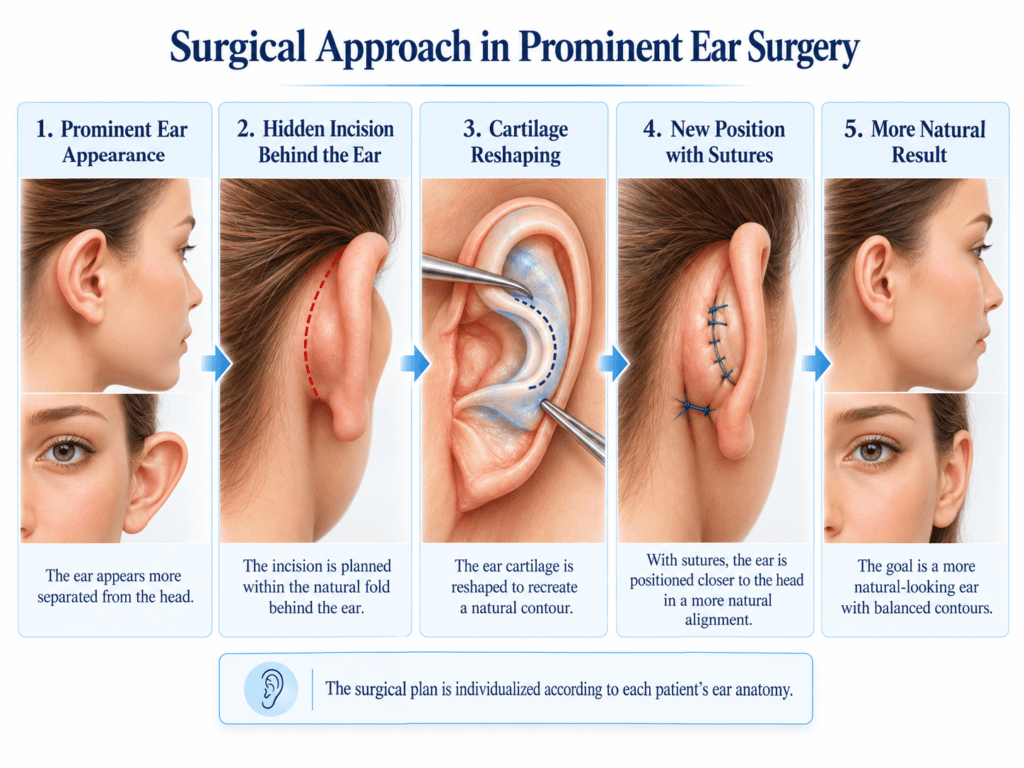
Creating the Antihelical Fold with Mustardé Sutures
One of the most common features in prominent ears is an underdeveloped antihelical fold.
In the Mustardé technique, permanent sutures are placed on the posterior surface of the ear cartilage to create a new antihelical fold.
These sutures fold the cartilage in a controlled manner and help give the ear a more natural shape.
Our approach is to preserve the cartilage as much as possible and reshape it with sutures rather than routinely cutting it.
When Are Concha-Mastoid Sutures Used?
In some patients, recreating the antihelical fold alone is not enough.
If the concha is prominent or the ear sits too far away from the head, sutures can be placed between the conchal cartilage and the mastoid region to bring the ear slightly closer to the head.
These are called concha-mastoid sutures.
They are not necessary in every patient. Mustardé sutures alone may be sufficient in some cases, while both techniques may be used together in others.
Is the Ear Cartilage Cut During Otoplasty?
Cartilage does not need to be cut in every patient.
At Anka Plastic Surgery, we generally prefer to preserve the cartilage as much as possible and reshape it with sutures.
However, additional cartilage-shaping procedures may sometimes be necessary, particularly in adults with very thick or stiff cartilage.
The surgical technique is selected according to the individual cartilage anatomy.
At What Age Can Prominent Ear Surgery Be Performed?
Most ear growth is completed during early childhood. For this reason, otoplasty can be considered before school age in children with a significant prominent ear deformity.
At Anka Plastic Surgery, surgery may be considered before the child starts primary school, provided that the child is old enough to cooperate with the operation and postoperative care.
The aim is not only to improve the anatomy. Reducing the risk of peer bullying and social distress related to appearance during school years can also be an important consideration.
Prominent Ear Surgery in Adults
Otoplasty is not limited to childhood and can also be performed in adults.
However, adult ear cartilage may be firmer and less flexible than in children. As a result, shaping can sometimes be more difficult and partial relapse, meaning that part of the ear gradually opens again, may occur over time.
If necessary, a limited revision procedure can be performed.
Can Prominent Ears Be Unilateral?
Yes.
In some patients both ears are prominent, while in others only one side is more noticeably projected.
When asymmetry is present, the same procedure does not necessarily need to be performed on both ears. Each ear is assessed separately according to its own anatomy.
The aim is not to make both ears mathematically identical, but to create a natural and balanced relationship with the face.
Will There Be a Scar After Prominent Ear Surgery?
The incision is usually placed on the back of the ear within the natural fold, so it is not visible when looking at the ear from the front.
As with any surgical procedure, otoplasty leaves a scar. However, because of its position behind the ear, the scar generally becomes less noticeable over time.
Recovery After Prominent Ear Surgery
During the first few days, patients may experience:
- tenderness,
- tightness,
- mild to moderate pain,
- swelling,
- bruising.
These symptoms generally decrease with time.
Unexpectedly increasing pain, marked swelling or a rapidly enlarging swelling on one side should be assessed for the possibility of a haematoma.
Bandaging and Headband Use After Surgery
A more protective dressing may be used during the early postoperative period.
After this, we generally recommend wearing a soft sports headband or similar headband for approximately four weeks.
The purpose of the headband is not to press the ears tightly against the head. Its main role is to protect the ears from trauma and from accidentally folding during sleep while the tissues are healing.
Can a Headband Correct Prominent Ears Without Surgery?
Age is important.
During the newborn period, ear cartilage is softer, and ear-moulding systems started at the appropriate time may be effective for certain deformities.
However, in older children and adults, wearing a headband alone does not permanently reshape the cartilage.
In these age groups, headbands are primarily used for postoperative protection.
How Should You Sleep After Otoplasty?
Direct pressure on the ears should be avoided during the first few weeks.
Patients are generally advised to sleep on their back whenever possible and to avoid allowing the ears to fold against the pillow.
A headband worn at night can also help prevent the ears from being accidentally folded forwards or backwards.
When Can You Return to Sport?
Light daily activities can usually be resumed relatively soon.
However, sports in which the ears may be struck, as well as contact sports, require a longer period of protection.
During the first few weeks, the cartilage and sutures are still healing, so the timing of return to sport should be determined according to the type of activity.
Are the Results of Prominent Ear Surgery Permanent?
Otoplasty permanently reshapes the ear cartilage.
However, as with any surgical procedure, a zero-risk guarantee for relapse is not possible.
Particularly in adults with firmer cartilage, the natural elasticity or “memory” of the cartilage may cause part of the ear to gradually open again over time.
This can occur on one or both sides, and revision surgery can be considered when necessary.
Can the Sutures Be Felt Under the Skin?
Yes.
With techniques such as Mustardé sutures, the permanent sutures used to shape the cartilage are located beneath the skin on the back of the ear.
In patients with thin soft tissue coverage, the suture knots may occasionally be palpable. Rarely, a suture may irritate the skin or move closer to the surface.
A troublesome suture can be surgically assessed and treated if necessary. This does not necessarily mean that the entire surgical result has failed.
What Are the Risks of Prominent Ear Surgery?
Otoplasty is generally a safe procedure, but like all surgery it carries certain risks.
These may include:
- bleeding,
- haematoma,
- infection,
- delayed wound healing,
- noticeable scarring,
- asymmetry between the ears,
- overcorrection,
- undercorrection,
- palpable or exposed sutures,
- partial relapse.
Very rarely, more serious complications such as cartilage infection may occur.
Our Approach to Prominent Ear Surgery
At Anka Plastic Surgery, we prefer techniques that preserve the cartilage and reshape it with sutures whenever possible.
When the antihelical fold is underdeveloped, our main approach is to recreate the natural fold using Mustardé sutures.
If the conchal anatomy also contributes to excessive projection, we add concha-mastoid sutures when necessary.
Each ear is planned individually. Particularly in asymmetric or unilateral deformities, the same procedure may not need to be performed on both sides.
In children with a significant deformity, surgery may be considered before school age when appropriate. In adults, we explain before surgery that firmer cartilage may carry a higher risk of partial relapse and that permanent sutures may occasionally be palpable beneath the skin.
After surgery, we generally recommend using a soft headband for approximately four weeks to protect the new ear shape during healing.
Conclusion
The aim of prominent ear surgery is not to press the ear as tightly as possible against the head.
The goal is to recreate the natural folds of the ear and achieve a more balanced and natural angle between the ear and the head.
Creating the antihelical fold with Mustardé sutures and adding concha-mastoid sutures when needed are cartilage-preserving techniques that can be used in otoplasty.
Protecting the ear during the first few postoperative weeks is also important for maintaining the stability of the surgical correction.