
Female Genital Aesthetic Surgery in Turkey: Labiaplasty, Vaginal Tightening and Perineoplasty
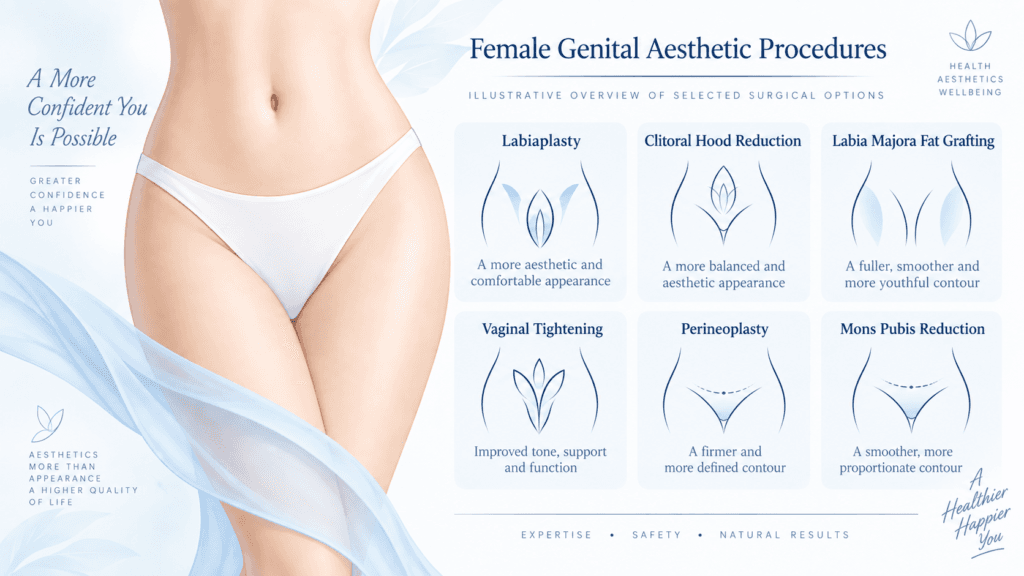
Female genital aesthetic surgery includes procedures addressing concerns such as the size, shape or asymmetry of the external genital area, as well as functional problems such as vaginal laxity.
Female genital anatomy naturally varies from person to person. Therefore, not every anatomical variation requires treatment. Surgery is generally considered when there is significant physical discomfort, a functional concern or persistent aesthetic dissatisfaction.
At Anka Plastic Surgery, female genital aesthetic surgery may include labiaplasty for enlarged or asymmetric labia minora, surgical vaginal tightening for vaginal laxity, perineoplasty when indicated, fat grafting for volume loss of the labia majora, and selected procedures involving the clitoral hood or mons pubis.
What Is Female Genital Aesthetic Surgery?
Female genital aesthetic surgery does not refer to a single operation. Different procedures may be planned depending on the patient’s anatomy and main concern.
Labiaplasty is performed to reduce enlarged labia minora or correct significant asymmetry. In selected patients, clitoral hood reduction may also be considered when there is excess tissue or asymmetry in the skin fold covering the clitoris.
Vaginal tightening surgery aims to reduce laxity of the vaginal canal and its supporting tissues, while perineoplastyaddresses laxity or anatomical irregularities in the perineal region between the vaginal opening and the anus.
In patients with volume loss of the outer labia, fat grafting may be considered. In selected patients with excess tissue or contour concerns involving the mons pubis, mons pubis contouring may also be appropriate.
The aim is not to create a standardised genital appearance, but to achieve a more balanced and functional result while preserving the patient’s natural anatomy.
Female Genital Anatomy
In everyday language, the word “vagina” is often used to describe the entire genital area, but anatomically the vulva and vagina are different structures.
The vulva refers to the external genital area and includes the labia majora, labia minora, clitoral region and vaginal opening.
The vagina is not an externally visible structure. It is a canal lined by mucosa and surrounded by muscular and supporting tissues, extending inward from the vaginal opening.
This distinction is important because labiaplasty and vaginal tightening are procedures performed on different anatomical structures.
Labiaplasty
What Is Labiaplasty?
Labiaplasty is a surgical procedure most commonly performed to reduce and reshape the labia minora.
It is generally considered when the inner labia are large enough to cause physical discomfort or when there is marked asymmetry between the two sides.
The aim is not to remove the labia minora completely. Excess tissue is reduced in a controlled manner while preserving natural anatomy and creating a more balanced appearance.
Why Can the Labia Minora Be Large or Asymmetric?
The size of the labia minora is usually a natural anatomical characteristic.
In some women, larger labia are apparent from adolescence, while in others they may become more noticeable with age, pregnancy, childbirth or natural tissue changes over time.
The two sides are not expected to be completely identical. Mild asymmetry is part of normal anatomical variation.
However, if one side is significantly longer, fuller or more prominent, this may cause physical or aesthetic concern.
In such cases, rather than removing the same amount of tissue from both sides, each side can be planned individually according to the degree of asymmetry.
How Is Labiaplasty Performed?
During labiaplasty, excess labial tissue is removed in a controlled manner and the remaining tissue is reshaped.
Different surgical techniques can be used. The choice of technique depends on the shape of the labium, the location of excess tissue, the appearance of the edge and the degree of asymmetry.
An important principle is not to remove more tissue than necessary.
The labia minora are not merely aesthetic structures. They are part of the natural anatomy surrounding the vaginal opening.
Recovery After Labiaplasty
Because the genital region has a rich blood supply, wound healing is generally good.
However, swelling and bruising may be noticeable during the first few days. The early postoperative appearance therefore does not represent the final result.
Absorbable sutures are commonly used.
During recovery, attention should be paid to hygiene, friction should be avoided and sexual intercourse and strenuous exercise should be postponed for the period recommended by the surgeon.
Will There Be a Scar After Labiaplasty?
Every surgical incision results in a wound-healing process.
Because of the tissue characteristics and blood supply of the genital region, scars often become less noticeable over time.
However, it would not be appropriate to guarantee that there will be no scar at all.
Does Labiaplasty Affect Sensation?
The aim of surgery is to preserve the important neural structures involved in genital sensation.
When surgery is performed in the appropriate anatomical plane and an appropriate amount of tissue is removed, preservation of sensation is the goal.
As with any surgery, temporary sensitivity, numbness or, rarely, more persistent sensory changes may occur.
Clitoral Hood Reduction
The clitoral hood is the natural fold of skin covering the clitoris. In some patients, there may be noticeable excess tissue or asymmetry in this area, which may need to be considered separately during labiaplasty planning.
In suitable patients, excess tissue may be reduced conservatively while preserving the underlying anatomy.
The aim is to create a more balanced external genital contour without damaging the clitoral structure or the nerves responsible for sensation.
Volume Loss of the Labia Majora and Fat Grafting
The labia majora may lose volume due to ageing, weight loss, hormonal changes or natural anatomy.
This can make the external genital area appear deflated or make the labia minora more prominent.
In selected patients, fat taken from the patient’s own body can be prepared and grafted into the labia majora.
The aim is not to over-enlarge the outer labia, but to restore lost soft-tissue volume and create a more balanced contour.
Not all transferred fat will necessarily survive permanently. Some of the fat may be absorbed over time, and selected patients may require an additional session.
Can Labiaplasty and Labia Majora Fat Grafting Be Performed Together?
Yes.
Some patients have both prominent labia minora and volume loss of the labia majora.
In suitable patients, combining labiaplasty with fat grafting to the labia majora may create a more balanced external genital contour.
One procedure reduces excess tissue, while the other restores volume where it has been lost.
Vaginal Tightening Surgery
What Is Vaginal Tightening?
Vaginal tightening surgery aims to reduce laxity of the vaginal canal and vaginal opening.
Particularly after vaginal childbirth, some women may develop stretching of the supporting tissues of the vagina and pelvic floor.
Patients may describe this as a feeling of vaginal looseness, reduced tightness during intercourse, widening of the vaginal opening or laxity in the perineal region.
Not every complaint of vaginal laxity requires surgery. If pelvic organ prolapse or a significant urogynecological problem is suspected, further assessment may be necessary.
How Is Vaginal Tightening Surgery Performed?
In surgical vaginal tightening, removing excess vaginal mucosa alone may not be sufficient.
The muscles and soft tissues supporting the posterior vaginal wall also need to be assessed.
At Anka Plastic Surgery, in suitable patients, the pelvic floor supporting structures may be approximated with sutures. The necessary amount of excess vaginal mucosa is then removed in a controlled manner and the tissues are closed.
This makes the procedure more than a superficial excision of mucosa and allows the supporting structures of the vaginal canal to be addressed as part of the surgery.
The aim is not to create excessive tightness, but to restore weakened anatomical support.
Removing too much mucosa can result in excessive narrowing, pain, scarring or discomfort during intercourse. For this reason, the amount of tissue removed should be determined according to the individual anatomy.
Perineoplasty
Following vaginal childbirth, widening, scarring or anatomical irregularity may develop in the perineal region between the vaginal opening and the anus.
When necessary, this area can also be reshaped during vaginal tightening surgery.
This procedure is called perineoplasty.
The aim is to restore a more anatomical configuration of the vaginal opening and perineal support.
Mons Pubis Contouring
The mons pubis is the area of fatty and soft tissue located above the external genital region.
In some patients, genetics, weight changes or ageing may lead to noticeable fullness or tissue laxity in this area.
In suitable patients, liposuction, limited tissue excision or a combination of surgical techniques may be used to improve the contour of the mons pubis.
The aim is not to flatten the area excessively, but to create a more balanced transition between the lower abdomen and genital region.
Are Labiaplasty and Vaginal Tightening the Same Procedure?
No.
Labiaplasty is performed on the external genital area to reduce or reshape the labia minora.
Vaginal tightening, on the other hand, is a deeper procedure addressing laxity of the vaginal canal and pelvic floor supporting tissues.
A patient may require only labiaplasty, only vaginal tightening or both procedures.
Can Labiaplasty and Vaginal Tightening Be Performed at the Same Time?
Yes.
In suitable patients with both enlarged or asymmetric labia minora and vaginal laxity, the procedures may be performed during the same surgical session.
However, the indication for each procedure should be assessed independently.
Does Vaginal Tightening Affect Sexual Function?
Sexual function is not determined solely by the width of the vaginal canal.
Psychological factors, hormones, pain, pelvic floor function and relationship dynamics can all influence sexual function.
In selected patients with a significant mechanical complaint related to vaginal laxity, correction of the anatomy may be beneficial.
However, it would not be appropriate to describe vaginal tightening as a procedure that guarantees increased sexual pleasure.
Which Procedure Is Used for Which Concern?
In general:
- Large or asymmetric labia minora: Labiaplasty
- Excess or asymmetric clitoral hood tissue: Clitoral hood reduction
- Volume loss of the labia majora: Fat grafting
- Prominent fat or excess tissue in the mons pubis: Mons pubis contouring
- Vaginal laxity: Vaginal tightening
- Widening of the vaginal opening or perineal region: Perineoplasty
When more than one anatomical concern is present, procedures may be combined.
Anaesthesia for Female Genital Aesthetic Surgery
The type of anaesthesia depends on the extent of the procedure.
Limited labiaplasty may be performed under local anaesthesia or sedation in suitable patients, while more extensive procedures such as vaginal tightening may require general or regional anaesthesia.
The decision is based on the planned surgery and the patient’s individual circumstances.
Recovery After Female Genital Aesthetic Surgery
Recovery varies according to the procedure performed.
After labiaplasty, swelling and tenderness of the external genital region may be more prominent, while vaginal and perineal tightness may be more noticeable following vaginal tightening.
During the early recovery period, good genital hygiene is important. Friction should be avoided, strenuous exercise should be postponed and sexual intercourse should be avoided for the period recommended by the surgeon.
When Can Sexual Intercourse Be Resumed?
The timing depends on the extent of surgery and the progress of wound healing.
Following labiaplasty or vaginal tightening, the sutures and tissues should be allowed sufficient time to heal.
The exact timing is determined during follow-up. Resuming sexual intercourse too early may increase the risk of wound separation, bleeding and pain.
Can I Give Birth After Female Genital Aesthetic Surgery?
Labiaplasty does not prevent future pregnancy or childbirth.
Pregnancy is also possible after vaginal tightening.
However, a future vaginal delivery may stretch tissues that have previously been tightened and supported surgically.
For this reason, the timing of vaginal tightening should be considered carefully in patients planning pregnancy in the near future.
What Are the Risks of Female Genital Aesthetic Surgery?
As with any surgical procedure, complications can occur.
Possible risks include:
- infection,
- bleeding or haematoma,
- wound separation,
- asymmetry,
- scarring,
- temporary or, rarely, persistent changes in sensation,
- need for revision surgery.
Following vaginal tightening, excessive narrowing or discomfort during sexual intercourse may also occur.
With fat grafting, part of the transferred fat may be absorbed or there may be some difference in volume between the two sides.
What Is Assessed Before Female Genital Aesthetic Surgery?
During consultation, the size and asymmetry of the labia minora, volume of the labia majora, vaginal opening, perineal region, degree of vaginal laxity and previous childbirth history are assessed together.
The patient’s main concern is important.
Sometimes a patient presents asking for “genital aesthetic surgery” when the actual concern is only labial asymmetry. In other cases, several anatomical issues may be present at the same time.
Are the Results Permanent?
Tissue removed during labiaplasty does not grow back.
However, ageing, hormonal changes and natural changes in the tissues may affect the appearance of the genital region over time.
With fat grafting, some of the transferred fat may be absorbed.
Following vaginal tightening, future pregnancy and particularly vaginal childbirth may stretch the pelvic floor tissues again.
Our Approach to Female Genital Aesthetic Surgery
At Anka Plastic Surgery, our aim is not to create a standardised genital appearance, but to address the patient’s specific anatomical concern while preserving natural structure and function.
In labiaplasty, enlarged or significantly asymmetric labia minora are reduced conservatively, with care taken to preserve natural anatomy and avoid unnecessary tissue removal.
In patients with volume loss of the labia majora, fat grafting may be used to restore soft-tissue volume and create a more balanced external genital contour.
For vaginal tightening, our approach is not limited to removing excess vaginal mucosa. In suitable patients, the pelvic floor supporting structures are approximated with sutures and excess mucosa is removed in a controlled manner. When necessary, the perineal region may also be reshaped during the same procedure.
In selected patients, anatomical concerns involving the clitoral hood and mons pubis are also assessed as part of the overall genital contour.
The goal is not maximum reduction or maximum tightening. The aim is to achieve a balanced and functional result suited to the patient’s anatomy, symptoms and individual needs. Yapıştırılan metin
Online Consultation and Further Information
For further information about female genital aesthetic surgery, preliminary assessment or an online consultation, you can contact Anka Plastic Surgery via WhatsApp.
In suitable patients, an initial assessment may be carried out using photographs together with the medical history. If necessary, an online consultation can then be arranged before an in-person examination and surgical planning.