
Lip Lift Surgery in Turkey
Lip lift is a general term for surgical procedures designed to change the position of the upper lip and improve the proportions around the mouth. The most commonly performed technique is the subnasal lip lift, in which the distance between the base of the nose and the upper lip is shortened.
However, the anatomical problem is not the same in every patient. In some people, the main issue is a long distance between the nose and upper lip, while in others the aim may be to increase the visible red lip, elevate downturned mouth corners or reduce excessive lip volume.
For this reason, lip aesthetics should not be planned simply in terms of “making the lips bigger” or “lifting the lip”. The relationship between the nose, lips, teeth, chin and overall facial proportions should be assessed together.
What Is a Lip Lift?
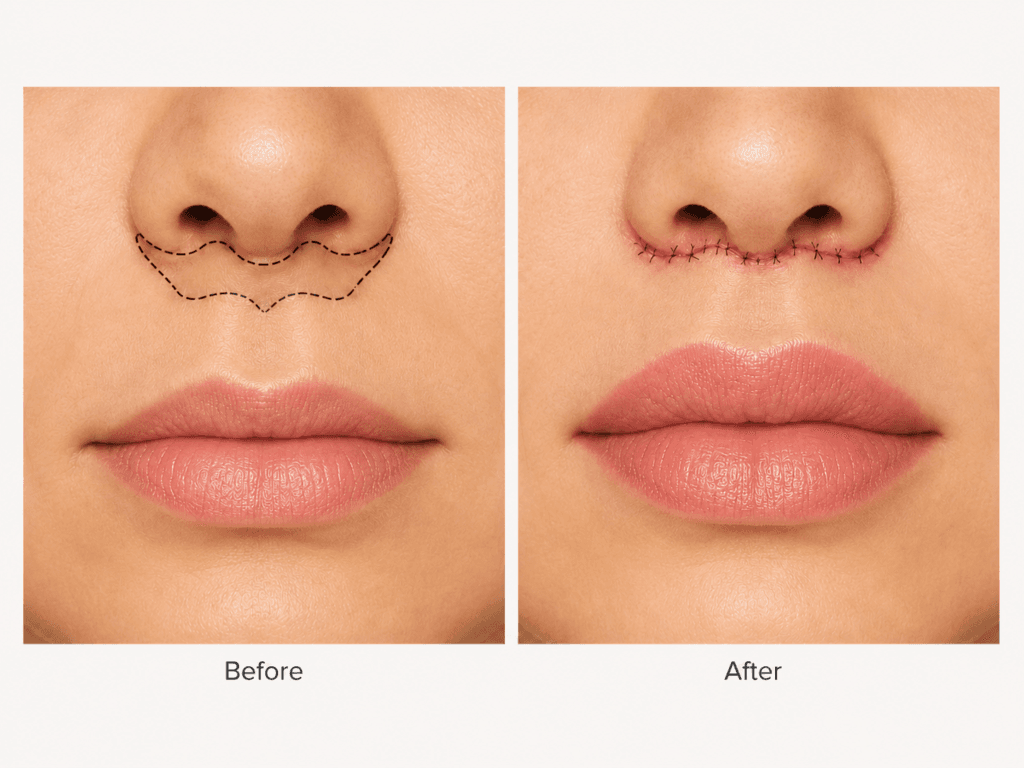
In a classic lip lift, a carefully planned amount of skin is removed from just beneath the base of the nose. The upper lip is then repositioned upwards, shortening the distance between the nose and the lip.
This may make the red portion of the upper lip more visible, enhance the Cupid’s bow, increase upper tooth show at rest in some patients and create a more balanced relationship between the nose, lips and lower face.
One of the most commonly used techniques is the subnasal lip lift, also known as the bullhorn lip lift.
Which Techniques Can Be Used for Lip Lifting?
The surgical technique should be selected according to the anatomical problem that needs to be corrected.
Subnasal Lip Lift (Bullhorn Lip Lift)
The subnasal lip lift is the technique we most commonly use in patients with a long distance between the base of the nose and the upper lip.
The incision is planned along the natural contours beneath the nose. After a limited amount of skin is removed, the upper lip is carefully repositioned upwards.
This technique is particularly useful for reducing philtrum length and increasing the visible red portion of the upper lip. The natural folds beneath the nose help to camouflage the incision as much as possible.
Vermilion Border Lip Lift
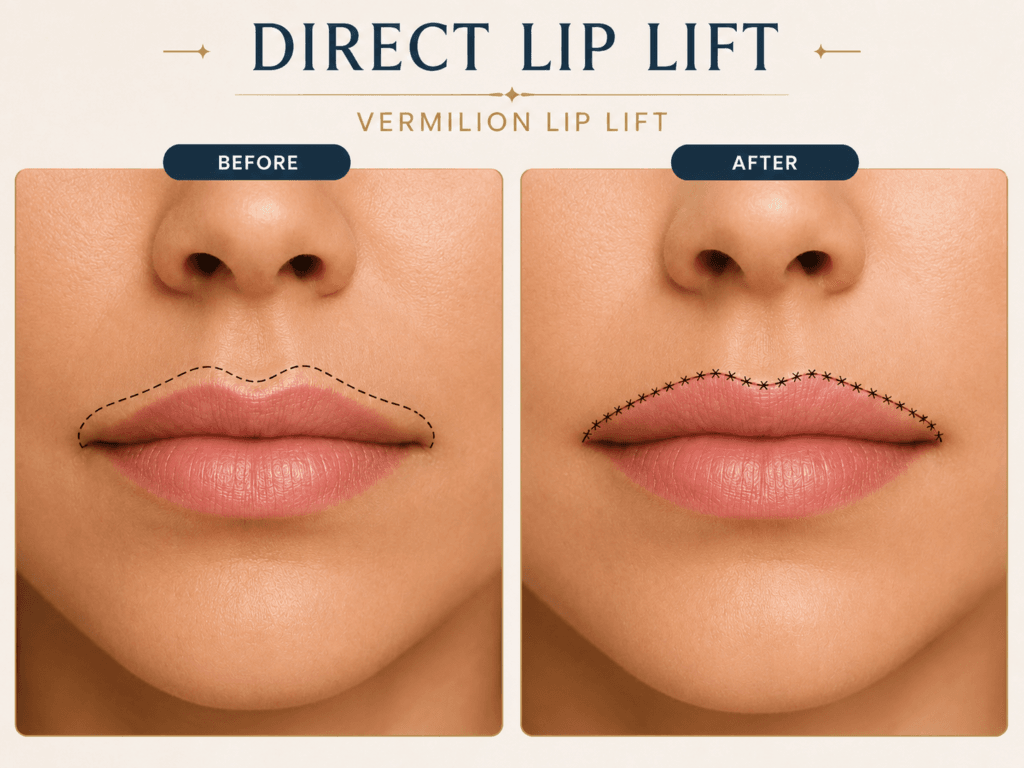
In some patients, the main problem is not a long nose-to-lip distance, but limited visibility of the red portion of the lip.
In selected cases, the incision can therefore be placed along the vermilion border, where the skin meets the red lip. A narrow strip of skin is removed to increase the amount of visible vermilion.
This technique does not shorten the philtrum as directly as a subnasal lip lift. Its main purpose is to increase red lip show.
One of its disadvantages is that the incision lies directly along the lip border. For this reason, the scar may be more visible than with a subnasal lip lift, where the incision is hidden within the natural folds beneath the nose. Patient selection is therefore particularly important.
Corner Lip Lift
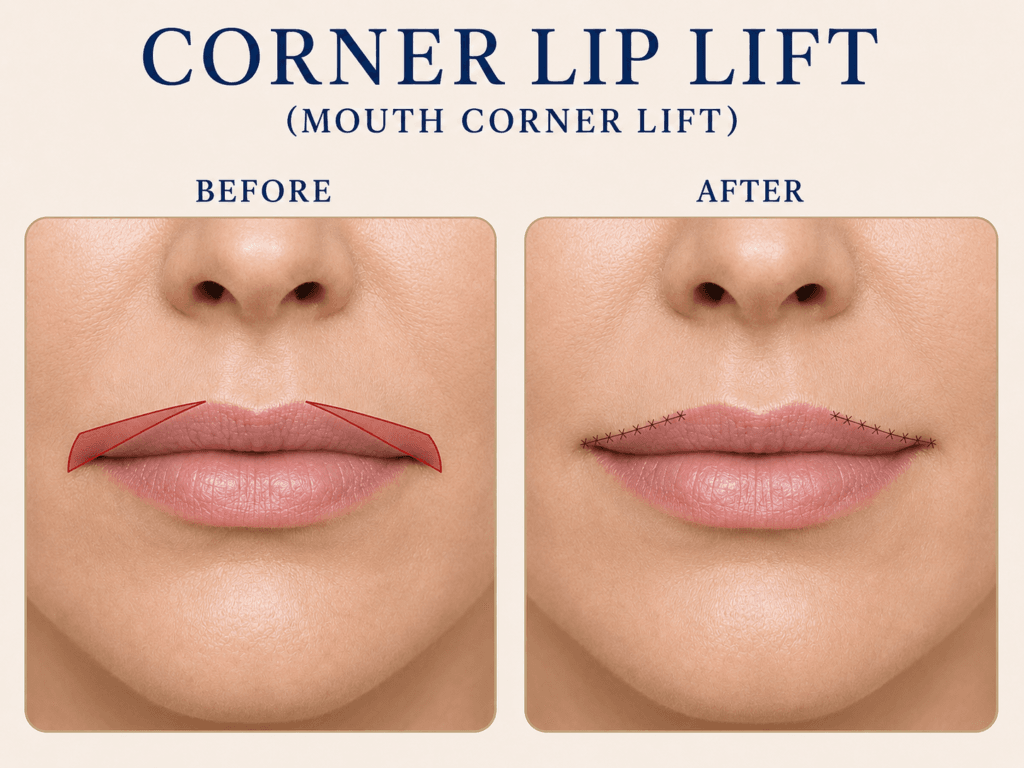
In some people, the central portion of the upper lip is in a normal position but the corners of the mouth point downwards. This can create a tired or sad expression.
A corner lift is a limited surgical procedure designed to elevate the corners of the mouth.
It does not shorten the distance between the nose and upper lip and is therefore not the same procedure as a classic lip lift.
In selected patients, a subnasal lip lift and corner lift may be considered together, depending on facial anatomy.
Lip Reduction Surgery
Lip aesthetics does not always mean increasing volume.
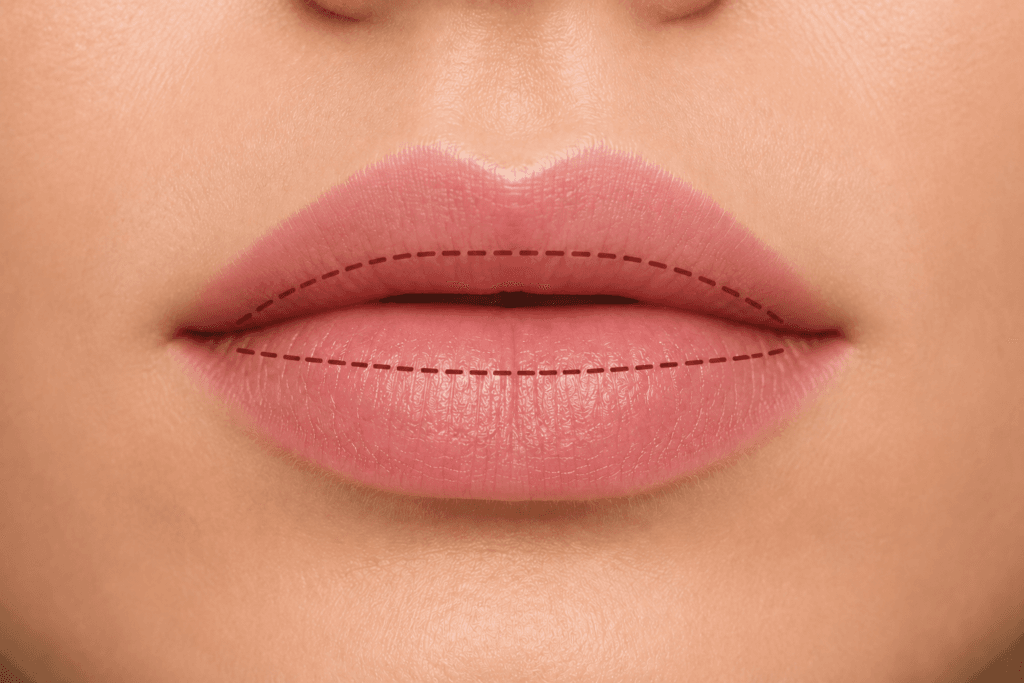
In patients with naturally very full lips, or in those whose lips have become excessively bulky after previous procedures, lip reduction surgery may be considered.
The procedure usually involves removing a carefully planned amount of mucosa and soft tissue from the inner surface of the red lip. Because the incision and sutures are placed inside the mouth, visible external skin scarring is largely avoided.
Depending on the suture material used, the stitches may dissolve naturally or be removed during follow-up.
Lip reduction surgery may be performed in both women and men. The aim is not to make the lips as small as possible or to achieve a standard size, but to create a more balanced relationship between the upper and lower lips and the rest of the face.
For this reason, lip surgery should be planned according to the underlying anatomical problem, rather than according to the name of a procedure alone.
What Is the Philtrum?
The area between the base of the nose and the red portion of the upper lip is called the philtrum.
When this distance is long in relation to the rest of the face, it may make the upper lip appear thinner, reduce red lip show, reduce upper tooth visibility at rest and make the lower face appear longer.
However, there is no single ideal nose-to-lip distance that applies to everyone.
Sex, facial height, nasal anatomy, lip thickness and chin proportions should all be considered together.
How Much Shortening Is Performed During a Lip Lift?
The amount of skin removed during a lip lift should be individualised.
In our clinical approach, we may use approximately 12 mm as one reference value for the distance between the base of the nose and upper lip. However, 12 mm is not a universal target that every patient should reach. Overall facial proportions are more important than a single millimetric measurement.
In many patients, approximately 4–5 mm of shortening may be sufficient. Removing too much skin can elevate the upper lip excessively and disturb the natural balance of the face.
For this reason, our aim is not to remove the maximum possible amount of skin, but to achieve a controlled shortening that suits the patient’s facial proportions.
Who May Be Suitable for a Lip Lift?
A lip lift may be considered in patients with a long distance between the nose and upper lip, limited visibility of the red upper lip, reduced upper tooth show at rest or in those who cannot achieve the desired facial proportions with lip filler alone.
It may also be an option for selected patients who want a more visible upper lip without increasing lip volume with filler. However, a long philtrum alone does not mean that surgery is necessary.
Nasal shape, lip thickness, tooth show, smile dynamics and lower facial proportions should all be assessed together.
Lip Lift in Men
In men, a long distance between the nose and upper lip may go unnoticed for many years. One reason is that a moustache can naturally camouflage the philtrum area.
In clinical practice, some men only notice that the nose-to-lip distance appears long after shaving off a moustache they have worn for many years, and may then seek advice about lip lift surgery.
When planning a lip lift in men, we consider not only millimetric measurements, but also facial length, nasal shape, lip thickness, chin proportions and beard or moustache distribution.
What Is the Difference Between a Lip Lift, Lip Filler and Lip Flip?
These three procedures do not correct the same anatomical problem.
A lip lift surgically shortens the distance between the nose and upper lip and changes the position of the upper lip within the face.
Hyaluronic acid lip filler adds volume to the lip tissue. It does not shorten the philtrum.
A lip flip is a temporary non-surgical treatment that reduces the activity of selected muscles around the upper lip, allowing the lip to turn slightly outwards. This may increase the visible red lip to a small degree, but it does not shorten the anatomical distance between the nose and lip.
For this reason, repeatedly adding more filler in a patient with a long nose-to-lip distance may increase lip projection without correcting the underlying proportion.
In contrast, if the philtrum length is normal and the patient simply wants more lip volume, a lip lift may not be appropriate.
No filler or implant is placed inside the lip during a lip lift, so the operation does not create a true increase in volume. However, because more of the red lip becomes visible after the lip is repositioned, the upper lip may appear more defined and fuller.
This appearance is therefore created by changing lip position rather than adding volume.
Previous lip filler does not automatically prevent a patient from having a lip lift. However, the amount and location of filler, and the extent to which it has altered the natural lip anatomy, should be assessed.
In selected patients, dissolving existing hyaluronic acid filler before surgery may help us assess the natural anatomy more accurately and plan the operation more reliably.
Can a Lip Lift Be Performed at the Same Time as Rhinoplasty?
A lip lift and rhinoplasty can be planned during the same surgical session in selected patients.
However, both procedures can affect the base of the nose and the surrounding tissues, so planning needs to be individualised.
Any changes to the nasal base during rhinoplasty, the position of the lip lift incision and the tension on the surrounding tissues should be considered together.
For this reason, the decision to perform both procedures at the same time should be based not only on whether each operation is indicated individually, but also on the combined nose-lip anatomy.
Recovery After Lip Lift Surgery
Swelling around the base of the nose and upper lip is normal after surgery. During the first few days, the upper lip may feel tight. Smiling, speaking and eating may feel different from usual.
The early lip position should not be considered the final result. As swelling decreases, the tissues gradually soften and lip movement becomes more natural. Scar maturation usually takes longer than the swelling itself to settle.
Does a Lip Lift Leave a Scar?
Because lip lift is a surgical procedure, a scar forms along the incision line.
In a subnasal lip lift, the incision is placed within the natural folds beneath the nose in an attempt to camouflage the scar as much as possible.
During the early period, the incision may appear red or pink. Over time, it usually becomes lighter and less noticeable, although scar healing varies from person to person.
Skin type, genetic healing characteristics, smoking, sun exposure, infection and tension along the incision can all affect scar quality.
Removing too much skin may increase tension on the incision, which is why greater shortening does not always mean a better result.
In vermilion border lip lifts, the incision lies directly at the junction between the skin and red lip, making scar visibility even more important in patient selection. For this reason, the term “scarless lip lift” is not medically accurate.
How Do We Assess Lip Lift Before and After Surgery?
When assessing lip lift before and after photographs, it is not enough to look only at the distance between the nose and upper lip.
We also assess red lip show, upper tooth visibility, the Cupid’s bow, the proportion between the upper and lower lips, the relationship between the nose and lips, lower facial height and overall facial balance.
Even a few millimetres of change can have a noticeable effect on facial expression. For this reason, the result should not be judged before the early swelling has subsided and the tissues have softened.
Is Lip Lift Permanent?
Because a lip lift surgically changes the anatomical distance between the nose and upper lip, the shortening is long-lasting.
Unlike filler, the effect is not expected to disappear completely after a certain period of time.
However, natural ageing continues. Over the years, further age-related changes can develop in the lips and surrounding tissues.
What Are the Risks of Lip Lift and Lip Surgery?
As with any surgical procedure, lip surgery carries risks.
These may include bleeding, infection, visible or widened scarring, asymmetry, sensory changes, prolonged swelling, temporary changes in lip movement, under-correction, over-correction and the need for revision surgery.
The nature of the risks varies according to the technique used.
For example, in a subnasal lip lift, scar quality beneath the nose and excessive shortening are particularly important considerations. In a vermilion border lift, the visibility of the scar along the lip border becomes more relevant.
How Is the Cost of Lip Lift and Lip Surgery Determined?
The cost of lip lift and other lip aesthetic procedures depends on the technique performed. Subnasal lip lift, corner lift, vermilion border lift and lip reduction are different surgical procedures.
The type of anaesthesia, the extent of surgery and whether the procedure is combined with another operation may also affect the overall cost.
For this reason, an exact price is best determined after an examination or, in suitable patients, an initial assessment based on photographs.
Lip Lift Consultation in Istanbul
Before planning surgery, we assess more than the length of the philtrum.
The consultation may include evaluation of:
- Overall vertical facial proportions,
- Nasal base and nasal tip,
- Upper-lip length,
- Vermilion show,
- Cupid’s bow,
- Upper tooth show at rest,
- Smile dynamics,
- Upper-to-lower lip relationship,
- Chin and lower-face proportions.
The aim is not to make every upper lip conform to the same measurement.
The aim is to determine whether changing the position, shape or volume of the lip would improve the overall balance of the face.
Frequently Asked Questions
Does lip lift surgery hurt?
Lip lift surgery can often be performed under local anaesthesia, so the surgical area is numb during the procedure. After surgery, patients may experience tenderness, tightness and swelling around the upper lip and nasal base. Severe pain is not usually expected, although pain perception varies from person to person.
How long does a lip lift take?
A lip lift usually takes approximately 30–45 minutes when performed as a standalone procedure. The exact duration may vary depending on the surgical technique and whether another procedure, such as a corner lift or additional facial surgery, is performed at the same time.
Does a lip lift change the shape of the nose?
A lip lift is designed to alter the upper lip rather than the nose.
However, because the incision is positioned around the nasal base, excessive tension or an inappropriate surgical design may influence the appearance of the nostrils or nasal base. Careful planning and controlled tissue removal are therefore important.
Can a lip lift be repeated later?
Revision or additional lip lift surgery may be possible in selected patients, but it requires more careful assessment because previous surgery changes the tissues and scar pattern.
The decision depends on the remaining philtrum length, scar quality, lip movement and overall facial proportions.
Is there an age limit for lip lift surgery?
There is no single age that determines suitability for a lip lift.
The more important factors are facial maturity, anatomy, general health and whether the patient’s concern is caused by lip position rather than another issue.
Lip lift may be considered in younger adults with naturally long upper lips as well as in older patients whose upper lip has lengthened with age.