
Buccal Fat Removal Surgery in Turkey
Buccal fat removal is a facial contouring procedure designed to reduce fullness in the lower cheek area by removing a portion of the buccal fat pad, also known as the Bichat fat pad.
The procedure is sometimes described as cheek fat removal, buccal fat reduction or buccal fat extraction.
The aim is not to make the entire face thinner. In appropriately selected patients, buccal fat removal can reduce fullness in the mid-to-lower cheek and create a clearer transition between the cheekbones and jawline.
However, not every round or full face is caused by excess buccal fat. Bone structure, superficial facial fat, masseter muscle volume and overall facial proportions all contribute to facial shape. For this reason, careful patient selection is one of the most important parts of buccal fat removal surgery.
What Is the Buccal Fat Pad?
The buccal fat pad is a distinct collection of deep facial fat located within the cheek.
Unlike superficial fat directly beneath the skin, the buccal fat pad lies deeper within the facial anatomy and has several extensions into surrounding areas.
During buccal fat pad removal, only the appropriate portion of this fat is gently delivered through a small incision inside the mouth.
The goal is not to completely empty the buccal fat compartment. Removing excessive volume may produce an overly hollow appearance, particularly as the face naturally loses volume with age.
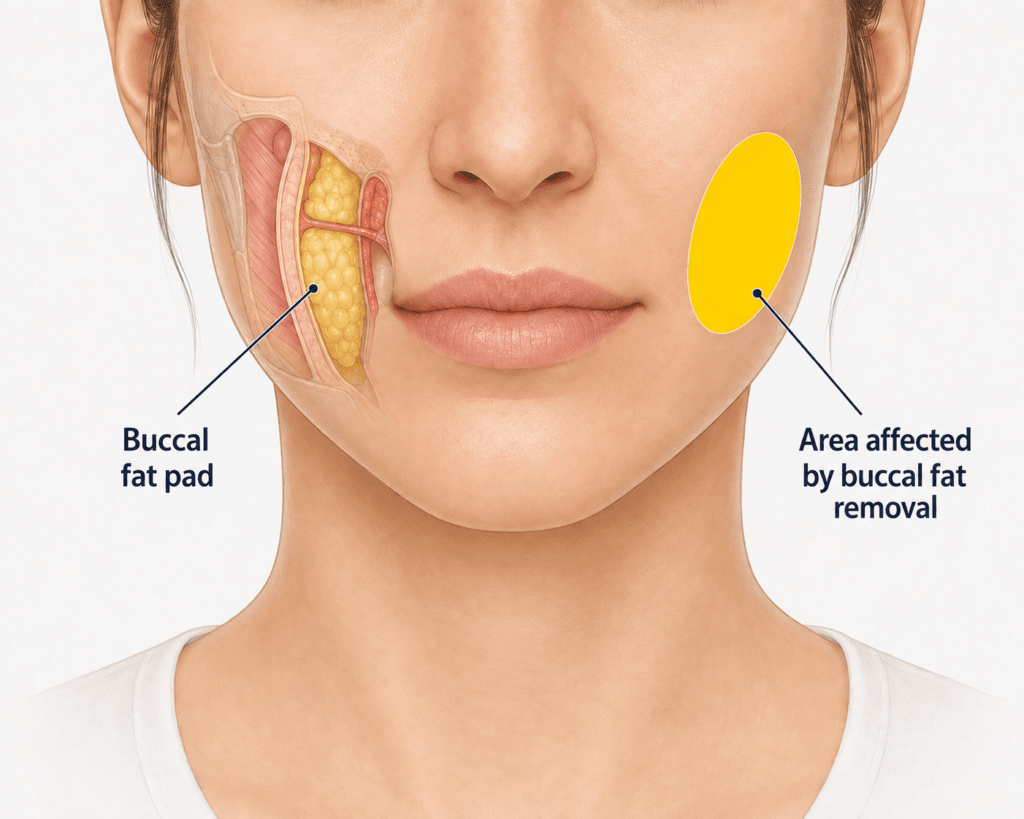
What Does Buccal Fat Removal Do?
In suitable patients, buccal fat removal may help:
- reduce fullness in the lower cheeks,
- create greater definition beneath the cheekbones,
- improve the transition between the cheek and jawline,
- make a naturally round face appear more contoured.
It is important to understand that buccal fat removal is not a weight-loss procedure.
If facial width is mainly caused by prominent masseter muscles, broad facial bones or superficial fat, removing the buccal fat pad alone may produce relatively little change.
The anatomy of the entire face should therefore be assessed before recommending surgery.
Who May Be Suitable for Buccal Fat Removal?
Good candidates are generally adults who remain noticeably full in the cheeks despite having a stable and healthy body weight.
Buccal fat reduction may be considered when:
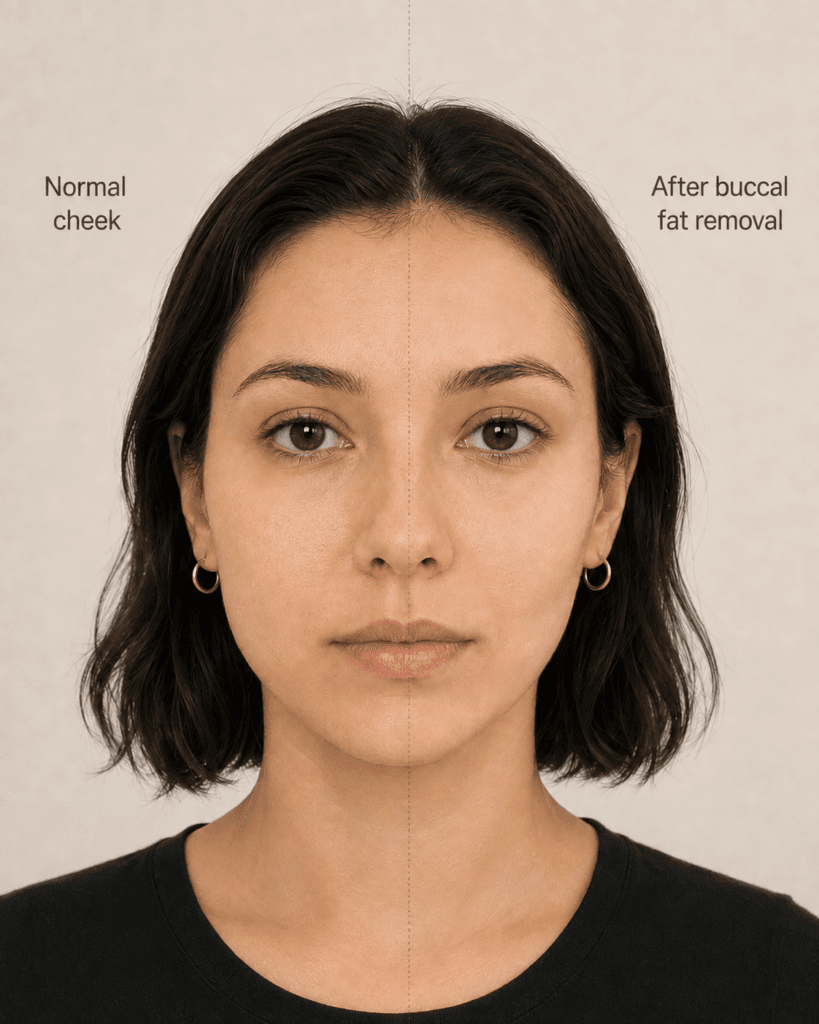
- the mid-to-lower cheeks are naturally full,
- the face appears round despite a normal body weight,
- the buccal fat pad contributes significantly to cheek fullness,
- greater cheekbone and facial contour definition is desired,
- facial proportions are suitable for volume reduction.
A request for a “slimmer face” alone is not enough to determine whether buccal fat removal is appropriate.
Who May Not Be a Good Candidate?
Buccal fat removal should be approached cautiously in patients who already have a naturally thin or narrow face.
It may also be less suitable in people with:
- prominent hollowing beneath the cheekbones,
- significant age-related facial volume loss,
- a long and narrow facial shape,
- very little deep cheek fat,
- facial fullness caused primarily by muscle or bone structure.
Removing volume from an already thin face can exaggerate hollowing over time.
This is one reason conservative patient selection is more important than simply removing as much fat as possible.
Can Buccal Fat Removal Make the Face Look Older?
This is an important consideration when planning surgery.
The face naturally loses and redistributes volume with ageing. Both superficial and deep facial fat compartments change over time.
In a young patient with naturally full cheeks, carefully reducing the buccal fat pad may improve facial definition without creating an unnaturally hollow appearance.
However, aggressive buccal fat extraction in someone who already has a relatively lean face may contribute to excessive hollowing later in life.
For this reason, our approach is generally conservative rather than aggressive.
The aim is to achieve proportionate contouring while preserving enough facial volume for the long term.
How Much Buccal Fat Is Removed?
There is no fixed volume that should be removed from every patient.
The amount depends on individual anatomy.
In our clinical experience, the amount of buccal fat removed is usually approximately 2–2.5 g of tissue, depending on the patient’s anatomy.
This is not a target volume.
The surgeon should not continue removing tissue simply to reach a predetermined amount. The priority is facial balance, symmetry and preservation of long-term volume.
How Is Buccal Fat Removal Surgery Performed?
Buccal fat removal surgery is performed through a small incision inside the cheek.
The surgeon carefully enters the appropriate anatomical plane and identifies the buccal fat pad. The relevant portion of fat is gently delivered and removed in a controlled manner.
The incision is then closed inside the mouth.
Because the incision is intraoral, there is no visible external facial scar from the procedure.
Can Buccal Fat Removal Be Performed Under Local Anaesthesia?
Yes.
Selected patients can undergo buccal fat removal under local anaesthesia, and we have performed the procedure this way in our clinic.
In practice, many of our patients request buccal fat removal as an additional procedure while already undergoing another aesthetic operation.
In those cases, the anaesthesia is generally determined by the main surgical procedure.
Can Buccal Fat Removal Be Combined With Other Procedures?
Yes.
Buccal fat removal is frequently requested as a secondary facial contouring procedure when a patient is already undergoing another operation.
Depending on facial anatomy, it may be considered alongside:
- chin surgery,
- facial or neck contouring procedures,
- selected facial rejuvenation operations,
- other aesthetic procedures performed during the same surgical session.
However, simply being under anaesthesia for another operation is not in itself a reason to perform buccal fat removal.
Each additional procedure should have a genuine anatomical indication.
What Is Recovery Like After Buccal Fat Removal?
Swelling of the cheeks is expected during the first few days after surgery.
Patients may also experience:
- mild soreness,
- tenderness when chewing,
- temporary discomfort around the intraoral incision.
Good oral hygiene is particularly important while the incision heals.
Soft foods may be more comfortable during the early recovery period.
The majority of swelling gradually settles over the following weeks.
When Will I See the Result?
The appearance immediately after surgery does not represent the final result.
In fact, early postoperative swelling can temporarily make the cheeks appear fuller rather than slimmer.
As swelling decreases, greater cheek definition gradually becomes visible.
A meaningful buccal fat removal before and after comparison should therefore be made after the tissues have had sufficient time to settle. Final facial contour may take several months to become fully apparent.
Is Buccal Fat Removal Permanent?
The portion of buccal fat that is surgically removed does not grow back in the same form.
However, the appearance of the face continues to change throughout life.
Weight fluctuations, ageing, skin laxity and changes in other facial fat compartments can all alter facial contour over time.
For this reason, permanent removal of a portion of the buccal fat pad does not mean that the face itself will remain unchanged forever.
Is Buccal Fat Removal the Same as Facial Slimming?
Not necessarily.
“Facial slimming” is a broad term and can refer to several different treatments.
A broad lower face may be caused by prominent masseter muscles, in which case treatment directed at the masseter may be more relevant.
A double chin or superficial fat accumulation requires a different approach.
A broad skeletal structure cannot be changed by buccal fat removal.
Buccal fat surgery specifically addresses deep cheek fat.
The correct treatment therefore depends on what is actually causing the face to appear wide or full.
Buccal Fat Removal vs Masseter Muscle Treatment
These treatments act on completely different structures.Treatment directed at the masseter muscle aims to reduce excessive muscle activity and, over time, may decrease muscle volume along the lower jaw.
Buccal fat removal reduces a portion of the deep fat within the cheek.Some patients have prominent masseter muscles, others have significant buccal fat, and some have both.A facial assessment is needed before deciding which treatment, if either, is appropriate.
Buccal Fat Removal and the “Hollywood Cheek” Look
The term “Hollywood cheeks” is commonly used online to describe a face with prominent cheekbones and a relatively hollow area beneath them.
It is not a medical diagnosis or a specific surgical technique.
Buccal fat reduction may contribute to this appearance in selected patients, but facial shape also depends heavily on:
- cheekbone projection,
- jaw structure,
- facial width,
- superficial fat,
- skin thickness.
Removing cheek fat alone cannot create the same facial proportions in every patient.
For this reason, treatment should be based on anatomy rather than a fashionable facial template.
Can Men Have Buccal Fat Removal?
Yes.
Buccal fat removal can be performed in both women and men.
However, male and female facial proportions are not identical. Jaw width, cheekbone projection and lower facial shape should all be considered when deciding whether reduction of the buccal fat pad would improve facial balance.
The same principle applies to both sexes: the procedure should only be performed when buccal fat genuinely contributes to unwanted cheek fullness.
What Are the Risks of Buccal Fat Removal?
Although buccal fat removal is generally a relatively limited surgical procedure, it still carries potential risks.
These may include:
- bleeding,
- infection,
- haematoma,
- asymmetry,
- delayed healing inside the mouth,
- insufficient volume reduction,
- excessive volume reduction,
- injury to nearby anatomical structures.
Important structures, including branches of the facial nerve and the parotid duct, lie within the surrounding anatomy.
A detailed understanding of facial anatomy is therefore important when performing buccal fat surgery.
Can Too Much Buccal Fat Be Removed?
Yes, and this is one of the reasons conservative surgery is important.
More fat removal does not automatically produce a better facial contour.
Excessive removal can create pronounced hollowing beneath the cheekbones and may become more noticeable as natural facial ageing progresses.
Correcting excessive volume loss later may require treatments such as fat grafting, but replacing lost volume is not the same as restoring the original buccal fat pad.
The best strategy is therefore to avoid over-resection in the first place.
Can the Face Look Hollow After Buccal Fat Removal?
The intention of surgery is not to create an unnaturally hollow face.
However, the risk can increase when:
- the patient was not an appropriate candidate,
- the face was already lean,
- too much fat was removed,
- significant age-related volume loss develops later.
When evaluating a younger patient, the surgeon should therefore consider not only how the face looks today but also how its volume may change with ageing.
Buccal Fat Removal Cost
Searches for buccal fat removal cost, buccal fat removal price UK and how much is buccal fat removal are common, but there is no single price applicable to every patient.
Cost may depend on:
- whether the procedure is performed alone or alongside another operation,
- the type of anaesthesia,
- the hospital or clinical setting,
- the overall surgical plan.
For international patients considering buccal fat removal in Turkey, an individual assessment is needed before an accurate treatment quotation can be provided.
Price should also not be the only factor when choosing surgery. Patient selection, facial anatomy, surgical planning and long-term facial balance are more important than simply finding the cheapest procedure.
Buccal Fat Removal in Turkey for UK Patients
Patients from the UK may consider travelling to Turkey for facial aesthetic surgery, including buccal fat removal.
At Anka Plastic Surgery in Istanbul, international patients can initially be assessed remotely using photographs and, where appropriate, an online consultation.
If surgery is suitable, the treatment plan may include the operation itself as well as the necessary hospital or clinic arrangements and postoperative review during the patient’s stay in Istanbul.
Because buccal fat removal is frequently performed as an additional procedure alongside another aesthetic operation, the overall travel and recovery plan depends on the main surgery being performed.
Our Approach to Buccal Fat Removal
At Anka Plastic Surgery, buccal fat removal is not planned simply according to the size of the cheeks.
We assess:
- overall facial width and length,
- cheekbone projection,
- deep and superficial fat distribution,
- jawline anatomy,
- masseter muscle prominence,
- skin and soft tissue quality,
- age and expected long-term facial volume changes.
Our aim is not to remove the maximum possible amount of buccal fat.
The goal is to achieve controlled, proportionate facial contouring in appropriately selected patients while preserving natural facial volume for the future.
Online Consultation
If you would like to find out whether buccal fat removal may be suitable for your facial anatomy, you can contact our team via WhatsApp for an online assessment.
You can send your photographs and briefly describe your expectations. After an initial evaluation, we can advise you about suitable treatment options and the next steps.
Contact us on WhatsApp for an online assessment.