
Breast Reconstruction in Turkey
Breast reconstruction refers to a group of surgical procedures performed to recreate the shape of the breast after all or a significant part of the breast has been removed because of breast cancer.
Reconstruction is not simply about restoring breast volume. The condition of the skin envelope, chest wall, shape of the opposite breast, history of radiotherapy, available donor tissues and any treatments that may be required in the future should all be considered together.
Breast reconstruction may be performed using implants, the patient’s own tissues, or a combination of both methods.
Throughout my surgical career, I have performed TRAM flap, latissimus dorsi flap and implant-based breast reconstructions. Today, in suitable patients, I tend to favour implant-based reconstruction because it avoids creating an additional donor-site defect elsewhere in the body and may allow reconstruction with a more limited surgical procedure. However, the same method is not appropriate for every patient.
When Is Breast Reconstruction Performed?
Breast reconstruction may be performed at the same time as mastectomy or at a later stage.
Immediate Breast Reconstruction
Reconstruction performed during the same operation as the mastectomy is known as immediate breast reconstruction.
In suitable patients, part of the breast skin can be preserved, which may provide important advantages for reconstruction. In selected patients, the nipple and areola may also be preserved when this is oncologically appropriate.
Delayed Breast Reconstruction
Reconstruction performed months or years after completion of cancer treatment is known as delayed breast reconstruction.
In patients who have previously undergone mastectomy or radiotherapy, the condition of the remaining skin and soft tissues becomes particularly important when selecting the reconstructive method.
Risk-Reducing Mastectomy and Implant Reconstruction in BRCA-Positive Patients
In some women with a disease-associated mutation in the BRCA1 or BRCA2 gene, bilateral risk-reducing mastectomy may be considered before breast cancer develops.
In these patients, the breasts are healthy at the time of surgery. The aim is not to remove an existing tumour, but to remove as much breast tissue as possible that carries a future risk of developing cancer.
After the breast tissue has been removed, the resulting space can be reconstructed with silicone implants during the same operation. In suitable patients, risk-reducing mastectomy and breast reconstruction can therefore be completed as part of the same surgical procedure.
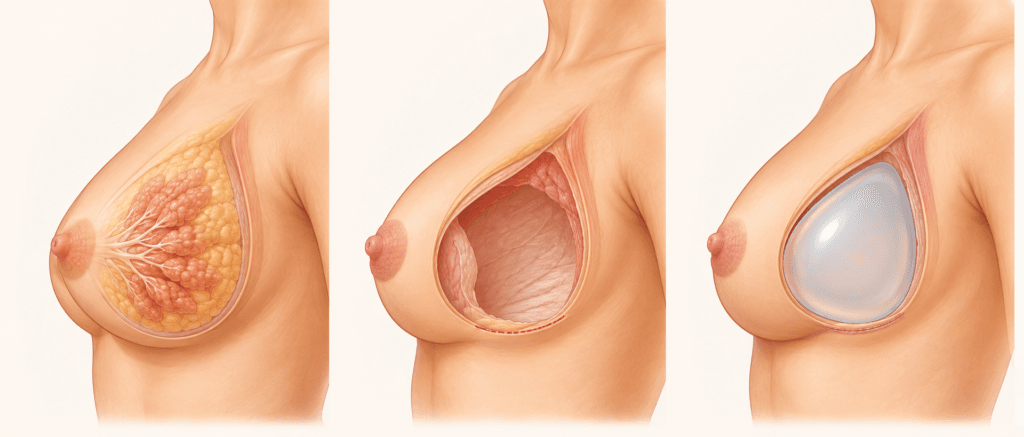
When planning reconstruction, breast size, skin quality, nipple position, existing breast shape and the desired result are considered together. Decisions regarding removal of the breast tissue and oncological safety are made by the breast surgeon, while the reconstruction plan is developed in collaboration with the plastic surgeon.
Risk-reducing mastectomy aims to substantially reduce the future risk of breast cancer. However, because it is not possible to remove every microscopic amount of breast tissue, the risk cannot be reduced to zero.
What Are the Main Types of Breast Reconstruction?
There are three main approaches:
- Implant-based reconstruction
- Reconstruction using the patient’s own tissue
- A combination of an implant and the patient’s own tissue
The most appropriate method depends on the patient’s anatomy, previous or planned cancer treatments and individual expectations.
Breast Reconstruction with Implants
Implant-based breast reconstruction is one of the commonly used methods of breast reconstruction.
If there is sufficient healthy skin following mastectomy, a permanent breast implant may be placed during the same operation. In some patients, reconstruction may instead be planned in two stages.
Direct-to-Implant Breast Reconstruction
In suitable patients, a permanent breast implant can be placed immediately after mastectomy during the same operation.
One of the main advantages of this approach is that muscle, skin or fat does not need to be taken from another part of the body such as the abdomen or back. This avoids creating an additional donor site and may allow a shorter operation and recovery than some autologous reconstruction procedures.
However, direct-to-implant reconstruction is not suitable for every mastectomy patient. The blood supply and quality of the remaining mastectomy skin are particularly important.
Tissue Expander Followed by Implant
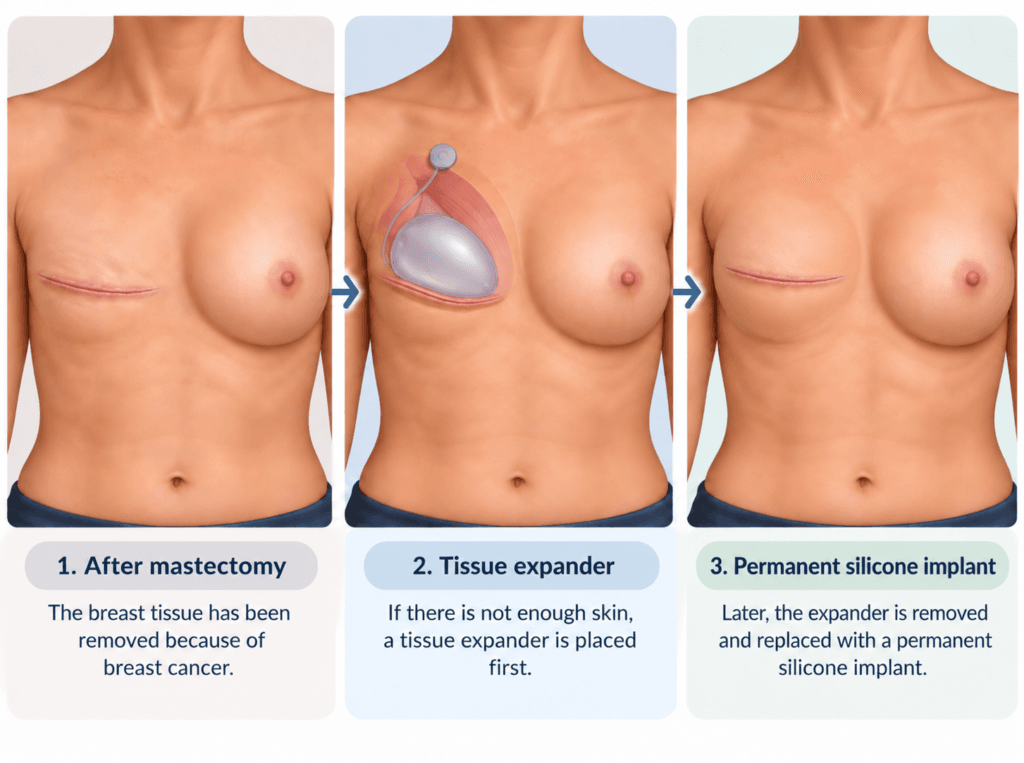
In some patients whose skin envelope is not suitable for immediate placement of a permanent implant, a tissue expander may be inserted during the first operation.
The expander is gradually filled over the following weeks to prepare the skin and soft tissues. Once an adequate volume has been achieved, it is removed during a second operation and replaced with a permanent implant.
AlloDerm and Other Biological Support Materials in Implant Reconstruction
In some implant-based breast reconstructions, acellular dermal matrices such as AlloDerm may be used to provide additional support for the implant and reinforce the soft-tissue envelope.
Although patients sometimes refer to these materials as “artificial skin”, they are biological tissue matrices used to provide additional structural support around the implant.
They may be particularly useful for supporting the lower and lateral parts of the implant, helping control implant position and shaping the inframammary fold.
They are not necessary in every patient. The decision to use an acellular dermal matrix depends on the quality of the remaining skin and soft tissues after mastectomy and the overall reconstruction plan.
Why We Currently Favour Implant-Based Reconstruction in Suitable Patients
Reconstruction using the patient’s own tissue remains an extremely valuable option in appropriate patients. However, taking tissue from another area such as the abdomen or back creates a second surgical site.
This can mean a longer operation and recovery, additional scars and additional surgical burden at the donor site.
For this reason, when the mastectomy skin is healthy and sufficient and the oncological treatment plan is suitable, Iwe often consider implant-based reconstruction to be a more rational option.
However, implants also have their own long-term risks, and the reconstructive method should always be selected individually.
Risks of Silicone Breast Implants
Potential complications associated with implants used for breast reconstruction include:
- Infection
- Capsular contracture
- Implant exposure
- Change in implant position
- Implant damage or rupture
- Asymmetry
- The need for revision surgery in the future
It is not possible to guarantee that a patient with breast implants will never require another operation during her lifetime.
What Is BIA-ALCL?
Breast Implant-Associated Anaplastic Large Cell Lymphoma (BIA-ALCL) is a rare type of lymphoma that may develop in the capsule surrounding a breast implant.
The risk has been particularly associated with certain textured-surface implants. BIA-ALCL is not breast cancer.
One of the typical presentations is sudden fluid accumulation and swelling of the breast several years after implant placement. Less commonly, a mass or changes in the capsule may occur.
For this reason, implant selection should take into account not only breast shape, but also the characteristics of the implant and available long-term safety data.
Breast Reconstruction with a TRAM Flap
The TRAM flap is a classic autologous reconstruction technique in which skin, fat and part of the rectus abdominis muscle from the lower abdomen are used to reconstruct the breast.
It allows a breast with a natural soft-tissue consistency to be created using the patient’s own tissue. Its main disadvantage is that tissue is taken from the abdominal wall.
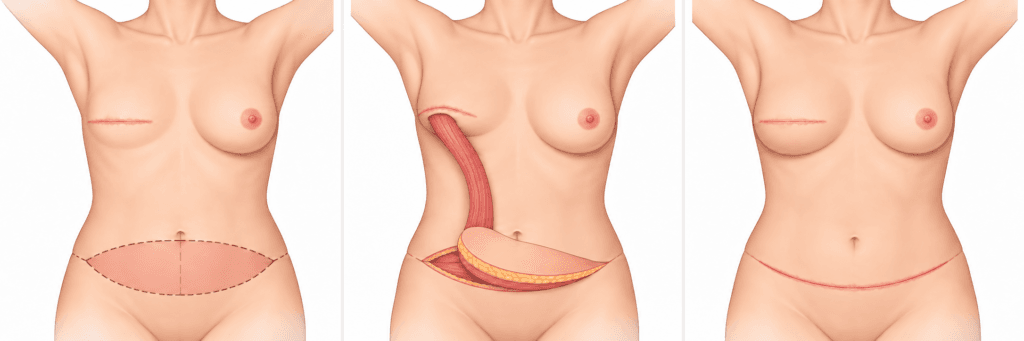
Potential donor-site problems include:
- Abdominal wall weakness
- Bulging
- Hernia
- A longer operation and recovery period
Breast Reconstruction with a Latissimus Dorsi Flap
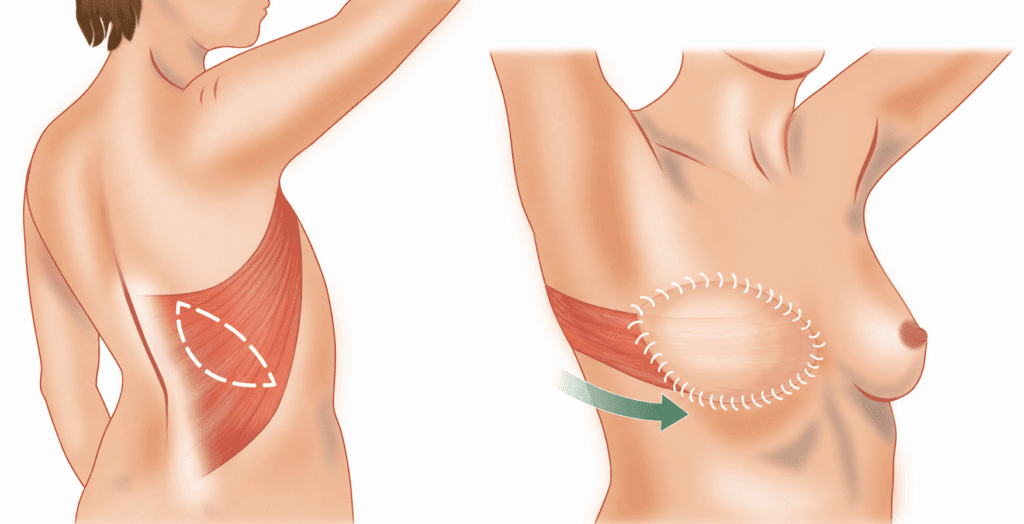
In latissimus dorsi flap reconstruction, the broad back muscle together with overlying skin and fatty tissue is transferred to the chest.
The flap maintains its own blood supply during transfer. In some patients, the flap may provide sufficient volume on its own, although in many cases an implant is also required to achieve the desired breast volume.
This technique may be useful in selected patients with inadequate skin or soft-tissue coverage over the chest wall. However, it creates an additional surgical site and scar on the back and may be associated with seroma formation and, in some patients, functional effects. It is therefore not a procedure that needs to be routinely used in every patient.
Own Tissue or Silicone Implant?
There is no single answer that applies to every patient.
An important advantage of autologous reconstruction is that breast volume is recreated using living tissue from the patient’s own body. An important advantage of implant reconstruction is that a large amount of tissue does not need to be taken from another area such as the abdomen or back.
When selecting a method, I consider factors including:
- The quality of the remaining skin after mastectomy
- Whether radiotherapy has been or will be required
- The breast volume needed
- The patient’s abdominal and back tissues
- Previous surgery
- General health
- The patient’s own preferences
In some patients who have undergone radiotherapy, or who do not have adequate healthy soft-tissue coverage for an implant, reconstruction using their own tissue may be more appropriate.
Does Radiotherapy Affect Breast Reconstruction?
Yes.
Radiotherapy can cause changes in the skin and subcutaneous tissues including:
- Hardening
- Loss of elasticity
- Changes in blood circulation
- Fibrosis
These changes may increase the risk of complications with implant reconstruction, including capsular contracture, wound-healing problems or implant exposure.
For this reason, the reconstructive method must be selected particularly carefully in patients who have received radiotherapy. In some cases, bringing well-vascularised tissue from another part of the body may be a more suitable option.
Fat Grafting in Breast Reconstruction
Fat grafting can be used as an additional technique at different stages of breast reconstruction.
It may be particularly useful to:
- Reduce visible or palpable implant edges
- Correct small contour irregularities
- Increase soft-tissue thickness over the chest wall
- Correct small volume differences between the two breasts
Fat is taken from the patient’s own body, prepared and injected in small amounts into the required areas.
Reconstructing an entire large breast using fat grafting alone in a single session is not possible in every patient.
Nipple and Areola Reconstruction
If the nipple and areola cannot be preserved during mastectomy, a new nipple can be created at a later stage of reconstruction.
The appearance of the areola may then be restored using techniques such as a skin graft from the groin or medical tattooing.
These procedures are generally planned after the main breast volume has been reconstructed and the breast shape has stabilised.
Is Surgery on the Opposite Breast Necessary?
The goal of reconstruction is not simply to create a breast on the treated side, but also to achieve the best possible balance between the two breasts.
For this reason, some patients may benefit from surgery on the opposite breast, such as:
- Breast lift
- Breast reduction
- Breast augmentation with an implant
However, surgery on the opposite breast is not necessary in every patient.
How Many Stages Does Breast Reconstruction Require?
In some patients, reconstruction can be largely completed in a single operation.
In others, the process may involve several stages:
- Creation of the breast volume
- Implant exchange or contour correction if required
- Fat grafting
- Nipple and areola reconstruction
In patients undergoing ongoing cancer treatment, the surgical plan may change over time.
Does Breast Reconstruction Interfere with Cancer Follow-Up?
When appropriately planned, breast reconstruction should not prevent the necessary oncological follow-up.
The method of surveillance may vary according to the type of cancer surgery and reconstruction performed. Follow-up should therefore continue according to the programme determined by the patient’s breast surgery and oncology teams.
A Multidisciplinary Approach to Breast Reconstruction
Breast reconstruction after cancer is not a decision made by the plastic surgeon alone.
When appropriate, treatment planning may involve:
- Breast surgery
- Medical oncology
- Radiation oncology
- Plastic, reconstructive and aesthetic surgery
The need for radiotherapy or additional oncological treatment may influence both the timing and the type of reconstruction.
Conclusion
There is no single ideal breast reconstruction method for every patient.
Implants, TRAM flaps, latissimus dorsi flaps, fat grafting and other autologous reconstruction techniques each have different advantages and disadvantages.
The most appropriate method should be selected by considering the patient’s oncological treatment, available skin and soft tissues, history of radiotherapy, general health, personal preferences and the surgical burden that reconstruction may create in other areas of the body.