
Thigh Lift Surgery in Turkey
Thigh lift surgery is a body contouring procedure designed to remove excess, sagging skin, particularly from the inner thighs. Also known as an inner thigh lift, the procedure is commonly performed in patients who have developed significant skin laxity following bariatric surgery or substantial weight loss.
The surgical plan is tailored to the amount and distribution of excess skin. In patients with limited laxity confined to the upper thigh, a horizontal incision placed close to the groin crease may be sufficient. When excess skin extends further down the thigh, a vertical incision or a combination of horizontal and vertical incisions may be required.
What Is Thigh Lift Surgery?
The aim of a thigh lift is not simply to reduce the circumference of the legs. The procedure removes excess, sagging skin, improves the contour of the inner thighs and creates a smoother transition between the thighs and the surrounding body contours. In patients whose skin folds cause friction, irritation or hygiene problems, surgery may also help reduce these symptoms.
Following significant weight loss, fat volume may decrease substantially while the skin fails to contract to the same degree. This can result in loose, folded skin hanging along the inner thighs. When true skin excess is present, liposuction alone is usually not sufficient because it reduces fat volume but does not remove excess skin.
What Causes Sagging of the Thighs?
The most common causes of thigh skin laxity include significant weight loss, changes following bariatric surgery, ageing, genetically reduced skin elasticity and repeated fluctuations in body weight.
When planning treatment, it is important to distinguish mild skin laxity from true excess skin. Liposuction may be sufficient in patients who still have good skin elasticity and whose main concern is localised fat. When the skin is significantly loose, folded or hanging, however, removal of excess skin may be necessary.
Thigh Sagging After Bariatric Surgery or Significant Weight Loss
Thigh lift surgery is frequently considered in patients who have lost a substantial amount of weight following bariatric surgery or medical weight-loss treatments. In these patients, excess skin may not be limited to the upper inner thigh and can extend from the groin towards the knee.
More advanced skin excess may cause friction while walking, recurrent irritation, hygiene difficulties and problems with clothing. For this reason, surgery in post-bariatric patients is planned according to both the direction and the extent of the skin laxity.
*Significant weight loss can also lead to loose skin in several areas of the body. You can find more information about the timing of surgery in our article [When Should Body Surgery Be Performed After Mounjaro and Ozempic?].*
Where Are the Incisions Made in Thigh Lift Surgery?
There is no single incision pattern that is suitable for every patient. The technique is selected according to the location and direction of the excess skin.
Horizontal Thigh Lift
In a horizontal thigh lift, the incision is generally placed close to the groin crease. Excess skin is lifted upwards and removed, allowing the inner thigh tissues to be repositioned at a higher level.
One advantage of this technique is that much of the scar can remain close to the underwear line. However, a horizontal thigh lift is most suitable for selected patients whose excess skin is mainly confined to the upper thigh. When skin laxity extends further down the leg, a horizontal incision alone may not provide sufficient correction.
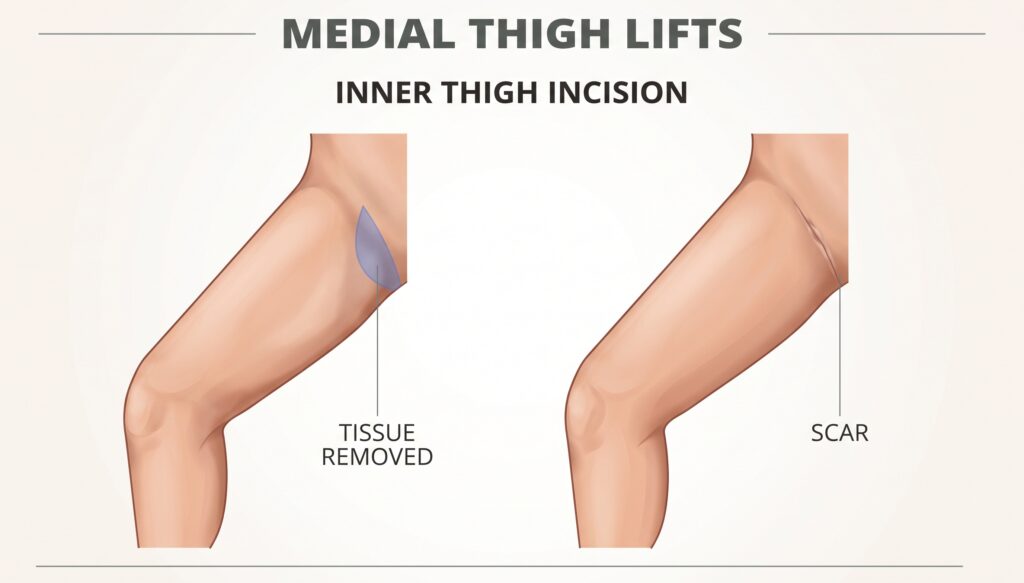
Vertical Thigh Lift
In a vertical thigh lift, the incision extends down the inner thigh and is usually connected to an incision placed along the groin crease. This approach is particularly useful after bariatric surgery or significant weight loss when excess skin is not limited to the upper thigh but continues along a larger portion of the thigh.
This technique allows more extensive skin excess and circumferential laxity of the inner thigh to be removed more effectively. Its main disadvantage is that the scar extends from the groin area down along the inner thigh. In patients with advanced skin excess, it may be more appropriate to choose an incision pattern that provides adequate correction rather than removing too little tissue simply to achieve a shorter scar.
Incision Length Varies Between Patients
A vertical thigh lift does not have one fixed incision length. In some patients, the vertical component may remain limited to a shorter segment of the thigh, while in more advanced cases it may extend further towards the knee.
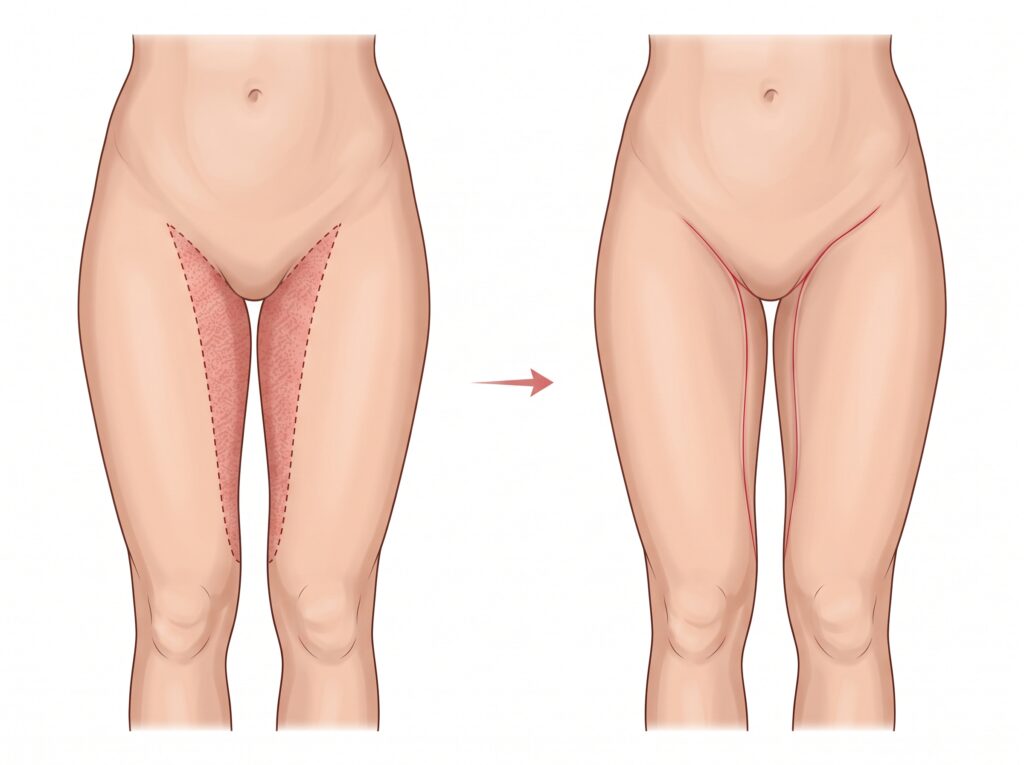
The length of both the groin-based horizontal component and the vertical incision is planned according to the amount and distribution of excess skin. For this reason, the final scar pattern may resemble a T-shape or an inverted L and will not be the same in every patient.
Can Thigh Lift Surgery Be Combined With Liposuction?
Some patients have localised fat deposits around the upper thighs, inner knees or surrounding areas in addition to excess skin. In selected cases, liposuction can be combined with thigh lift surgery to improve transitions between these areas and create a smoother overall contour.
The extent of liposuction is determined according to the patient’s anatomy and the amount of skin that will be removed. Preserving blood supply to the skin is particularly important during more extensive thigh lift procedures, so liposuction needs to be performed in a controlled manner.
Liposuction reduces fat volume but does not remove excess skin. It therefore does not replace thigh lift surgery in patients with significant skin laxity.
Our Approach to Thigh Lift Surgery
At Anka Plastic Surgery, thigh lift surgery is planned individually according to the amount and direction of excess skin, tissue quality and the patient’s overall anatomy. The aim is not simply to create the shortest possible scar, but to achieve an appropriate and safe contour improvement with a scar pattern that is acceptable for the degree of correction required.
In patients who have experienced substantial weight loss, weight stability, nutritional status, tissue quality and excess skin in other areas of the body are also taken into account when planning surgery.
Frequently Asked Questions
Who Is a Suitable Candidate for Thigh Lift Surgery?
Thigh lift surgery may be considered for patients who have developed significant excess skin on the inner thighs following major weight loss, whose body weight has become relatively stable and whose skin laxity cannot be adequately treated with liposuction alone.
Friction between skin folds, recurrent irritation and hygiene difficulties may also contribute to the decision to undergo surgery. A thigh lift is not a weight-loss procedure. Ideally, patients should be close to their target weight and should no longer be experiencing major fluctuations in body weight.
How Long Does Thigh Lift Surgery Take?
The duration of surgery depends on the extent of the procedure. A limited horizontal thigh lift and a more extensive vertical thigh lift combined with liposuction do not require the same operating time. More extensive thigh lift procedures may take approximately 3 to 4 hours.
In post-bariatric patients, thigh lift surgery may sometimes be combined with other body contouring procedures. In combined surgery, the total operating time, expected blood loss, general health and the patient’s ability to recover safely must all be considered.
Where Are Thigh Lift Scars Located?
The position of the scar depends on the technique used. In a horizontal thigh lift, the scar follows the groin crease and is positioned as close to the underwear line as possible. In a vertical thigh lift, the scar extends down the inner thigh and, depending on the degree of skin excess, may approach the level of the knee.
With a combined technique, both a horizontal scar in the groin area and a vertical scar along the inner thigh are present. Thigh lift surgery therefore requires a balance between scar length and the degree of contour improvement that can be achieved.
Do Thigh Lift Scars Disappear?
No surgical scar disappears completely. Scars may initially appear redder and more noticeable, but they generally soften, fade and become less prominent over time.
Patients considering a vertical thigh lift should understand before surgery that a permanent scar may extend along the inner thigh.
What Is Recovery Like After Thigh Lift Surgery?
Swelling, bruising, tightness and tenderness with movement are common during the early postoperative period. Because the groin and inner thighs are highly mobile areas, movements that place excessive tension on the incision lines should initially be avoided.
Patients are encouraged to begin controlled walking early after surgery. Swelling and tightness are usually more noticeable during the first week, while return to normal daily activities gradually becomes easier over the following two to four weeks. If recovery progresses normally, a gradual return to exercise may be considered after approximately four to six weeks. These time frames vary according to the extent of surgery and individual healing.
Is a Compression Garment Used After Thigh Lift Surgery?
A compression garment is used in many patients following thigh lift surgery. It may help control swelling, support the operated tissues and improve comfort during movement.
The type of garment and the duration of use depend on the extent of surgery and the patient’s recovery.
What Are the Risks of Thigh Lift Surgery?
Thigh lift surgery, particularly when performed after substantial weight loss, can be an extensive body contouring procedure. Possible complications include bleeding, infection, seroma, delayed wound healing, wound separation, noticeable scarring, asymmetry, changes in sensation, contour irregularities, lymphatic swelling and deep vein thrombosis.
Incisions around the groin are exposed to moisture, movement and tension, so careful postoperative wound monitoring is particularly important.
Can Lymphoedema Occur After Thigh Lift Surgery?
Important lymphatic structures are located in the thigh. Although care is taken to preserve these structures during surgery, temporary swelling may occur after more extensive tissue dissection.
Persistent lymphatic problems are less common but remain a possible complication. Respecting the appropriate anatomical planes is particularly important during extensive vertical thigh lift procedures.
Can the Wound Open After Thigh Lift Surgery?
Partial wound separation can occur following thigh lift surgery. Incisions around the groin, areas under greater tension, poorer tissue quality following obesity and smoking can increase the risk of wound-healing problems.
Small areas of wound separation may heal with dressings and local wound care, whereas more extensive problems may require additional treatment. General health, smoking status and nutritional condition are therefore assessed before surgery.
Why Is Nutrition Important After Bariatric Surgery?
In patients who have undergone bariatric surgery, body weight alone does not provide enough information about readiness for body contouring surgery. Deficiencies in protein, iron, vitamin B12, folate and other vitamins or minerals may affect wound healing.
For this reason, nutritional status and general health should be assessed before extensive body contouring procedures, and relevant deficiencies should be corrected before surgery where necessary.
Can a Thigh Lift Be Performed Without Surgery?
Non-surgical skin-tightening treatments may provide limited improvement in patients with mild skin laxity. However, they cannot remove genuinely excess or folded skin.
When significant excess skin has developed following major weight loss, surgical removal of the excess tissue is required to achieve a meaningful correction.
Are Thigh Lift Results Permanent?
The excess skin removed during surgery does not grow back. However, the body continues to age and significant changes in weight can lead to further skin laxity over time.
Maintaining a relatively stable body weight therefore helps preserve the result for longer.
Can Thigh Lift Surgery Be Combined With Other Procedures?
Following major weight loss, excess skin of the thighs may occur together with loose skin of the abdomen, arms, breasts, back or waist. In selected patients, some of these areas may be treated during the same operation.
However, performing all body contouring procedures in a single session is not always safe or appropriate. Planning depends on the total operating time, expected blood loss, the patient’s health and their ability to recover safely. When necessary, body contouring procedures may be divided into separate surgical stages.
What Determines the Cost of Thigh Lift Surgery?
The extent of thigh lift surgery can vary considerably between patients. A limited horizontal thigh lift is different from a procedure requiring a vertical incision, liposuction or combination with another body contouring operation.
The cost therefore depends on the surgical technique, whether liposuction or additional procedures are required, and hospital and overnight stay arrangements. The final surgical plan and cost can be determined after clinical assessment.