
Dermapen and Microneedling Treatment in Turkey
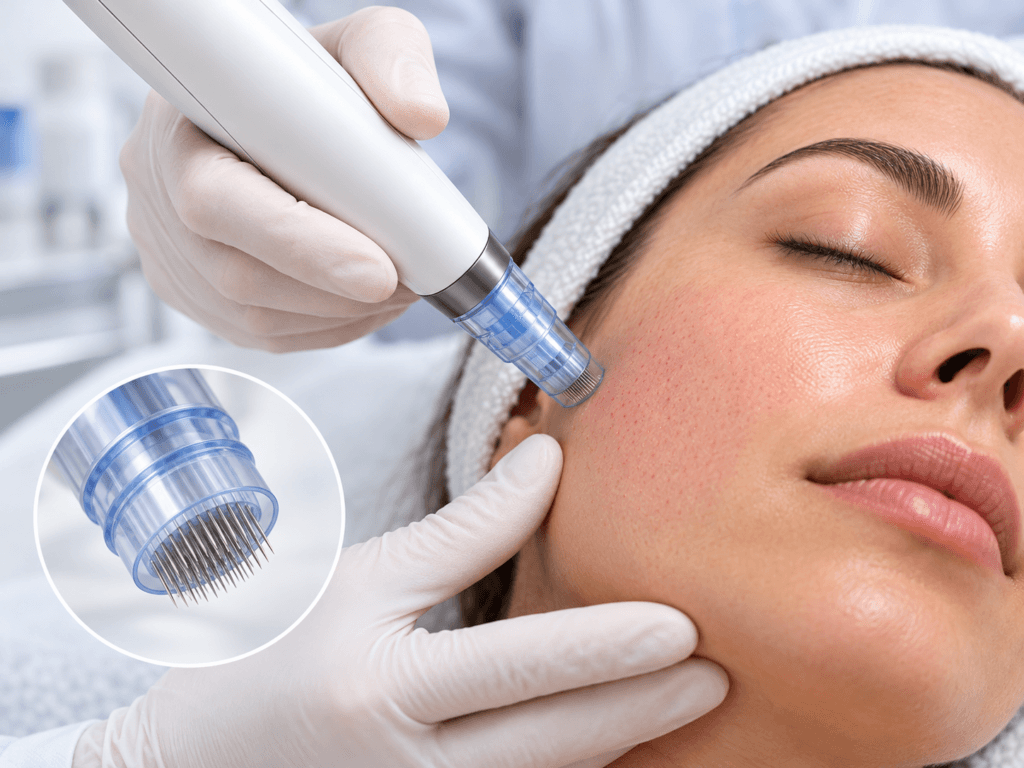
Dermapen is a microneedling treatment designed to create multiple controlled microchannels in the skin, stimulating the natural wound-healing response and tissue remodelling processes. Fine needles at the tip of a motorised device move vertically into and out of the skin, and the treatment depth can be adjusted according to the area being treated.
Microneedling is the general name of the treatment method, while Dermapen is one of the motorised devices used to perform microneedling.
At our clinic, we use Dermapen on the face, neck and scalp. The treatment may be performed as mechanical microneedling alone or, in suitable patients, combined with PRP, mesotherapy or exosome therapy.
Our approach is not to perform a deeper or more aggressive treatment, but to create a controlled stimulus appropriate for the patient’s skin quality, anatomical area and treatment goals.
How Does Dermapen Work?
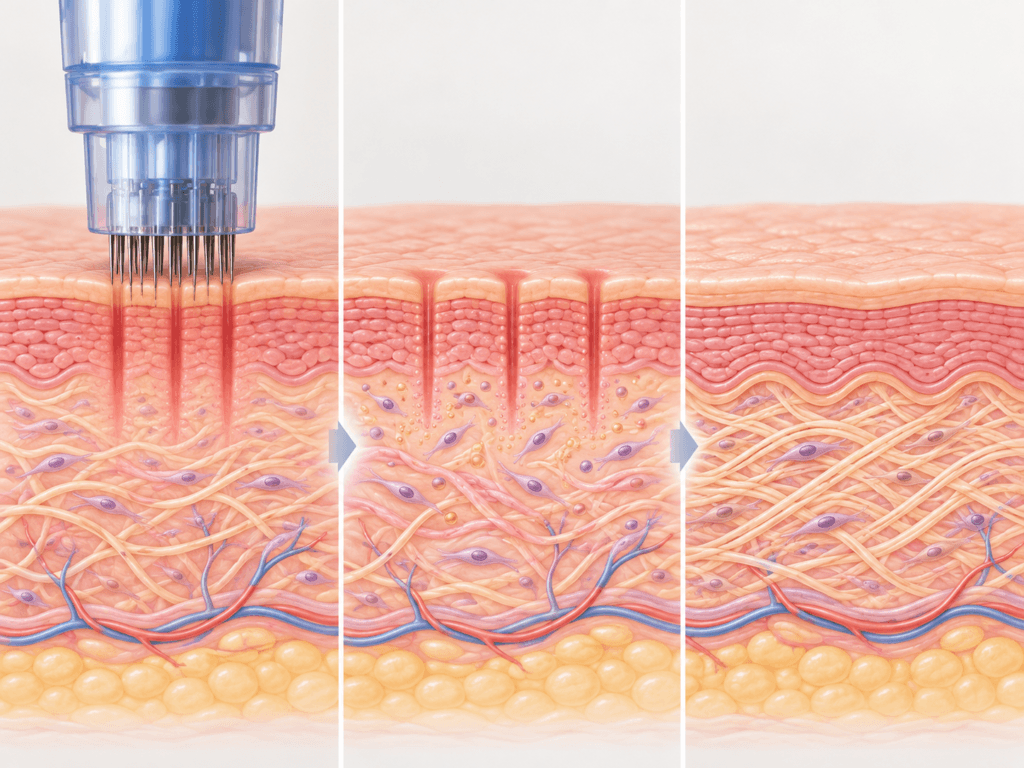
The controlled micro-injuries created by the needles stimulate the skin’s natural wound-healing mechanisms. In the early phase, inflammatory signalling is activated, followed by fibroblast activity, cellular signalling, collagen and elastin metabolism, and remodelling of the extracellular matrix.
For this reason, the effect of Dermapen does not depend only on any serum or product applied during treatment. Microneedling itself is also a biological stimulus.
With the device we use in our clinic, the needle depth can be adjusted to approximately 0.5–2 mm. We do not use the same depth across the entire face or for every patient. More superficial settings may be preferred in thinner and more sensitive areas, while deeper settings may be considered in thicker or scarred areas when appropriate.
Deeper treatment does not automatically mean better treatment. Excessively aggressive microneedling may increase the risk of bleeding, prolonged redness, inflammation, delayed recovery and pigment changes. The appropriate depth should therefore be only as deep as the tissue requires, not as deep as possible.
What Can Dermapen Be Used For?
Microneedling may be considered in selected patients to support skin quality and texture. It can be used as one of the treatment options for fine lines, uneven skin texture, enlarged pore appearance, dull or tired-looking skin, mild atrophic acne scars and certain superficial scars.
Different areas of the face have different skin thicknesses and anatomical characteristics. The forehead, cheeks, perinasal area and chin may therefore require different treatment depths during the same session.
The skin of the neck is generally thinner and more sensitive than facial skin. In selected patients with fine lines, horizontal neck lines or reduced skin quality, microneedling may be used to support regenerative tissue response. However, it does not lift significant skin laxity or replace lost volume.
Microneedling can also be used on the scalp. The goal is not to create new follicles in areas where follicles are no longer present, but to support the local tissue response and, in selected patients, complement other hair-loss treatments. Scalp microneedling may be combined with PRP or exosome therapy where appropriate.
Acne Scars, Pores and Pigmentation
Microneedling may be useful in selected atrophic acne scars. Controlled injury within the dermis can stimulate tissue remodelling, but different scar types such as ice-pick, boxcar and rolling scars do not respond in the same way. Deeper or more pronounced scars may require combination treatment with other methods.
Pores are a normal part of skin anatomy and cannot be permanently eliminated. In some patients, microneedling may help pores appear less visible by improving skin texture and collagen organisation.
Pigmentation requires a more cautious approach. Some superficial pigmentation irregularities may improve as skin quality changes, but inflammation may worsen pigmentation in conditions such as melasma or in patients prone to post-inflammatory hyperpigmentation. Treatment depth, intensity and sun protection are especially important in darker skin types.
Dermapen with PRP, Mesotherapy and Exosome Therapy
Dermapen does not have to be combined with another product in every patient. In some cases, microneedling alone may be sufficient, while in others PRP, mesotherapy or exosome therapy may be incorporated into the same treatment plan according to the treatment goal.
PRP is platelet-rich plasma prepared from the patient’s own blood. Its biological mechanism differs from microneedling, but the two may be used together in selected patients for the face, neck or scalp.
Mesotherapy involves the injection of active substances such as hyaluronic acid, amino acids or other compounds into the skin. Dermapen and mesotherapy are not the same treatment, although they may be combined in selected patients when suitable products are used. Not every cosmetic product is appropriate for application after microchannels have been created, so the material used must be assessed for this purpose.
Exosome treatments may also be combined with microneedling on the face, neck or scalp in selected patients. Exosomes are extracellular vesicles released by cells; they are not stem cells. The aim is not to create unrealistic expectations such as “forming new skin”, but to support the existing regenerative tissue response.
For this reason, we do not use a single standard “Dermapen serum” for every patient. If an additional product is used, it is selected according to factors such as skin dryness, scar characteristics, fine lines, hair loss, overall skin quality and the patient’s treatment goals.
How Is Dermapen Performed?
Before treatment, the skin and the anatomical area are assessed. The area is cleansed and a topical anaesthetic cream may be applied when appropriate.
A sterile, single-use needle cartridge is moved across the skin in a controlled manner. Needle depth is adjusted according to the treatment area. Mild redness may be sufficient in more superficial applications, while pinpoint bleeding may occur during deeper scar treatments.
The procedure may be performed alone or combined with PRP, suitable mesotherapy products or exosome therapy according to the treatment plan.
How Many Sessions Are Needed?
There is no single standard number of Dermapen sessions suitable for everyone. Mild reduction in skin quality, pronounced acne scarring and scalp concerns do not require the same treatment protocol.
Treatment is often planned as several sessions at appropriate intervals. Rather than assigning the same fixed number of sessions to every patient in advance, we prefer to reassess according to how the skin or scalp responds to treatment.
After a single session, the skin may temporarily appear brighter or feel smoother, but collagen production and tissue remodelling take time. Particularly in scar and texture treatments, it is not appropriate to judge the final result within the first few days.
Recovery After Dermapen
Recovery time varies according to the treatment depth and intensity. During the first few hours, the skin may develop redness, warmth, mild tenderness and tightness similar to a mild sunburn. Redness may last longer after deeper treatments, and mild dryness or flaking can occur during the first few days.
Visible peeling is not required for the treatment to have worked. Unlike a chemical peel, the purpose of microneedling is not necessarily to produce obvious shedding of the skin.
During the early recovery period, aggressive cleansers, retinoids, strong acids, peeling products and irritating active ingredients are generally avoided. Moisturiser and appropriate sun protection are important parts of aftercare. If PRP, mesotherapy or exosome therapy is used in the same session, aftercare instructions may be adjusted accordingly.
Who May Not Be Suitable for Dermapen?
Microneedling may need to be postponed in patients with active bacterial or viral skin infections, active herpes, open wounds, significant inflammatory acne or active dermatitis in the treatment area.
Treatment decisions should also be made more cautiously in patients with conditions affecting wound healing or a significant tendency to develop keloid scars.
For this reason, microneedling should not be viewed simply as a routine “skin care” procedure. The patient’s skin structure and existing concerns should first be assessed.
Possible Side Effects
Microneedling is a controlled treatment, but it is not completely risk-free. Temporary redness, tenderness, swelling, pinpoint bleeding, bruising and dryness may occur.
Less commonly, infection or post-inflammatory hyperpigmentation can develop. Pigment changes are particularly relevant in darker skin types, after overly aggressive treatment or following significant sun exposure during recovery.
Selecting the appropriate treatment depth and intensity according to the patient’s individual needs is therefore one of the most important aspects of treatment planning.
Dermapen vs Dermaroller
Dermapen and dermaroller are based on the same basic principle of microneedling, but the way the needles enter the skin differs.
With a dermaroller, the needles are mounted on a rotating cylinder and may enter the skin at varying angles. With Dermapen, the needles move more vertically and in a controlled manner using a motorised system. Needle depth can also be adjusted during treatment according to the anatomical area.
This can make it easier to tailor treatment across facial areas where skin thickness varies.
At-Home Dermapen Use
At-home microneedling devices are not equivalent to professional microneedling performed in a clinical environment. Particularly with longer needles, sterilisation, correct anatomical depth, infection risk, pigmentation risk and the suitability of products applied over newly created microchannels become important considerations.
Not every cosmetic product is safe to apply after microchannels have been created. For this reason, we prefer professional-depth microneedling treatments to be performed under controlled clinical conditions.
Our Approach to Dermapen
At our clinic, we do not consider Dermapen to be a standard device-based treatment. We approach it as a microneedling procedure individually planned according to the patient and the tissue being treated.
We adjust needle depth between approximately 0.5 and 2 mm according to the thickness of the anatomical area, skin or scar characteristics and the treatment goals. Where appropriate, microneedling may be combined with PRP, mesotherapy or exosome therapy, while in some patients it may be performed alone.
Skin dryness, acne scars, fine lines, overall skin quality and scalp concerns do not have the same biological requirements. The important point is therefore not simply to “perform Dermapen”, but to determine which patient is suitable, what depth should be used and how microneedling should fit into the overall treatment plan.