
PRP Treatment: Hair, Face, Under-Eye and Neck Applications in Istanbul
PRP is a regenerative treatment based on applying plasma prepared from the patient’s own blood and enriched with platelets to selected tissues. PRP stands for Platelet-Rich Plasma. Platelets are not only involved in blood clotting; they also play a role in the release of various growth factors and biological signals during tissue healing. For this reason, PRP can be used in the scalp, face, eye area, neck and other tissue-healing applications.
At our clinic, we use PRP particularly for hair loss, support of skin quality, facial and neck rejuvenation and selected under-eye treatments. The treatment plan is personalised according to the treatment area and the patient’s individual needs.
What Is PRP and How Is It Prepared?
PRP is platelet-rich plasma obtained from the patient’s own blood. First, a certain amount of venous blood is collected, transferred into special tubes and separated into its components by centrifugation.
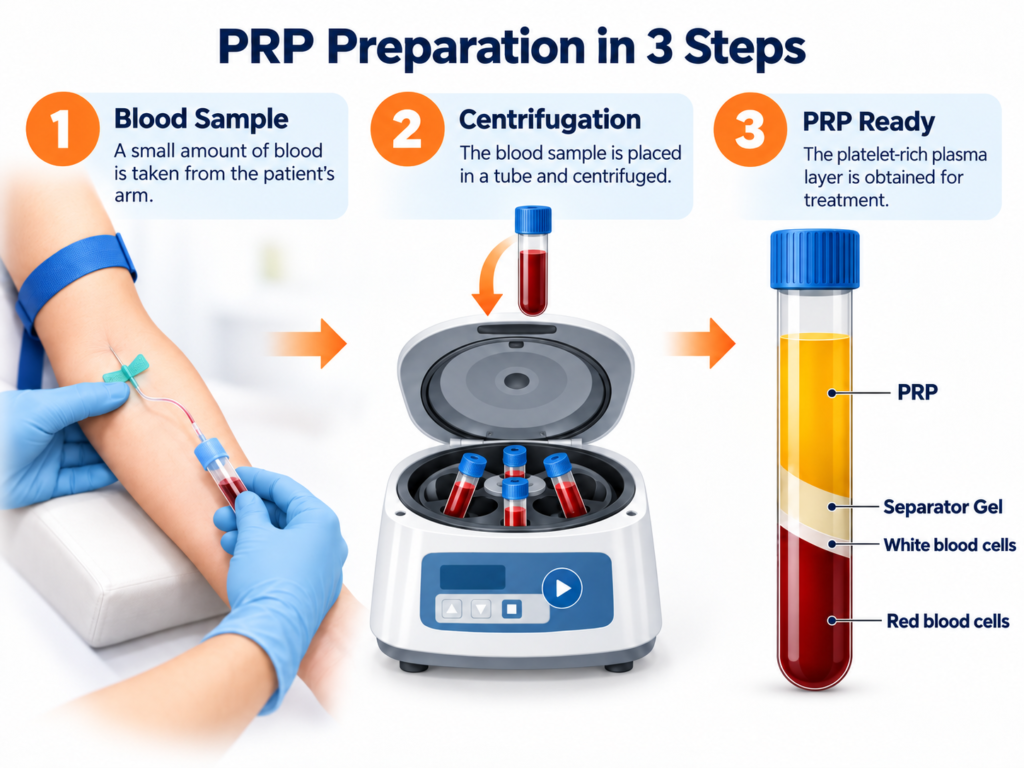
This process produces the platelet-rich plasma fraction, which is then applied to the treatment area. PRP is an autologous treatment, meaning that the biological material used comes from the patient’s own blood. This makes it different from conventional fillers or externally prepared biological products.
Why Are Platelets Important in PRP?
Platelets contain various biological mediators involved in tissue healing. These may include growth factors such as PDGF, TGF-β, VEGF, EGF, FGF and IGF. These molecules play roles in processes such as cell migration, proliferation, blood vessel formation and regulation of the extracellular matrix.
The purpose of PRP is not to physically fill the tissue, but to support the body’s existing healing and regenerative mechanisms. For this reason, its effects should be evaluated differently from those of a volumising filler treatment.
Why Does the PRP System Matter?
PRP preparation methods and kits are not all the same. Different systems may produce preparations that vary in platelet concentration, leukocyte content, red blood cell contamination and plasma volume.
At our clinic, we use RegenLab PRP systems. In this system, blood is centrifuged within a closed tube system and the PRP fraction is prepared. According to the manufacturer, the system produces a standardised PRP preparation with reduced leukocyte content and substantial removal of red blood cells.
What Does PRP Do?
The aim of PRP varies depending on the area being treated. On the scalp, the objective is to support the biological environment around existing hair follicles. On the face, around the eyes and on the neck, the focus may be on skin quality, fine lines and tissue renewal.
PRP is not a filler that creates significant volume, and it should not be considered a lifting procedure that physically elevates tissue. The main goal is to support the biological quality of the tissue.
PRP Treatment for Hair
Hair loss is one of the common areas in which PRP is used. It may be considered as a supportive treatment in some forms of hair loss where the follicles are still present but the hair shafts have become thinner.
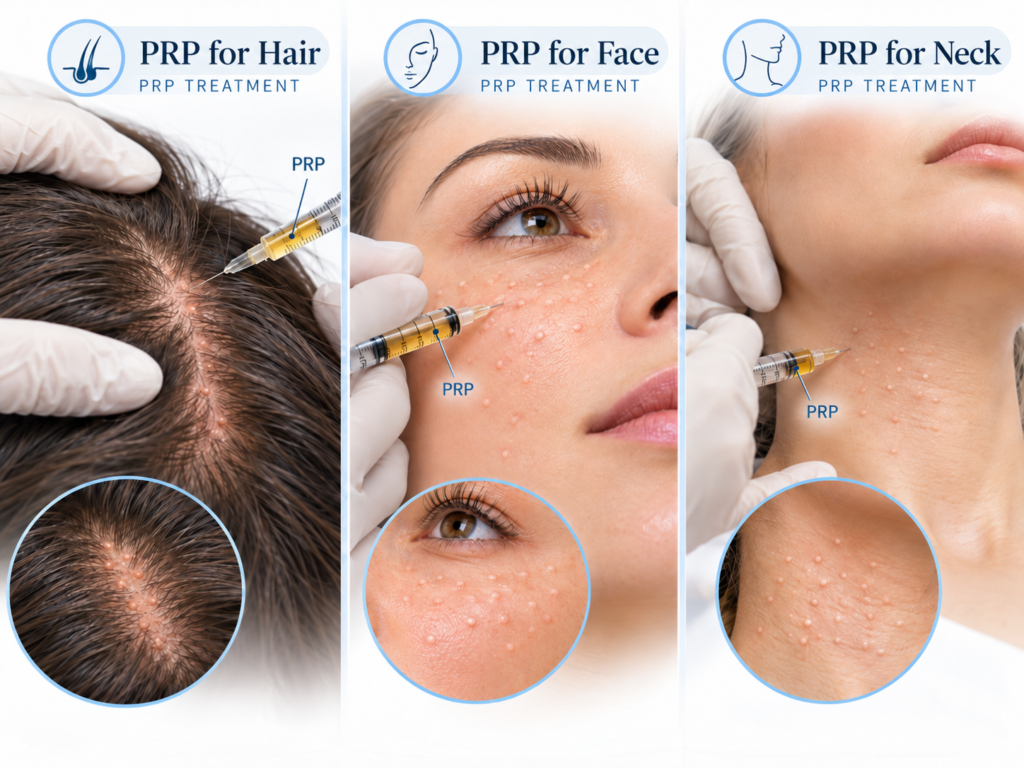
PRP is prepared from the patient’s blood and injected in small amounts into areas where hair loss or thinning is most noticeable. The aim is to create a regenerative biological stimulus in the tissue surrounding the hair follicles.
Can PRP Grow New Hair?
It would not be accurate to describe PRP as a treatment that guarantees new hair growth. Patients who are expected to benefit most are generally those whose hair follicles are still present but producing thinner hair.
It is not realistic to promise that PRP can recreate hair follicles that have been completely lost for a long period of time. For this reason, the type and degree of hair loss should be assessed before treatment.
Which Types of Hair Loss Can PRP Be Used For?
PRP may be considered as a supportive treatment particularly in androgenetic hair loss. However, not all hair loss is caused by androgenetic alopecia.
Iron deficiency, thyroid disorders, hormonal problems, autoimmune conditions, certain medications, severe stress and nutritional deficiencies can also contribute to hair loss. In cases of unexplained or rapidly progressing hair loss, the underlying cause should be investigated first.
Facial PRP Treatment
The aim of PRP treatment on the face is not to create structural volume, but to support skin quality and natural regenerative processes. In selected patients, it may be considered for fine lines, dull or tired-looking skin, reduced skin quality and mild loss of elasticity.
Conventional PRP is not a dermal filler. It does not create significant structural volume in areas such as the cheeks, lips or chin. If there is a true volume deficiency in these areas, hyaluronic acid fillers or fat transfer may be more appropriate options.
PRP and Hyaluronic Acid Combination
In some patients, we prefer treatments that combine PRP with hyaluronic acid. For this purpose, we use the RegenLab Cellular Matrix system. This system combines PRP prepared from the patient’s own blood with non-crosslinked hyaluronic acid in the same preparation.
Hyaluronic acid has a high water-binding capacity and is naturally present in the extracellular matrix of the skin. The aim of combining it with PRP is to bring together the regenerative biological support of PRP with the hydration and tissue-support properties of hyaluronic acid. Because the hyaluronic acid used is non-crosslinked, this treatment should not be considered equivalent to conventional volumising fillers.
PRP and Hyaluronic Acid for the Under-Eye Area
The under-eye area requires separate assessment because of its thin skin and delicate anatomy. In selected patients, PRP or a PRP-hyaluronic acid combination may be used for under-eye skin quality, fine lines and a tired appearance.
Prominent under-eye bags are usually caused by anatomical protrusion of the fat pads. PRP does not remove these fat pads. If there is significant fat bulging, excess skin or eyelid laxity, lower eyelid surgery, or blepharoplasty, may be a more appropriate option.
The under-eye area is also prone to swelling because of its lymphatic anatomy and thin tissue structure. For this reason, injectable treatments should be assessed carefully in patients with significant oedema or malar bags.
PRP Treatment for the Neck
The skin of the neck can be relatively thin, and with age, reduced skin quality, loss of elasticity and horizontal neck lines may become more noticeable. In selected patients, PRP may be used to support overall skin quality and the regenerative response of the neck.
PRP does not physically lift significant neck sagging. In patients with more advanced skin laxity, HIFU, surgical neck lift or other treatment options may be more appropriate.
Our PRP Approach at Anka Plastic Surgery
At our clinic, we do not view PRP as a single standard “rejuvenation injection”. We tailor the treatment according to the area being treated and the patient’s individual needs.
For the scalp, our aim is to support the biological environment around existing hair follicles. On the face and neck, we use PRP to support skin quality and subtle signs of ageing. In the under-eye area, when the anatomy is suitable, we may use conventional PRP or combinations of PRP with non-crosslinked hyaluronic acid.
We use RegenLab systems for conventional PRP preparation and Cellular Matrix technology when combining PRP with hyaluronic acid. For us, the key point is not the product name itself, but using the right treatment in the right anatomical area and for the right indication.
Conclusion
PRP is an autologous treatment in which platelet-rich plasma prepared from the patient’s own blood is used for regenerative purposes. It may be used to support the biological environment around existing hair follicles on the scalp, improve skin quality on the face and neck, and provide regenerative support in selected under-eye patients.
In some patients, PRP may also be combined with non-crosslinked hyaluronic acid. These treatments are not the same as conventional volumising fillers, stem cell treatments or exosome therapies. The most appropriate approach should be selected according to the actual cause of the patient’s hair or skin concern and their individual anatomy.
Frequently Asked Questions
Can PRP Reduce Fine Wrinkles?
PRP may improve the appearance of fine lines in some patients by supporting skin quality. However, it would not be realistic to expect it to completely remove deep wrinkles.
The cause and type of the wrinkle are important when choosing treatment. Expression lines, volume loss and advanced skin laxity may require different treatment approaches.
How Many PRP Sessions Are Recommended?
We generally plan PRP treatment as a course of 3 sessions at 2-week intervals. This initial protocol may be used for hair, face, under-eye and neck treatments according to the patient’s needs.
After the initial 3 sessions are completed, follow-up is planned according to the clinical response. In suitable patients, one maintenance PRP session per year may be performed to support the treatment effect.
When Will I See the Results of PRP?
Because PRP is not a filler, its results are not assessed by an immediate increase in volume after treatment. Biological processes in the skin and hair tissues take time.
For this reason, changes may become more noticeable over the following weeks and months. The duration and degree of improvement can vary depending on the treatment area and the patient’s individual biological response.
Is PRP Permanent?
PRP is not a permanent implant. Skin and hair continue to age and undergo biological changes, so the effects may gradually decrease over time.
Repeat treatments may be considered in selected patients. PRP can therefore be viewed as a regenerative treatment that may be repeated when clinically appropriate.
What Happens After PRP Treatment?
Temporary redness, tenderness, mild swelling or small bruises may occur in the treated area. Short-term sensitivity may also occur at injection points on the scalp.
Swelling may be somewhat more noticeable in the under-eye area than in other facial regions. These effects are generally temporary and may vary depending on the treatment area.
What Should I Avoid After PRP?
It may be advisable to avoid unnecessary pressure or vigorous massage over the treated area during the first hours after treatment. Strenuous exercise, sauna and excessive heat exposure may also be postponed for a short period.
Sun protection is important after skin treatments. Specific aftercare recommendations may vary according to the area treated and the technique used.
What Are the Side Effects and Risks of PRP?
Because PRP is prepared from the patient’s own blood, it is not a foreign biological material. However, this does not mean that the procedure is completely risk-free.
The most common side effects include pain, bruising, redness, tenderness and temporary swelling at the injection site. More rarely, infection or other injection-related complications may occur. For this reason, preparation and treatment should be performed under sterile conditions using appropriate medical systems.
Can PRP Cause an Allergic Reaction?
Because conventional PRP is prepared mainly from the patient’s own blood, the risk of an allergic reaction related to foreign proteins is low.
However, the contents of the preparation kit and any additional substances used together with PRP should also be considered. For example, in PRP-hyaluronic acid combinations, hyaluronic acid is a separate component of the treatment.
Is PRP the Same as Mesotherapy?
No. PRP is an autologous product prepared from the patient’s own blood. Mesotherapy may involve externally prepared ingredients such as hyaluronic acid, amino acids or polynucleotides.
Both treatments may be delivered by injection, but their contents and biological mechanisms are different.
Is PRP the Same as Exosome Therapy?
No. PRP is platelet-rich plasma, whereas exosomes are extracellular vesicles released by cells.
They are biologically different products with different mechanisms of action and should not be used interchangeably.
Is PRP the Same as Stem Cell Treatment?
No. PRP is not a stem cell treatment. It mainly contains plasma, platelets and platelet-derived biological factors.
Cell-based treatments such as adipose-derived SVF belong to a different category of regenerative therapies.