
Gynecomastia Surgery (Male Breast Reduction) in Turkey
Gynecomastia is a condition in which the male chest becomes more prominent because of an increase in breast tissue, fat, or a combination of both. It is commonly referred to as male breast enlargement.
Many patients who contact Anka Plastic Surgery describe a similar concern:
“I exercise and I have lost weight, but my chest still has not improved.”
The reason is that not every case of male breast enlargement is the same. In some patients, the problem is mainly excess fat. In others, there is true glandular breast tissue beneath the nipple, which does not disappear completely with weight loss or exercise.
Gynecomastia can also affect confidence and daily life. Some patients avoid fitted T-shirts, swimming, changing rooms or situations where the chest is exposed.
At Anka Plastic Surgery, treatment planning is based on the amount of glandular tissue, fat distribution, skin elasticity and nipple position.
Our aim is to create a natural male chest contour using the least extensive surgical approach appropriate for the patient. Whenever possible, liposuction is used first. If firm glandular tissue remains beneath the nipple, it can be removed through a short incision along the lower border of the areola.
What Are the Different Types of Gynecomastia?
Gynecomastia is not the same in every patient. Identifying which tissue is responsible for the enlargement is an important part of treatment planning.
True Gynecomastia
In true gynecomastia, the main problem is enlargement of glandular breast tissue.
A firm or rubbery area may be felt beneath the nipple.
Possible causes include hormonal changes during puberty, certain medications, hormonal disorders or cases where no specific cause can be identified.
Once glandular breast tissue has developed, weight loss and chest exercises alone may not be sufficient to correct the appearance.
Pseudogynecomastia
In pseudogynecomastia, the enlargement is mainly caused by excess fatty tissue rather than enlarged breast glands.
Weight loss may reduce chest volume, but some patients continue to have localised fat even after reaching a healthy weight.
In these cases, liposuction may be sufficient.
Mixed Gynecomastia
This is one of the most common patterns seen in clinical practice.
Both excess fat and glandular breast tissue are present.
Liposuction is often performed first. If a firm glandular component remains beneath the nipple, it may then be removed through a small periareolar incision.
Grades of Gynecomastia
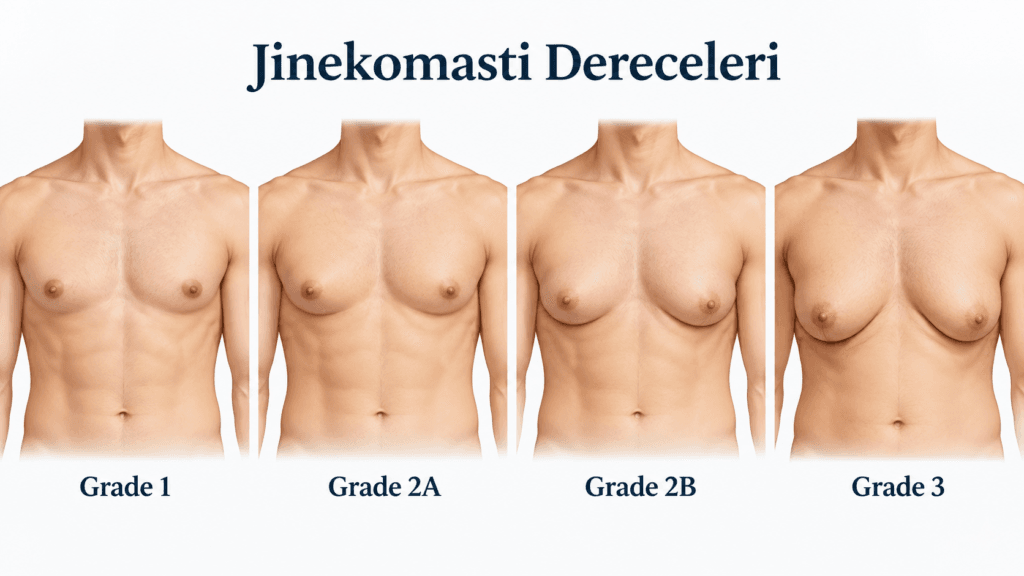
The grade of gynecomastia depends on the amount of breast enlargement and the degree of excess skin.
Grade 1
There is mild enlargement with little or no excess skin.
Liposuction alone may be sufficient in some patients. If a firm glandular component is present, it can be removed through a small incision.
Grade 2A
The enlargement is more noticeable, but there is minimal or no skin excess.
Liposuction combined with limited glandular excision is often sufficient.
Grade 2B
Breast enlargement is accompanied by mild skin excess.
In patients with good skin elasticity, the skin may gradually contract after treatment. Additional skin removal may occasionally be necessary.
Grade 3
There is significant breast enlargement together with marked excess skin.
Liposuction alone is usually not sufficient. Glandular tissue and, when necessary, excess skin may also need to be removed.
The incision pattern is determined according to the amount of skin excess and the position of the nipple.
Our Surgical Approach to Gynecomastia
At Anka Plastic Surgery, the aim is to achieve a natural male chest contour while keeping scars as limited as reasonably possible.
In mild and moderate gynecomastia, liposuction with or without limited glandular excision is often sufficient.
When there is more significant skin excess, skin removal around the areola may be necessary. In advanced Grade 3 cases, a wider scar pattern may occasionally be required to achieve an appropriate chest contour.
The surgical plan is therefore tailored to the individual anatomy rather than applying the same technique to every patient.
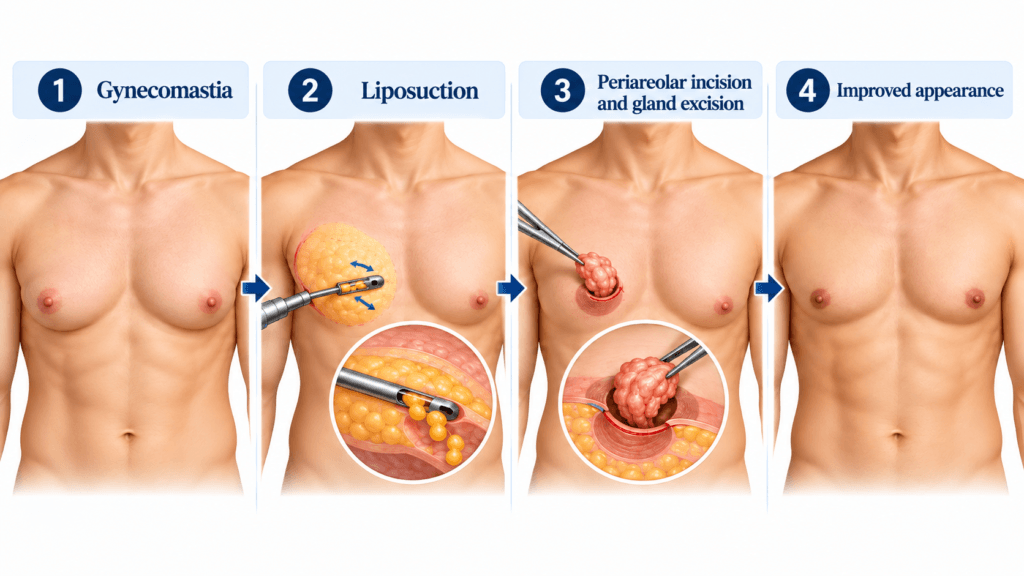
How Is Gynecomastia Surgery Performed?
Gynecomastia surgery aims to reduce excess fat, enlarged glandular tissue and, in more advanced cases, excess skin in order to create a more natural male chest contour.
Whenever appropriate, liposuction is used as the first step to reduce excess fatty tissue and shape the chest.
If firm glandular tissue remains beneath the nipple, it can be removed through an approximately 2–3 cm incision along the lower half of the areola.
In patients with good skin elasticity, the skin may gradually adapt to the new chest contour after liposuction. If there is significant skin excess, additional skin removal may be necessary.
The operation is performed under general anaesthesia and usually takes approximately 1–2 hours.
A compression garment is applied after surgery. Patients may usually leave hospital the same day or stay overnight when clinically appropriate.
Recovery After Gynecomastia Surgery
Mild discomfort, tightness, bruising and swelling can occur during the early recovery period.
A compression garment is usually worn for the period recommended by the surgical team to help control swelling and support the new chest contour.
Patients with desk-based work can often return to work within approximately 3–7 days.
Walking can begin early, but heavy lifting and strenuous upper-body exercise should initially be avoided.
Weight training and exercises that place significant stress on the chest muscles can usually be resumed after approximately 4–6 weeks, depending on recovery.
Swelling gradually decreases over the following weeks, while the chest contour becomes more defined. Scar maturation and final tissue settling can continue for several months.
Risks of Gynecomastia Surgery
As with any surgical procedure, gynecomastia surgery carries potential risks.
These may include:
- bleeding or haematoma,
- infection,
- seroma,
- temporary swelling and bruising,
- temporary changes in nipple sensation,
- contour irregularity or asymmetry,
- and, occasionally, the need for additional correction or revision.
The individual risk profile depends on the surgical technique, amount of tissue removed, skin quality and healing characteristics.
One important technical consideration is avoiding excessive removal of glandular tissue directly beneath the nipple.
Removing too much tissue can create a depressed or adherent appearance around the nipple-areola complex.
For this reason, at Anka Plastic Surgery the aim is not simply to remove as much tissue as possible, but to preserve a natural transition between the nipple area and the surrounding chest wall.
Gynecomastia Surgery Cost
The cost of gynecomastia surgery depends on the surgical technique and the extent of treatment required.
The overall plan may differ depending on whether treatment involves:
- liposuction alone,
- liposuction combined with glandular excision,
- or additional skin removal.
For international patients, treatment packages may include surgery, hospital fees, surgeon fees, accommodation and VIP airport transfers.
A preliminary assessment can often be performed using clear photographs taken from the front and side, followed by an in-person consultation when the patient arrives in Istanbul.
Frequently Asked Questions
Can gynecomastia go away on its own?
Gynecomastia that develops during puberty may improve spontaneously within 1–2 years.
Long-standing gynecomastia in adults is less likely to disappear completely without treatment.
Will losing weight improve gynecomastia?
If the enlargement is mainly caused by excess fat, weight loss may improve the appearance considerably.
However, if enlarged glandular tissue is present, a firm projection beneath the nipple may remain even after reaching an ideal weight.
Can exercise get rid of gynecomastia?
Chest exercises can improve muscle definition and overall body shape, but they cannot remove enlarged glandular breast tissue.
Is liposuction or gland excision better?
Neither technique is universally better.
The correct treatment depends on the type of tissue present.
Liposuction may be sufficient when excess fat is the main problem. If a firm glandular component remains beneath the nipple, limited surgical excision may also be required.
Will gynecomastia surgery leave scars?
Liposuction requires only small access incisions.
If glandular tissue needs to be removed, the incision is usually placed along the natural colour transition at the lower border of the areola, where the scar can become less noticeable over time.
Can gynecomastia return after surgery?
Recurrence is possible if an underlying hormonal condition remains untreated, anabolic steroid use continues, or there is significant weight gain.
Can gynecomastia affect only one side?
Yes.
Gynecomastia may occur on one side only or may be significantly more pronounced on one side than the other.
Treatment is planned individually for each side.
Can gynecomastia surgery be performed in patients who use anabolic steroids?
Surgery may be performed, but continued anabolic steroid use can increase the risk of glandular tissue enlarging again.
When should adolescent gynecomastia be treated surgically?
Many cases of pubertal gynecomastia improve spontaneously, so a period of observation is usually appropriate.
Surgery may be considered when the condition persists or significantly affects the patient’s quality of life.
Can gynecomastia be a sign of breast cancer?
Gynecomastia and male breast cancer are different conditions.
However, a rapidly enlarging unilateral mass, a hard or irregular lump, nipple retraction or bloody nipple discharge should be medically evaluated.