
Dermal Fillers and Hyaluronic Acid Face Fillers in Turkey
Dermal fillers are injectable treatments used to restore selected areas of facial volume, soften certain folds and lines, and improve facial contours without surgery.
At Anka Plastic Surgery, we primarily use hyaluronic acid fillers.
Our approach is not to add as much volume as possible or to treat every visible line. Instead, we assess the structure of the whole face and place filler only where additional support or contour correction is genuinely useful.
Hyaluronic acid is our preferred filler material because it has been used in aesthetic medicine for many years, is available in different formulations for different facial regions and, importantly, can be dissolved with hyaluronidase when necessary.
What Are Dermal Fillers?
Dermal fillers are injectable materials designed to add volume or structural support beneath the skin.
Depending on where they are placed, fillers can be used to:
- restore age-related volume loss,
- improve facial proportions,
- support the cheeks and midface,
- define the lips or chin,
- soften folds,
- improve selected depressions,
- and refine facial contours.
The term “filler” covers different materials, but in our practice we mainly use hyaluronic acid-based products.
What Is Hyaluronic Acid?
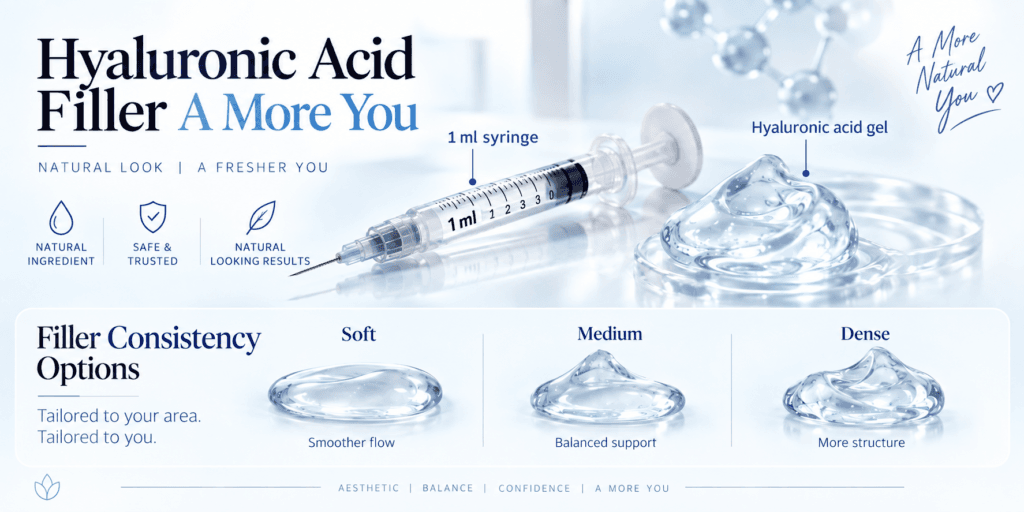
Hyaluronic acid is a molecule naturally found in the human body.
It has a strong ability to bind water and contributes to tissue hydration and volume.
Hyaluronic acid fillers used in aesthetic medicine are specially formulated with different levels of firmness, elasticity and cohesivity.
This is important because a product used deep over bone for structural support should not necessarily have the same properties as a product used in the lips or in fine superficial lines.
For this reason, filler treatment is not simply about how many millilitres are used. It is also about which product is placed in which anatomical layer and for what purpose.
Why Do We Prefer Hyaluronic Acid Fillers?
Several types of injectable fillers have been developed over the years.
Our preference for hyaluronic acid is based on a combination of experience, versatility and reversibility.
Hyaluronic acid fillers have a long history of use in aesthetic medicine and can be selected according to the needs of different facial areas.
Most importantly, they can be dissolved using hyaluronidase when clinically necessary.
This can be valuable if:
- excessive volume has been placed,
- a patient no longer likes the result,
- a filler needs to be adjusted,
- or a rare vascular complication is suspected.
One of the hyaluronic acid product ranges we use is Juvéderm®, although the properties of the filler and its suitability for the intended anatomical area are more important than the brand name alone.
What Is the Aim of Face Filler Treatment?
The aim is not to make the face generally fuller.
A well-planned filler treatment should correct a specific deficiency while preserving the patient’s natural facial identity.
We therefore assess:
- facial bone structure,
- soft-tissue volume,
- fat compartments,
- skin quality,
- lip-to-chin proportions,
- profile,
- and facial asymmetry.
Sometimes a small amount of filler placed in the correct structural point can improve facial balance more effectively than larger volumes injected directly into the most visible line.
Which Areas Can Be Treated With Dermal Fillers?
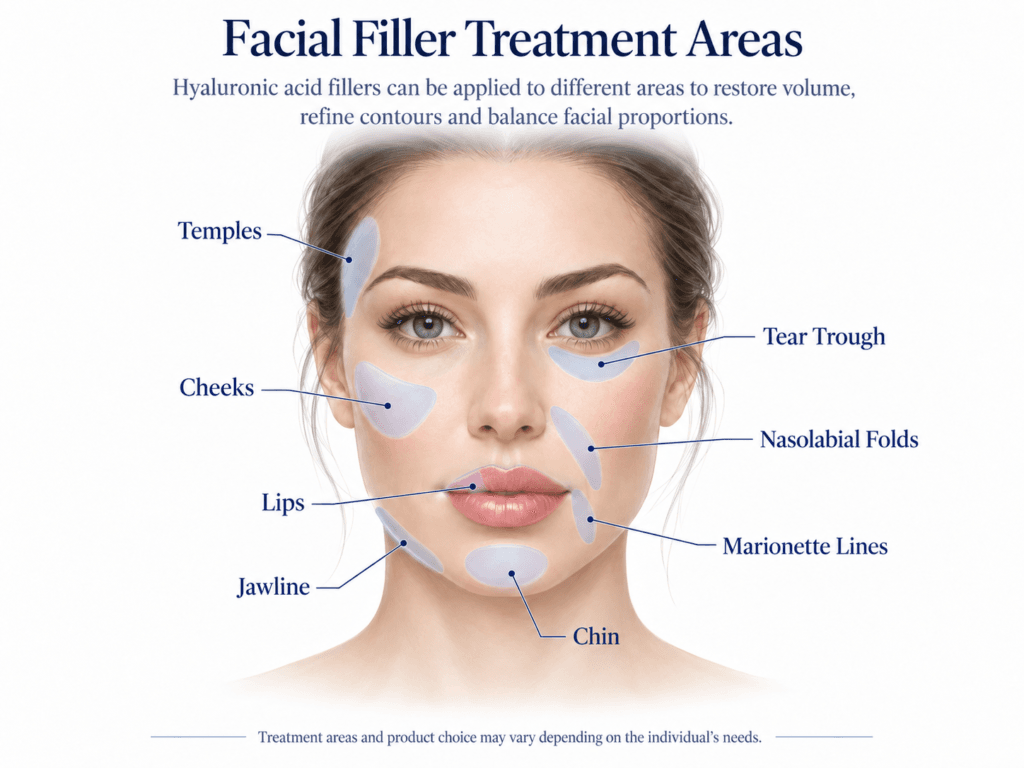
Hyaluronic acid fillers can be used in several parts of the face, but each region requires a different anatomical approach.
Common treatment areas in our practice include:
- cheeks,
- anterior maxilla and midface,
- lips,
- nasolabial folds,
- marionette lines,
- chin,
- jawline,
- tear trough,
- temples,
- selected areas beneath the eyebrow,
- nose,
- selected forehead lines,
- and fine horizontal neck lines.
Cheek Filler
The cheeks are an important structural area of the face.
With ageing, the midface can lose volume and support. Some patients also naturally have relatively flat cheek projection.
Carefully placed filler over the cheekbone can improve projection and support the midface.
The objective is not to create exaggerated cheekbones.
We aim to restore or improve proportionate structural support appropriate to the patient’s face.
Anterior Maxillary and Midface Filler
Sometimes a deep nasolabial fold is not primarily caused by a lack of volume within the fold itself.
Reduced projection or support in the anterior maxillary region can contribute to a deeper appearance around the nose and upper lip.
In selected patients, supporting the anterior maxilla and central midface can improve facial balance without heavily filling the nasolabial fold directly.
This is one reason we evaluate facial structure before treating individual lines.
Lip Filler
Lip filler can be used to:
- increase volume,
- improve symmetry,
- support the lip border,
- or restore age-related loss of definition.
Not every patient needs significant enlargement.
In some patients, a subtle correction of contour or asymmetry is sufficient.
Our preference is to avoid lip volume that becomes disproportionate to the chin, nose and rest of the face.
Nasolabial Fold Filler
Nasolabial folds are natural facial creases extending from the sides of the nose toward the corners of the mouth.
They should not necessarily be completely erased.
These folds can become more prominent because of midface volume changes and tissue descent.
Treatment may involve direct filler placement in the fold, but in some patients it is more appropriate to first support the cheek or anterior maxillary region.
This helps avoid creating unnecessary heaviness around the mouth.
Marionette Line Filler
Marionette lines extend downward from the corners of the mouth toward the chin.
Their appearance can result from a combination of volume loss, tissue descent and muscle activity.
Small amounts of filler can improve selected cases.
However, when there is significant lower-face laxity, repeatedly filling the area may create excess volume without treating the underlying tissue descent.
In these patients, other treatment options may be more appropriate.
Chin Filler
The chin plays an important role in facial profile and lower-face balance.
Hyaluronic acid filler can be used to increase projection or improve minor asymmetry in selected patients.
The chin should always be evaluated in relation to the lips, nose and jawline.
When there is substantial skeletal retrusion, filler may be insufficient and more definitive options such as a chin implant or genioplasty can be considered.
Jawline Filler
Jawline filler can improve definition of the lower facial border in selected patients.
It may be useful when the mandibular contour is weak or when the transition between the chin and jawline lacks definition.
However, excessive filler in this area can make the lower face appear unnecessarily broad or heavy.
For this reason, jaw width, facial shape and chin projection should all be considered before treatment.
Tear Trough Filler
The tear trough is the depression extending from the inner lower eyelid toward the cheek.
When this area is hollow, it can create a persistently tired appearance.
In carefully selected patients, small amounts of hyaluronic acid filler may soften the transition between the lower eyelid and cheek.
Is Tear Trough Filler Suitable for Everyone?
No.
Tear trough filler is not a treatment for every under-eye problem.
Patients with significant eye bags, lower eyelid laxity or excess skin may be better candidates for lower blepharoplasty.
The under-eye region is also prone to swelling and fluid retention, so conservative patient selection and product choice are particularly important.
Temple Filler
The temples can lose volume with age, creating a more hollow or bony appearance in the upper face.
Hyaluronic acid filler can be used to restore selected temple volume and smooth the transition between the forehead, temple and cheek.
The temple contains important blood vessels and deeper anatomical structures, so this is a region where detailed anatomical knowledge is particularly important.
Filler Under the Eyebrow
Selected patients develop volume loss beneath the outer eyebrow.
A small amount of filler in the appropriate anatomical plane may support this area and create a subtle lifting effect.
This should not be confused with a true brow lift.
When there is significant brow descent, surgical or other lifting techniques may be more appropriate.
Non-Surgical Nose Filler
Hyaluronic acid filler can be used in selected patients to camouflage minor contour irregularities of the nose.
Potential uses include:
- small dorsal depressions,
- selected contour irregularities,
- and limited support of the nasal tip.
Nose filler does not make the nose physically smaller.
It works by adding carefully placed volume to create a smoother visual contour.
Patients with significant structural problems may be better candidates for rhinoplasty.
Filler for Fine Forehead Lines
Many forehead lines are caused by repeated muscle movement and are therefore primarily treated with botulinum toxin.
However, some static lines remain visible even when the muscle is relaxed.
In selected patients, very small amounts of appropriate hyaluronic acid filler may be used to support these persistent lines.
The forehead has an important vascular anatomy and should be treated with particular caution.
Filler for Fine Neck Lines
Horizontal neck lines can be present from a relatively young age and may become more noticeable over time.
In selected patients, carefully placed superficial hyaluronic acid filler can soften these lines.
Because the neck skin is thin, conservative product selection and volume are important.
How Are Dermal Fillers Performed?
Before treatment, the face is examined both at rest and during expression.
The treatment area and underlying cause of the concern are identified first.
The appropriate filler is then selected according to:
- anatomical region,
- depth of injection,
- desired structural effect,
- and tissue characteristics.
Depending on the area, filler may be injected with a needle or cannula.
Some treatments are placed deeply over bone, while others require more superficial placement.
There is therefore no single injection technique that is appropriate for the entire face.
How Much Filler Do I Need?
There is no standard number of millilitres that suits every face.
One patient may benefit from a small amount distributed across several key structural points.
Another patient with more significant age-related volume loss may require more product.
The amount should be determined by anatomy rather than by a pre-set “full face package”.
Our principle is to use enough filler to correct the deficiency without creating unnecessary volume.
How Long Do Dermal Fillers Last?
Hyaluronic acid fillers are temporary.
Duration varies according to:
- the specific product,
- treatment area,
- injection depth,
- facial movement,
- and individual metabolism.
Fillers in highly mobile areas may reduce more quickly, while deeper structural fillers in less mobile regions can last longer.
For this reason, one universal duration cannot be given for every filler treatment.
Do Hyaluronic Acid Fillers Completely Disappear?
Hyaluronic acid is gradually broken down over time.
However, the rate of degradation varies considerably.
In patients who have had repeated treatments, residual filler may sometimes remain longer than expected.
Before automatically adding more product, it is therefore useful to reassess how much volume is actually still present.
Can Dermal Fillers Be Dissolved?
Yes.
One of the main advantages of hyaluronic acid fillers is that they can be dissolved using hyaluronidase.
This allows unwanted or excessive filler to be reduced when appropriate.
Hyaluronidase can also play an important role in the management of certain filler complications.
The fact that hyaluronic acid can be reversed is one of the main reasons we prefer it over permanent filler materials.
Are Dermal Fillers Safe?
Dermal filler treatment is non-surgical, but it is still a medical procedure and is not completely risk-free.
More common temporary effects include:
- swelling,
- bruising,
- tenderness,
- redness,
- and temporary asymmetry.
Less common complications can include prolonged swelling, lumps, infection or visible or palpable product.
Vascular Occlusion and Dermal Fillers
One of the most important rare complications of filler treatment is vascular occlusion.
This occurs when filler enters or compresses a blood vessel and compromises blood supply to the surrounding tissue.
Depending on the vessel involved, this can cause tissue injury.
Certain areas, including the nose, forehead and regions around the eye, require particular caution because of their vascular connections.
Very rarely, severe vascular complications involving vision have been reported following filler injections.
This is why filler treatment should be considered an anatomy-dependent medical procedure rather than a simple beauty treatment.
The ability to dissolve hyaluronic acid with hyaluronidase is an important advantage when vascular compromise is suspected.
What Should You Avoid After Dermal Fillers?
Mild swelling, tenderness and redness can occur immediately after treatment.
Patients are generally advised not to apply unnecessary pressure or aggressive massage to the treated area unless specifically instructed.
Strenuous exercise, excessive heat and sauna may be temporarily avoided.
After lip or tear trough treatment, swelling can initially make the area appear fuller than the final result.
Post-treatment advice varies according to the region treated.
How Long Does Swelling Last After Fillers?
Swelling varies by anatomical area.
The lips and under-eye region are more prone to visible oedema than some other parts of the face.
Most early swelling improves gradually over the first several days.
The final aesthetic result should not be judged immediately after injection.
Dermal Fillers vs Botox
Dermal fillers and botulinum toxin work in completely different ways.
Botulinum toxin reduces selected muscle activity and is mainly used for dynamic expression lines.
Dermal fillers add volume or structural support.
Some patients benefit from both treatments because they address different components of facial ageing.
For example, a forehead line caused mainly by muscle movement may first require botulinum toxin rather than filler.
Dermal Fillers vs Fat Transfer
Both fillers and fat transfer can restore volume, but they are different treatments.
Hyaluronic acid filler can be performed without harvesting tissue from another part of the body and can be adjusted in small amounts.
It also has the advantage of being dissolvable.
Fat transfer uses the patient’s own fat and may be useful when larger areas require volume restoration.
However, fat must first be harvested and processed, and the amount that survives long term is variable.
The appropriate method depends on the location and amount of volume required.
Do We Use Permanent Fillers?
We do not routinely use permanent facial fillers.
The face changes continuously with ageing.
A permanent material that cannot easily be reversed can become difficult to manage many years later if facial anatomy changes or complications develop.
For this reason, the temporary and reversible nature of hyaluronic acid is an important part of our treatment philosophy.
Can Too Much Filler Make the Face Look Puffy?
Yes.
Filler should not be used to continuously add volume to every area of the face.
An overfilled appearance can develop when excessive product is repeatedly added without reassessing the underlying anatomy or existing filler.
Our approach is to treat the specific area that lacks structural support rather than trying to fill every line or hollow.
How Do We Assess the Face Before Filler Treatment?
We do not assess only the line or depression the patient points to.
For example, a deep nasolabial fold may partly result from reduced support higher in the midface.
Similarly, chin and jawline treatment should be planned in relation to the nose, lips and overall facial profile.
The face is therefore considered as a connected three-dimensional structure.
This helps us decide where filler is actually needed and where adding volume would be unnecessary.
Our Approach to Dermal Fillers
Our approach is based on selective anatomical correction rather than high-volume filling.
The areas we most frequently treat include the cheeks, anterior maxilla, lips, nasolabial folds, marionette lines, chin, jawline, tear trough and temples.
In selected patients, filler may also be used beneath the eyebrow, in the nose, or for fine static lines of the forehead and neck.
We prefer hyaluronic acid fillers because of their long clinical history, versatility and the ability to dissolve them when necessary.
The objective is not to create a visibly “filled” face.
It is to provide the right amount of support in the right anatomical location while preserving natural facial proportions.
Dermal Fillers in Turkey for International Patients
International patients considering dermal filler treatment in Istanbul can begin with an online preliminary assessment.
Photographs from the front and oblique views can help identify areas of volume loss and facial imbalance.
However, final filler planning is performed in person because facial movement, tissue quality and three-dimensional anatomy need to be assessed directly.
For patients who are also considering surgery, filler treatment should be planned in the context of the overall facial treatment strategy rather than automatically performed before surgery.
Conclusion
Dermal fillers can be used for a wide range of facial concerns, from cheek and midface support to lip contouring, chin and jawline definition, tear trough treatment and selected fine lines.
Successful filler treatment is not based on filling every line or using the largest possible volume.
Different facial regions require different products, injection depths and treatment strategies.
At Anka Plastic Surgery, we primarily use hyaluronic acid fillers because they are versatile, extensively used and reversible with hyaluronidase when required.
Our goal is to preserve the patient’s natural facial identity while improving specific areas of volume deficiency or structural imbalance.