
Blepharoplasty and Eyelid Surgery in Turkey
Blepharoplasty, commonly known as eyelid surgery or an eyelid lift, is a surgical procedure designed to improve age-related changes of the upper and lower eyelids.
Patients commonly seek eyelid surgery because they feel that they look tired even when well rested, because excess upper eyelid skin has begun to fold over the lashes, or because under-eye bags make them appear older than they feel.
Ageing around the eyes is not caused by skin alone. Changes in the eyelids may involve skin laxity, protruding fat pads, muscle tone, eyebrow position and loss of volume at the eyelid-cheek junction.
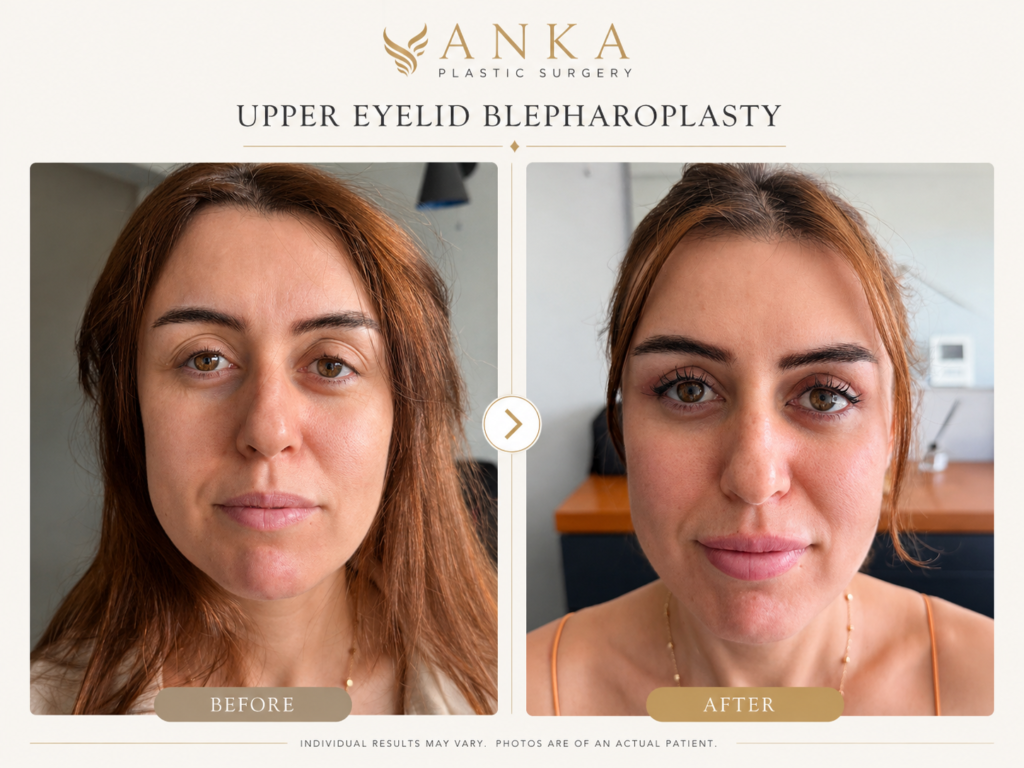
For this reason, our approach to blepharoplasty is not simply to remove as much skin or fat as possible. The aim is to preserve the patient’s natural eye shape while creating a more rested and balanced appearance.
What Is Blepharoplasty?
Blepharoplasty is cosmetic eyelid surgery performed to treat excess skin, prominent fat pads and contour changes around the upper or lower eyelids.
Depending on the patient’s anatomy, surgery may involve:
- upper eyelid surgery,
- lower eyelid surgery,
- or upper and lower eyelid surgery during the same operation.
The procedure is individually planned according to skin quality, fat distribution, eyebrow position, eyelid support and the relationship between the lower eyelid and cheek.
What Problems Can Eyelid Surgery Treat?
Blepharoplasty may be considered for patients with:
- excess upper eyelid skin,
- heavy or hooded upper eyelids,
- under-eye bags,
- prominent lower eyelid fat pads,
- a deep tear trough,
- an uneven eyelid-cheek transition,
- or a persistently tired appearance.
In selected patients, upper eyelid skin can become sufficiently redundant to interfere with the upper field of vision.
Upper Eyelid Surgery
The most common age-related change of the upper eyelid is loss of skin elasticity.
As the skin becomes more redundant, it may fold over the natural eyelid crease and eventually approach or rest on the eyelashes.
Upper blepharoplasty aims to remove only the amount of skin that is genuinely excessive while preserving normal eyelid closure and the patient’s natural eye shape.
Our Approach to Upper Blepharoplasty
In most of our patients, skin excision alone is sufficient.
We prefer a tissue-preserving approach and do not routinely remove muscle or fat unless there is a specific anatomical reason to do so.
If the upper eyelid is particularly full, a very limited strip of orbicularis muscle may occasionally be removed.
When there is marked fullness in the inner part of the upper eyelid, the medial fat pad can also be reduced in a controlled manner.
The objective is not to hollow the upper eyelid.
It is to remove genuine excess while maintaining a natural and youthful contour.
Where Is the Upper Eyelid Incision?
The incision is placed within the natural upper eyelid crease.
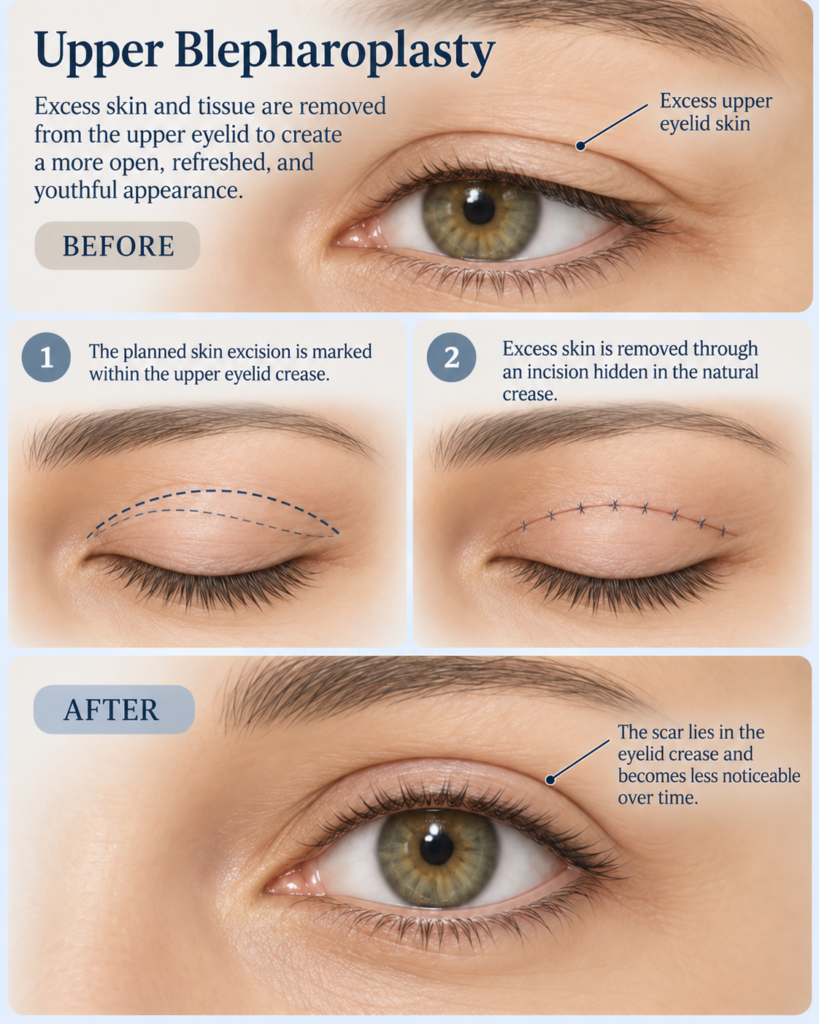
This allows the scar to sit inside an existing fold when the eye is open. During the first weeks, the scar may appear pink or slightly firm, but it usually becomes progressively less noticeable as healing continues.
No surgical procedure can be described as completely scar-free, but upper eyelid incisions are generally well concealed.
Lower Eyelid Surgery
Lower eyelid ageing is more complex than simply developing bags beneath the eyes.
Patients may also develop:
- protruding lower eyelid fat pads,
- skin laxity,
- a deepening tear trough,
- loss of volume around the orbital rim,
- and a more abrupt transition between the eyelid and cheek.
For this reason, modern lower blepharoplasty should not automatically consist of removing all visible fat.
Excessive fat removal can create a hollow or skeletonised appearance.
How Do We Perform Lower Blepharoplasty?
In our practice, lower eyelid surgery is commonly performed through a subciliary incision, positioned immediately below the eyelashes.
This approach allows us to assess both the lower eyelid skin and the underlying structures directly.
The three lower eyelid fat compartments are examined individually. Depending on the anatomy, prominent fat can be carefully reduced, preserved or repositioned.
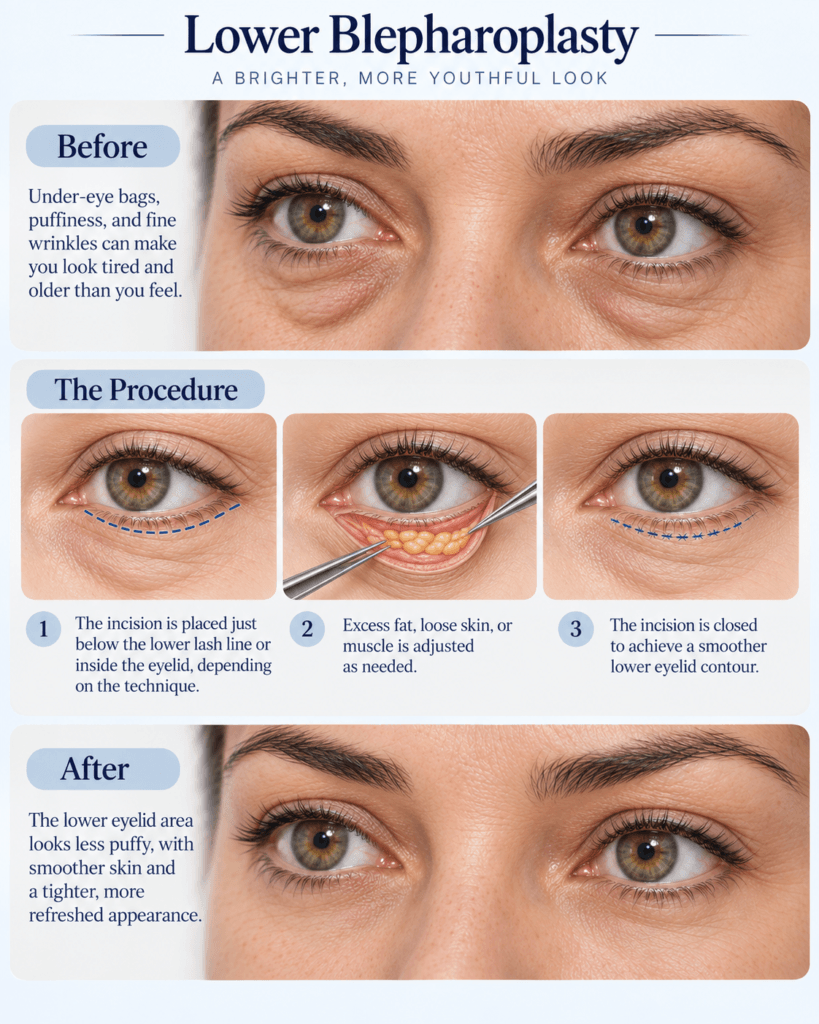
If excess skin is present, only the amount that can be safely removed without pulling the lower eyelid downward is excised.
Under-Eye Bags and Fat Pads
Under-eye bags frequently result from the natural orbital fat pads becoming more prominent.
In some patients, carefully reducing the excessive fat provides a smoother contour.
However, removing fat is not always the best solution.
If the transition between the eyelid and cheek is already hollow, further fat removal can make the area appear older rather than younger.
For this reason, the treatment strategy must consider both the bag and the surrounding volume.
Fat Repositioning in Lower Eyelid Surgery
In selected patients, lower eyelid fat can be released and repositioned rather than removed.
This technique may help smooth the transition between the lower eyelid and cheek and reduce the appearance of the tear trough.
The patient’s anatomy determines whether fat removal, fat repositioning or another technique is more appropriate.
Fat Grafting Around the Lower Eyelid
Some patients have significant volume deficiency at the lower orbital rim or eyelid-cheek junction.
In these cases, the patient’s own fat can be harvested from another body area, processed and injected in small amounts around the orbital rim.
Fat grafting may help soften a deep tear trough and provide a smoother transition between the eyelid and cheek.
It is not required in every lower blepharoplasty.
Upper and Lower Eyelid Surgery Together
Upper and lower eyelid surgery can be performed during the same operation when both areas require treatment.
This can provide a more balanced rejuvenation of the entire eye region and allows the patient to complete both procedures during a single recovery period.
However, the decision should be based on anatomy rather than automatically combining procedures.
Some patients require upper eyelid surgery only.
Others have more significant lower eyelid ageing and need treatment focused primarily on the under-eye region.
Is Blepharoplasty the Same as an Eyelid Lift?
The terms are often used interchangeably by patients.
“Eyelid lift” is a common non-medical term for blepharoplasty.
However, the eyelid itself is not simply lifted upward.
The operation involves reshaping excess skin, fat and sometimes other supporting tissues to improve the eyelid contour.
Eyelid Surgery and Brow Position
Not every patient who appears to have excess upper eyelid skin has an eyelid problem alone.
In some patients, the eyebrow has descended with age.
When the eyebrow moves downward, more skin becomes crowded over the upper eyelid and the patient may believe that all of the problem comes from the eyelid.
This is why we always assess brow position before planning upper blepharoplasty.
Can Blepharoplasty Be Combined With a Brow Lift?
Yes.
When significant brow descent contributes to upper eyelid heaviness, a brow lift may be combined with blepharoplasty.
The technique depends on:
- the degree of brow descent,
- hairline position,
- forehead anatomy,
- and where the brow requires elevation.
In selected patients, lifting the brow rather than simply removing additional eyelid skin produces a more natural result.
The aim is not to create an excessively high or surprised eyebrow position.
How Is Eyelid Surgery Performed?
The surgical technique depends on whether the upper eyelids, lower eyelids or both are being treated.
Upper eyelid surgery can often be performed under local anaesthesia with sedation.
For lower eyelid surgery or combined upper and lower blepharoplasty, general anaesthesia may be preferred for patient comfort.
During upper blepharoplasty, the incision is placed within the natural eyelid crease and the planned amount of redundant skin is removed.
If clinically necessary, limited muscle or medial fat pad treatment can be added.
During lower blepharoplasty, the incision is usually positioned just below the lashes. Fat pads, excess skin and the eyelid-cheek junction are then treated according to the patient’s anatomy.
The incisions are closed with fine sutures.
Many patients can leave the hospital or surgical facility on the same day.
Blepharoplasty Recovery
Recovery varies according to the extent of surgery and individual healing.
Because the eyelids have a rich blood supply, swelling and bruising are expected during the early postoperative period.
These changes are temporary.
First 24 Hours
During the first day, patients may experience:
- eyelid tightness,
- watering,
- temporary blurred vision from swelling or ointment,
- bruising,
- and oedema.
Keeping the head elevated and using cold compresses as instructed can help reduce swelling.
First Week
Swelling and bruising are usually most visible during the first few days and then gradually decrease.
Sutures are commonly removed during the first week when non-dissolving sutures have been used.
Many patients with desk-based jobs feel comfortable returning to work after approximately 5 to 7 days, although visible bruising can persist longer in some individuals.
Two to Six Weeks
Most of the obvious swelling continues to improve.
Patients usually return fully to normal social activities during this period.
Light exercise can generally be resumed gradually.
More strenuous exercise should wait until healing is sufficiently advanced.
Three to Twelve Months
The scars continue to soften and fade over several months.
The eyelids also continue to settle and develop a more natural appearance.
The final result should therefore not be judged during the first few postoperative weeks.
When Can I Exercise After Blepharoplasty?
Walking can generally begin early.
Running, heavy weight training and strenuous exercise are usually delayed for approximately 3 to 4 weeks, depending on the extent of surgery and the patient’s healing.
Activities that markedly increase blood pressure during the early recovery period can increase swelling and bleeding risk.
When Can I Wear Makeup?
Eye makeup should not be applied directly over fresh incisions.
Once the incisions have healed sufficiently and sutures have been removed, many patients can gradually resume eye makeup at around 10 to 14 days.
Timing may vary according to wound healing.
When Can I Wear Contact Lenses?
Contact lenses are generally avoided while the eyelids are swollen and sensitive.
Many patients can resume wearing contact lenses after approximately 1 to 2 weeks, once healing is adequate.
This should be confirmed during postoperative follow-up.
When Can I Drive After Eyelid Surgery?
Driving is not recommended during the early days when swelling, watering, temporary blurred vision or medication may affect vision and concentration.
Patients should resume driving only when vision is clear, they feel comfortable and they are no longer taking medication that could impair driving.
Is Blepharoplasty Painful?
Blepharoplasty is generally not considered a highly painful operation.
Most patients describe more tightness, swelling and pressure than significant pain.
Any pain that becomes severe or suddenly increases should be assessed.
What Are the Risks of Blepharoplasty?
As with every surgical procedure, blepharoplasty has potential complications.
These include bleeding, haematoma, infection, temporary dry eyes, watering, swelling, bruising, asymmetry, visible scarring and the possibility of revision surgery.
Lower eyelid surgery also has particular risks related to eyelid position.
Dry Eyes After Eyelid Surgery
Temporary dryness, irritation or excessive watering can occur during the early postoperative period.
Artificial tears may be recommended when appropriate.
Pre-existing dry eye symptoms should be discussed before surgery.
Lower Eyelid Retraction and Ectropion
One of the complications we particularly try to avoid in lower eyelid surgery is downward pulling of the lower lid.
If excessive skin is removed or the eyelid does not have adequate support, the lower eyelid can become displaced downward or turn outward.
This condition is known as ectropion.
For this reason, our approach to lower blepharoplasty is deliberately conservative with skin excision.
Removing more skin does not necessarily produce a better result.
Asymmetry
Human eyes and eyebrows are naturally not perfectly symmetrical.
Small differences may remain after surgery.
The objective is to improve obvious age-related changes while preserving a natural appearance rather than attempting to create mathematically identical eyelids.
Will Blepharoplasty Change My Eye Shape?
The aim of properly planned blepharoplasty is not to change the patient’s natural eye shape.
Excessive skin removal, aggressive fat removal or inappropriate tension can alter eyelid appearance.
For this reason, tissue preservation is an important part of our surgical philosophy.
We aim for patients to look more rested rather than obviously operated on.
How Long Do Blepharoplasty Results Last?
Blepharoplasty does not stop the ageing process.
The eyelids and surrounding tissues continue to change over time.
However, the tissue removed during surgery does not simply return to its original condition, and the improvement can remain visible for many years.
Sun protection, avoiding smoking and maintaining general skin health can help support long-term results.
What Is the Best Age for Blepharoplasty?
There is no single ideal age.
Many patients seek eyelid surgery from their forties onwards as age-related skin laxity and under-eye bags become more noticeable.
However, genetics can cause prominent eyelid skin or fat pads at a younger age.
The indication for surgery should therefore be based on anatomy rather than age alone.
Blepharoplasty for Men
Yes, eyelid surgery can also be performed in men.
The principles are similar, but male eyelid anatomy and aesthetic goals can differ.
In male patients, we pay particular attention to preserving a stronger and more masculine eyelid and brow contourrather than creating an overly elevated or feminised appearance.
Can Under-Eye Bags Be Treated Without Surgery?
This depends on what is causing the problem.
If the main issue is prominent orbital fat pads, creams and topical treatments cannot remove the underlying fat.
Non-surgical procedures may improve mild skin quality or selected volume problems, but established structural under-eye bags are most predictably treated surgically.
Careful examination is required to distinguish true fat herniation from tear trough hollowing, skin laxity and other causes of under-eye shadowing.
Can Upper Eyelid Skin Be Treated Without Surgery?
Non-surgical treatments may provide some improvement in very mild skin laxity.
However, when there is substantial redundant skin folding over the eyelid, surgery remains the most direct and predictable method of removing the excess.
The correct option depends on how much of the problem comes from the eyelid skin and how much comes from brow descent.
Our Approach to Blepharoplasty
We consider blepharoplasty a tissue-preserving operation, not simply a skin and fat removal procedure.
In upper eyelid surgery, we generally prefer to remove only the necessary amount of skin. Muscle and fat are treated only when the anatomy genuinely requires it.
In lower eyelid surgery, we assess all three fat compartments and the relationship between the eyelid and cheek. Depending on the patient, fat may be reduced, repositioned or supplemented with fat grafting around the orbital rim.
We also evaluate the eyebrow before every upper blepharoplasty because removing additional eyelid skin cannot fully correct a problem that primarily comes from brow descent.
Our aim is for the patient to look more rested and refreshed while still looking like themselves.
Blepharoplasty in Turkey for International Patients
International patients considering eyelid surgery in Istanbul can begin with an online preliminary assessment.
Clear photographs taken from the front, three-quarter views and side views help us evaluate:
- upper eyelid skin,
- under-eye bags,
- tear troughs,
- brow position,
- and overall eye symmetry.
Previous eye surgery, dry eye symptoms, contact lens use and relevant medical conditions should also be discussed.
A final surgical plan is made after direct examination in Istanbul.
Conclusion
Blepharoplasty can improve excess upper eyelid skin, under-eye bags and age-related changes around the eyes.
However, successful eyelid surgery requires more than removing tissue.
Upper eyelid surgery should preserve enough skin and volume to maintain natural eyelid function.
Lower eyelid surgery should consider not only the fat bags but also the relationship between the eyelid and cheek.
In selected patients, fat repositioning, fat grafting or brow lifting may produce a better result than simply removing additional tissue.
At Anka Plastic Surgery, our aim is to preserve the natural eye shape while creating a more rested, balanced and refreshed appearance.