Breast Augmentation in Turkey
Assoc. Prof. Anı Çinpolat, MD – Anka Plastic Surgery, Istanbul
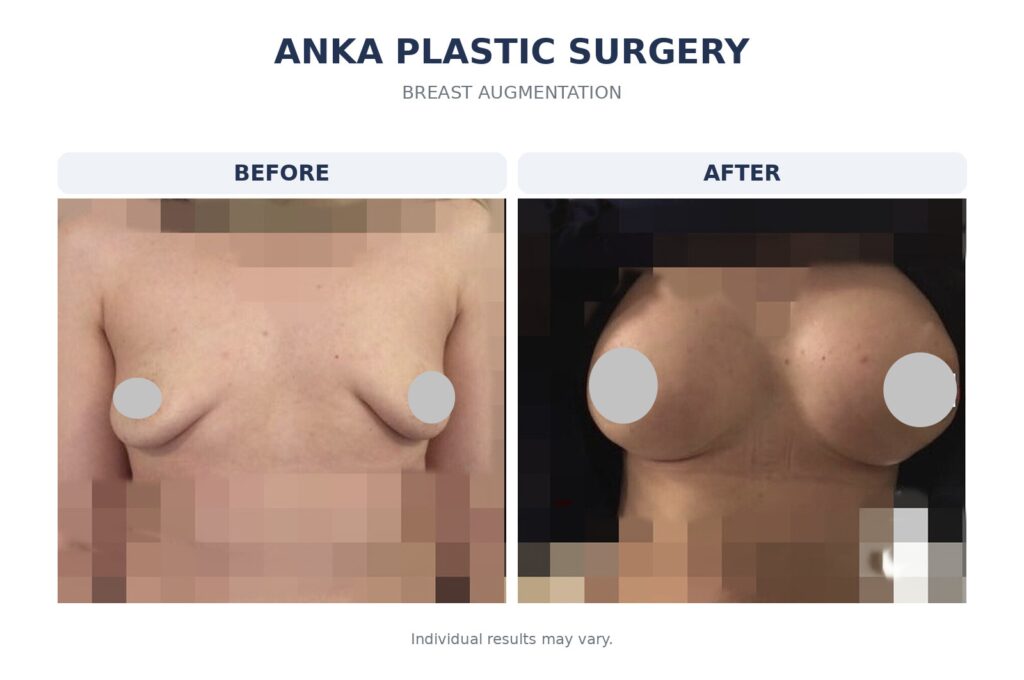
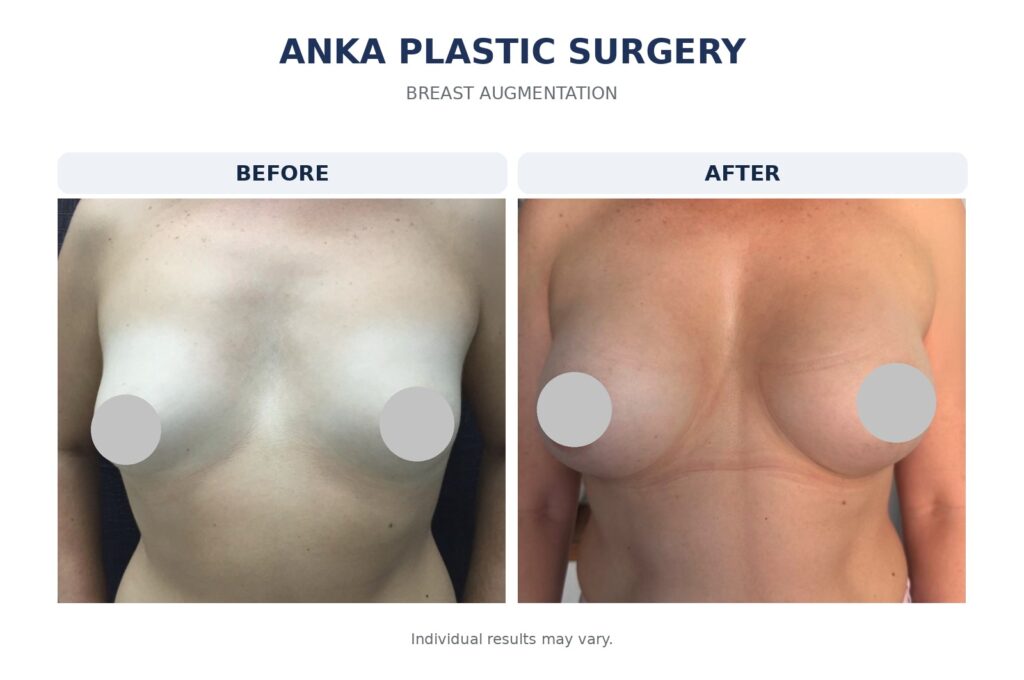
Breast augmentation in Turkey is a surgical procedure designed to increase breast volume, restore fullness lost after pregnancy or weight loss, improve breast symmetry and create more balanced body proportions.
At Anka Plastic Surgery in Istanbul, breast augmentation is individually planned according to the patient’s chest dimensions, existing breast tissue, skin quality and aesthetic goals. The objective is not simply to use the largest possible implant, but to select a technique and implant that are proportionate to the patient’s anatomy.
Breast augmentation can be performed using silicone breast implants, fat transfer or, in selected patients, a combination of both known as composite breast augmentation.
Breast Augmentation at a Glance
- Price: All-inclusive packages for international patients start from £5,000
- Anaesthesia: General anaesthesia
- Duration of surgery: Approximately 1–2 hours
- Hospital stay: One night
- Stay in Istanbul: Approximately 7 days
- Return to desk-based work: Approximately 3–7 days
- Driving: Usually after about 2 weeks
- Strenuous upper-body exercise: Usually after 4–6 weeks
- Final result: Develops gradually over 3–6 months
- Implants: Polytech® silicone implants (Mentor® available depending on the surgical plan)
Who Is Suitable for Breast Augmentation?
Breast augmentation may be suitable for women who are in good general health, have completed breast development and wish to increase or restore breast volume.
Common reasons for considering breast augmentation include:
- Naturally small breasts
- Loss of breast volume after pregnancy or breastfeeding
- Volume loss following weight reduction
- Breast asymmetry
- Desire for fuller or more proportionate breasts
Breast augmentation alone may not be sufficient when significant breast sagging is present. In these patients, a breast lift with or without implants may provide a more appropriate result.
Who May Need to Wait or Consider Alternatives?
The timing of surgery, or the choice of procedure, may need to be reconsidered in the following situations:
- Pregnancy or breastfeeding
- Medical conditions that are not well controlled
- Plans for major weight loss in the near future
- Smoking, because nicotine can interfere with wound healing
- Significant breast sagging, where a breast lift may be needed
- Expectations that cannot realistically be met by surgery
These points are always discussed individually during consultation.
Breast Augmentation Methods
Silicone Breast Implants
Silicone breast implants are the most frequently used method when a predictable and noticeable increase in breast volume is desired.
Implants are available in different sizes, shapes, projections and surface characteristics. The most appropriate implant is selected according to breast width, chest dimensions, existing soft-tissue coverage and the patient’s preferred appearance.
Fat Transfer Breast Augmentation
Fat transfer breast augmentation uses the patient’s own fat, usually harvested by liposuction from areas such as the abdomen, waist or thighs. The fat is prepared and then injected into the breasts.
Fat transfer is generally more suitable for women seeking a modest increase in breast volume or additional fullness in selected areas of the breast. Because some of the transferred fat is naturally absorbed, the achievable increase is more limited than with an implant, and an additional session may occasionally be required.
Composite Breast Augmentation
Composite breast augmentation combines a silicone implant with fat transfer.
This can be useful, particularly in thin patients, when additional soft-tissue coverage is desired around the implant, or when fat grafting can help soften implant edges, improve the décolletage or refine minor asymmetries.
It is not necessary for every patient and is considered according to breast tissue thickness and available donor fat.
Choosing the Right Breast Implants
Breast implant selection involves more than choosing a number of cubic centimetres. Several characteristics are considered together:
- Implant volume
- Implant width
- Implant shape
- Implant profile or projection
- Implant surface
- Placement above or below the pectoral muscle
At Anka Plastic Surgery, we primarily use Polytech® silicone implants. Mentor® implants are also available depending on the individual surgical plan and patient preference.
Round or Anatomical Breast Implants?
Round implants are the implants we use most frequently. With appropriate sizing and positioning, they can produce a natural breast shape. Because the implant is symmetrical, rotation does not usually cause a visible change in breast shape.
Anatomical or teardrop implants are shaped with relatively greater volume in the lower part of the implant. They can be useful in selected anatomical situations, including some patients with tuberous breast deformity. However, rotation of an anatomical implant can alter breast shape and may occasionally require corrective surgery.
For this reason, round implants are generally our preferred option, while anatomical implants are reserved for selected cases.
How Is Breast Implant Size Chosen?
Implant volume is usually expressed in cubic centimetres (cc), but the same implant volume can look very different on two patients.
A 250 cc implant, for example, may appear relatively prominent on a narrow chest but considerably smaller on a wider chest. Breast width, chest dimensions, existing breast tissue and skin characteristics therefore matter as much as the volume itself.
The goal is to select an implant that fits the patient’s breast base and desired appearance rather than choosing implant size by cc alone.
What Is Breast Implant Profile?
Implant profile describes how far the implant projects forward from the chest wall. Common options include:
- Low profile
- Medium profile
- High profile
- Extra-high profile in some implant ranges
For the same implant volume, a higher-profile implant generally has a narrower base and greater forward projection. A medium-profile implant usually distributes the volume over a wider base.
Profile selection is therefore closely related to chest width and breast base dimensions, not simply to the desired cup size.
Smooth or Textured Breast Implants?
Breast implants are manufactured with different surface characteristics, including smooth and textured surfaces.
Implant technology and surface classifications have evolved considerably over time. The choice of surface should therefore take into account the specific implant system being used, current medical evidence, the surgical technique and the individual patient’s anatomy.
Where Is the Breast Implant Placed?
Breast implants can be placed in different anatomical planes. The most appropriate placement depends mainly on existing breast tissue thickness, chest anatomy and the desired result.
Over the Muscle
In subglandular placement, the implant is positioned beneath the breast tissue but above the pectoralis muscle.
This may be suitable for patients who have enough natural breast tissue to provide adequate implant coverage. Because the pectoral muscle is not elevated, postoperative discomfort may also be less in some patients.
Under the Muscle
In submuscular placement, a greater proportion of the implant is covered by the pectoralis muscle. This can provide additional soft-tissue coverage in patients with thin breast tissue.
Dual Plane Breast Augmentation
Dual plane augmentation combines muscle coverage in the upper breast with greater freedom of the lower breast tissue.
It is particularly useful in patients with relatively thin upper breast tissue, because the muscle helps cover the upper part of the implant while allowing the lower breast contour to develop naturally.
At Anka Plastic Surgery, implant placement is selected individually rather than routinely using the same plane for every patient.
Preparing for Surgery
A detailed preparation plan is provided after your consultation. In general:
- Online assessment: Your photographs, medical history, current medications and desired breast size and shape are reviewed before you travel.
- Medical assessment: Preoperative examination and required tests are completed in Istanbul before the procedure.
- Breast imaging: Patients over a certain age, or with relevant family history, may be asked to provide recent breast imaging such as a mammogram or ultrasound.
- Smoking and nicotine: Patients are advised to stop smoking and avoid nicotine products for the period recommended by the surgeon before and after surgery.
- Medications and supplements: Blood-thinning medicines, anti-inflammatory drugs and some herbal supplements may need to be stopped beforehand. Never stop prescribed medication without medical advice.
- Stable weight: A stable, healthy weight before surgery helps maintain the result.
- Practical planning: Arrange help at home for the first days and loose, front-opening clothing for after surgery.
How Is Breast Augmentation Surgery Performed?
Breast augmentation is performed under general anaesthesia in a fully equipped hospital and usually takes approximately 1–2 hours.
Before surgery, final measurements and surgical markings are made. The selected implant is then placed into the planned anatomical pocket while breast symmetry, implant position and the inframammary fold are carefully assessed.
Breast Augmentation Incision
Our most frequently used approach is an incision of approximately 5 cm within the inframammary fold, the natural crease beneath the breast.
This approach provides direct access to the implant pocket while limiting unnecessary manipulation of the breast tissue and milk ducts. The scar is positioned within the natural breast crease and usually becomes less noticeable as it matures.
A periareolar incision, around the edge of the areola, may be considered in selected patients, particularly when limited skin adjustment around the areola is also required.
Recovery After Breast Augmentation
Recovery varies according to the implant placement, surgical technique and individual tissue characteristics.
Mild to moderate discomfort, tightness and swelling are expected during the first few days. Most symptoms gradually improve with prescribed medication. A supportive surgical bra is worn after surgery. Drains are not required in every patient but, when used, are commonly removed the following day.
First Week
Patients are encouraged to begin short walks soon after surgery. Heavy lifting, sudden arm movements and strenuous activity should be avoided. Many patients with desk-based jobs can return to work within approximately 3–7 days.
Weeks 2–6
Swelling and tightness gradually decrease and the breasts begin to soften. Physical activity is progressively increased, while strenuous upper-body exercise and weight training are generally resumed after approximately 4–6 weeks, depending on recovery.
Months 3–6
The implants gradually settle, residual swelling decreases and the breasts develop a softer and more natural appearance. Scars also continue to mature over several months.
Wearing the surgical bra for the recommended period and attending follow-up appointments are important parts of recovery.
Risks and Safety of Breast Augmentation
Breast augmentation is a commonly performed surgical procedure, but like all operations it carries potential risks. These may include:
- Bleeding or haematoma (collection of blood)
- Infection
- Delayed wound healing
- Temporary or persistent changes in nipple sensation
- Breast asymmetry
- Implant malposition
- Capsular contracture
- Rippling
- Implant rupture
- Visible or widened scars
- Anaesthetic risks and, rarely, blood clots
- Need for revision surgery
A capsule naturally forms around every breast implant as part of healing. In some patients, this capsule may become unusually firm, resulting in capsular contracture, which can cause firmness, discomfort or a change in breast shape.
Modern silicone implants are durable, but they are not considered lifetime devices. Implant replacement may become necessary if a complication develops or if the patient later wishes to change the size or shape of the implants.
A rare condition known as Breast Implant-Associated Anaplastic Large Cell Lymphoma (BIA-ALCL) has also been associated particularly with certain implant surface characteristics. Patients are informed about implant-related risks during the consultation process.
Breast Augmentation in Turkey for International Patients
International patients can begin the process with an online preliminary consultation.
Clear photographs and basic medical information allow us to assess breast shape, existing volume, asymmetry, skin quality and whether an implant alone is likely to be sufficient. Final surgical planning and implant selection are completed after an in-person examination in Istanbul.
Your Breast Augmentation Journey in Istanbul
Before You Travel
Before travelling, we review your photographs, medical history, current medications and desired breast size and shape. Based on this information, we can provide an initial surgical recommendation and personalised quotation.
Arrival in Istanbul
We generally recommend arriving in Istanbul approximately one day before surgery. Preoperative examination and required tests are completed before the procedure.
Surgery and Hospital Stay
Breast augmentation is performed under general anaesthesia. Most international patients stay in hospital for one night before returning to their hotel.
Returning Home
Most international patients remain in Istanbul for approximately seven days. Follow-up examinations are performed before departure, and postoperative communication continues online after the patient returns home.
Breast Augmentation Cost in Turkey
Our all-inclusive breast augmentation packages start from £5,000. The package includes:
- Breast augmentation surgery
- Surgeon’s fee
- General anaesthesia
- Hospital and operating room fees
- One-night hospital stay
- Polytech® silicone breast implants
- Hotel accommodation
- VIP airport transfers
- Postoperative follow-up during your stay
The final cost depends on the individual surgical plan. Additional procedures, such as a breast lift or fat transfer, may affect the total price.
After photographic assessment and online consultation, patients receive an individual quotation based on the planned procedure. Your quotation will clearly show what is included.
About Your Surgeon
Breast augmentation surgery at Anka Plastic Surgery is performed by Assoc. Prof. Anı Çinpolat, MD, an EBOPRAS-certified plastic, reconstructive and aesthetic surgeon based in Istanbul, Turkey.
Her surgical background includes aesthetic and reconstructive plastic surgery as well as participation in major reconstructive transplant procedures. She also holds a Master’s degree in Stem Cell and Tissue Engineering.
Breast augmentation planning focuses on implant selection, soft-tissue coverage, breast proportions and long-term surgical safety.
Breast Surgery in Istanbul for UK Patients
If you are travelling from the UK for breast augmentation, our dedicated UK patient page explains the assessment process, hospital stay, recovery in Istanbul and remote follow-up after you return home.
Frequently Asked Questions
Is breast augmentation painful?
Most patients experience tightness, tenderness or muscle-like discomfort during the first few days rather than severe pain. Symptoms generally improve progressively and can usually be controlled with prescribed medication.
When can I drive after breast augmentation?
Driving can usually be resumed after approximately two weeks, provided you are no longer taking medication that affects driving and can comfortably perform normal steering and emergency movements.
When can I lift my children?
Heavy lifting, including lifting young children, is generally avoided for approximately six weeks.
Do breast implants feel natural?
Modern silicone implants can feel very natural, but the final feel depends on implant characteristics, existing breast tissue, implant placement and individual healing.
What size implant will I need?
There is no single ideal size. The right implant depends on your breast width, chest dimensions, existing breast tissue and the look you want, not on cc alone. Size and profile are planned together with you during consultation, using your photographs before you travel and an in-person examination in Istanbul.
During surgery, we also compare the planned implant with slightly smaller and larger sizes, as well as different profiles when needed. This allows us to assess the fit directly on your chest and select the implant that gives the most balanced and proportionate result for your anatomy.
Will I need a breast lift as well?
If there is significant breast sagging, an implant alone may not give the result you want, and a breast lift with or without implants may be more appropriate. Your surgeon can advise on this from your photographs and confirm it at your examination.
How long do I need to stay in Istanbul?
Most international patients stay in Istanbul for approximately seven days, including one night in hospital. Follow-up examinations are carried out before you leave, and communication continues online after you return home.
How visible will the scars be?
The scar is usually placed in the natural crease beneath the breast, where it tends to become less noticeable as it matures. Scars cannot be removed entirely, and their final appearance depends on your skin type, healing and aftercare. Maturation continues over several months.
Can I breastfeed after breast augmentation?
Many women are able to breastfeed after breast augmentation. However, future breastfeeding cannot be guaranteed, because breastfeeding ability also depends on factors unrelated to implant surgery.
Can I have a mammogram after breast augmentation?
Yes. Women with breast implants can continue age- and risk-appropriate breast cancer screening.
The radiology team should be informed that breast implants are present so that appropriate implant-displacement mammography views can be obtained. Ultrasound or breast MRI may also be used when additional assessment of the implant or surrounding breast tissue is required. In our practice, MRI may be requested during long-term implant follow-up when clinically appropriate.
How long do breast implants last, and do they need to be replaced every 10 years?
Modern breast implants do not need to be routinely replaced after a fixed number of years, and there is no universal rule requiring replacement at 10 years.
Implants may remain in place for many years if the patient is satisfied and no implant-related problem develops. Replacement may be considered if there is implant rupture, capsular contracture, implant malposition, a significant change in breast shape, or if the patient wishes to change the implant size or type.
For more detailed information, you can read our article: When Should Breast Implants Be Replaced?
What happens if a breast implant ruptures?
If implant rupture is confirmed, treatment usually involves removal of the damaged implant, with replacement if the patient wishes to continue with breast implants.
Contact Our Team
International patients can send:
- Clear front and side photographs
- Age, height and weight
- Previous breast surgery history, if applicable
- Desired breast size and shape
- Relevant medical conditions
- Current medications
After assessment, Assoc. Prof. Anı Çinpolat can recommend whether silicone implants, fat transfer, composite augmentation or breast lift with implants is the more appropriate surgical option.