When Should Older Breast Implants Be Replaced? What to Know After 20–25 Years
One of the most common questions patients with breast implants ask is:
“Do breast implants need to be replaced after a certain number of years?”
There is no single number that applies to everyone.
You may have heard that breast implants should automatically be replaced every 10 years. This is not a rule. Many women can keep their implants for considerably longer without any problems.
However, implants and the tissues around them can change over time. For this reason, long-standing breast implants should not simply be forgotten about, even when there are no obvious symptoms.
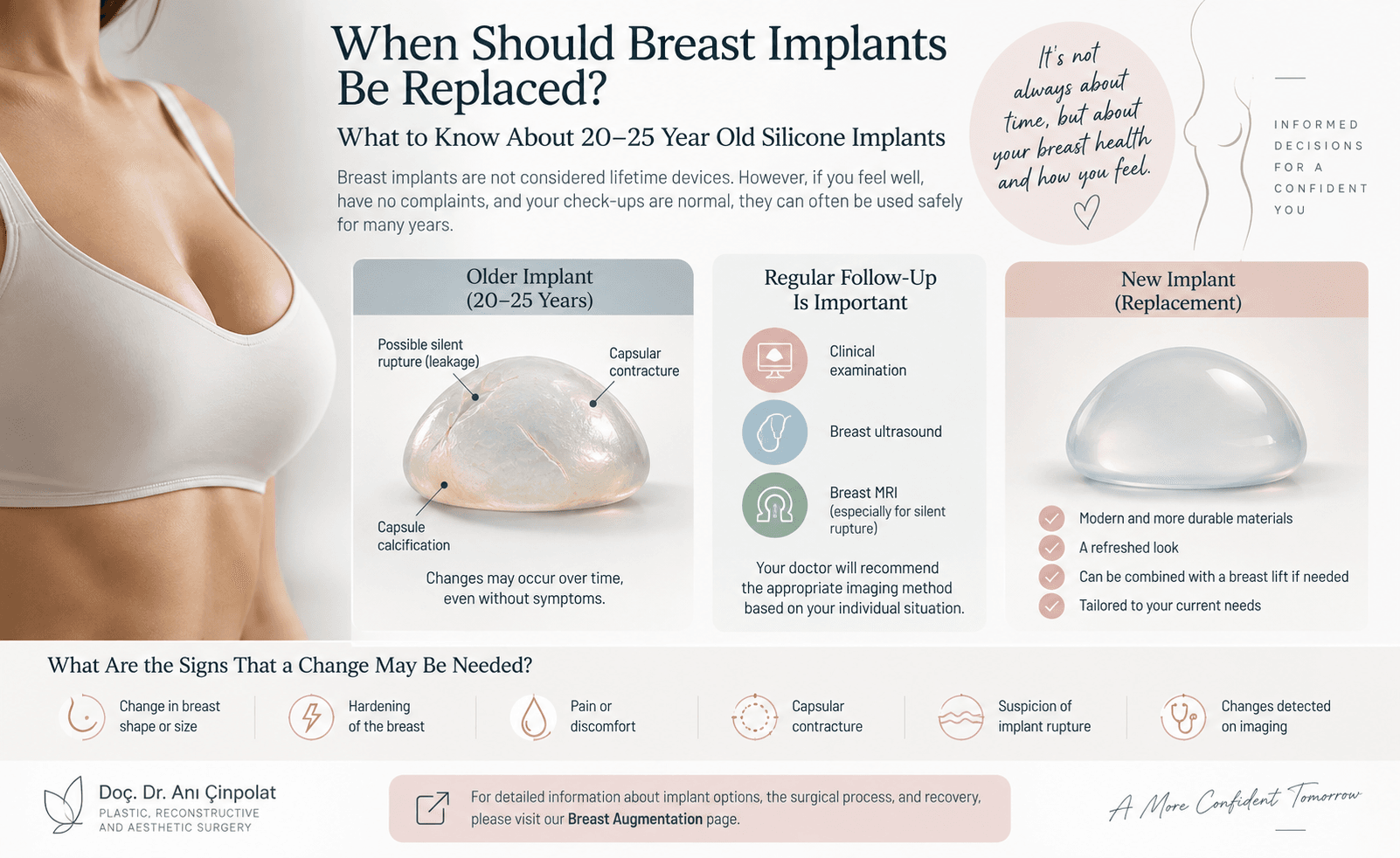
In my surgical practice, particularly when replacing implants inserted in the early 2000s and now more than 20 years old, I sometimes encounter findings such as small silicone leakage that was not clearly visible on preoperative imaging, thickening of the capsule or capsular calcification.
This does not mean that every old implant needs surgery. It means that after many years, periodic assessment becomes increasingly useful.
When Were Silicone Breast Implants First Used?
Modern silicone gel breast implants date back to 1962.
Since then, implant technology has changed considerably. The shell, silicone gel, surface characteristics and manufacturing techniques of today’s implants are very different from those used in the 1960s and 1970s.
How Have Breast Implants Changed Over the Years?
The development of silicone implants is often described in generations.
First-Generation Implants
The earliest implants used during the 1960s had relatively thick silicone shells and firm silicone gel.
They were mechanically robust, but the breasts could feel firmer and capsular contracture was an important problem.
Second-Generation Implants
During the 1970s, manufacturers tried to achieve a softer and more natural feel by making the implant shell thinner and the silicone gel more fluid.
This improved softness but also contributed to problems such as implant rupture and gel bleed, where small amounts of silicone can migrate through an intact implant shell.
Third-Generation Implants
From the 1980s onwards, implant shells were strengthened again and improved barrier layers were introduced to reduce silicone diffusion and improve durability.
Fourth- and Fifth-Generation Implants
From the 1990s onwards, silicone gels became increasingly cohesive, meaning that the gel is designed to hold together more effectively.
Modern silicone implants are the result of this ongoing development. Some publications also describe newer implant technologies as a sixth generation, although the classification is not completely standardised.
For an individual patient, knowing the manufacturer, model, surface type and year of implantation is often more useful than simply knowing which “generation” the implant belongs to.
Do Breast Implants Need to Be Replaced Every 10 Years?
No.
An implant does not automatically need to be replaced simply because it reaches its tenth year.
Many implants remain comfortable and clinically satisfactory well beyond 10 years.
At the same time, the longer an implant has been in place, the more useful it becomes to periodically evaluate both the implant and the capsule surrounding it.
In patients whose implants have been in place for 20 years or more, I generally consider a clinical review worthwhile even if they have no complaints.
Can a Silicone Implant Rupture Without Symptoms?
Yes.
A silicone implant rupture does not always cause pain, obvious asymmetry or a visible change in the breast.
This is why the term silent rupture is used.
Ultrasound and MRI are valuable tools for assessing silicone breast implants. However, imaging does not always reproduce exactly what is found during surgery.
In my own surgical experience, I have occasionally found small areas of silicone leakage during replacement surgery that were not obvious on the preoperative MRI.
This does not reduce the value of imaging. It simply means that imaging findings should be interpreted together with the age of the implant, clinical examination and the patient’s symptoms.
What Is the Capsule Around a Breast Implant?
The body naturally forms a thin layer of scar tissue around every breast implant. This is called the capsule.
In most patients it remains soft and causes no problem.
Over many years, however, the capsule may sometimes:
- become thicker,
- become firmer,
- contract,
- or develop calcification.
Capsular calcification can occasionally be quite marked in implants that have been in place for 20–25 years.
For this reason, when replacing an older implant I evaluate not only the implant itself but also the condition of the surrounding capsule.
Is the Capsule Sent for Pathology?
When I remove capsule tissue during older implant replacement surgery, I generally prefer to send the excised tissue for histopathological examination.
One reason is simply to document and evaluate the tissue microscopically.
A rare condition associated with breast implants is BIA-ALCL, or Breast Implant-Associated Anaplastic Large Cell Lymphoma. It is not a conventional breast cancer and has been particularly associated with certain textured implants.
Having an older implant does not mean that a patient has BIA-ALCL.
However, if there is late fluid accumulation, an unusual capsule, a mass or another suspicious finding, appropriate pathological assessment is important.
Is the New Implant Always Placed in the Same Pocket?
Not necessarily.
Many breast augmentations performed 20–25 years ago used a submuscular implant pocket.
During implant replacement, I reassess:
- breast tissue thickness,
- the condition of the capsule,
- the pectoral muscle,
- the position of the existing implant,
- skin quality,
- and the characteristics of the new implant.
In suitable patients, I may prefer to change the implant pocket rather than automatically place the new implant into exactly the same space.
For example, in selected patients with an old submuscular implant, the new implant may be moved to a more superficial plane.
This is not appropriate for everyone. Pocket selection should always be based on the patient’s current anatomy.
Is Implant Replacement the Same as a First Breast Augmentation?
Not always.
During primary breast augmentation, the surgeon is operating on tissues that have not previously contained an implant.
Replacement surgery may involve:
- the existing implant,
- an established implant pocket,
- scar tissue,
- the capsule,
- silicone leakage,
- capsular contracture,
- calcification,
- or age-related changes in the breast itself.
For this reason, replacing an implant that has been in place for 20–25 years can sometimes be more involved than a first breast augmentation.
In these cases, I routinely use a surgical drain, particularly when capsule surgery or pocket change has been performed. I generally keep the drain for approximately 2–3 days, depending on the amount of fluid produced.
Does an Old Implant Always Have to Be Replaced with Another Implant?
No.
The decision depends on the patient’s anatomy and wishes.
Options may include:
- replacing the implant with a new one,
- changing implant size,
- changing the implant pocket,
- combining replacement with a breast lift,
- or removing the implants without replacing them.
Patients who have had larger implants for many years may have some stretching of the skin and breast tissue. In these cases, implant removal or replacement may sometimes be combined with mastopexy.
Which Changes Should Be Checked Earlier?
Regardless of how old the implant is, it is sensible to arrange an assessment if you notice:
- new firmness of the breast,
- a change in breast shape or symmetry,
- new pain or tenderness,
- a change in implant position,
- sudden swelling or enlargement of one breast,
- fluid around the implant,
- a new lump,
- or swelling in the armpit.
These findings do not automatically mean that there is a serious problem, but they should be assessed.
What Should You Do If Your Breast Implants Are 20–25 Years Old?
There is no reason to become anxious simply because your implants are old.
A 20-year-old implant is not automatically damaged and does not automatically need to be replaced.
However, if your implants have been in place for many years, especially if you no longer know their manufacturer or model or have not had them checked for a long time, arranging an assessment is reasonable.
Clinical examination and appropriate imaging may show that everything is satisfactory and no surgery is required.
In other patients, imaging or examination may reveal implant rupture, silicone leakage, capsular changes or a breast shape change that makes replacement worth considering.
Conclusion
Breast implants do not have a universal expiry date.
They do not need to be routinely replaced at 10 years, and many women use their implants comfortably for much longer.
After many years, however, periodic review becomes increasingly useful.
The decision to replace an implant should not be based on age alone. Implant type, imaging findings, capsule condition, changes in breast tissue and the patient’s own preferences should all be considered together.
For more detailed information about implant selection, implant placement, surgery and recovery, you can visit our Breast Augmentation page.