Can the Nipple and Areola Be Made Smaller?
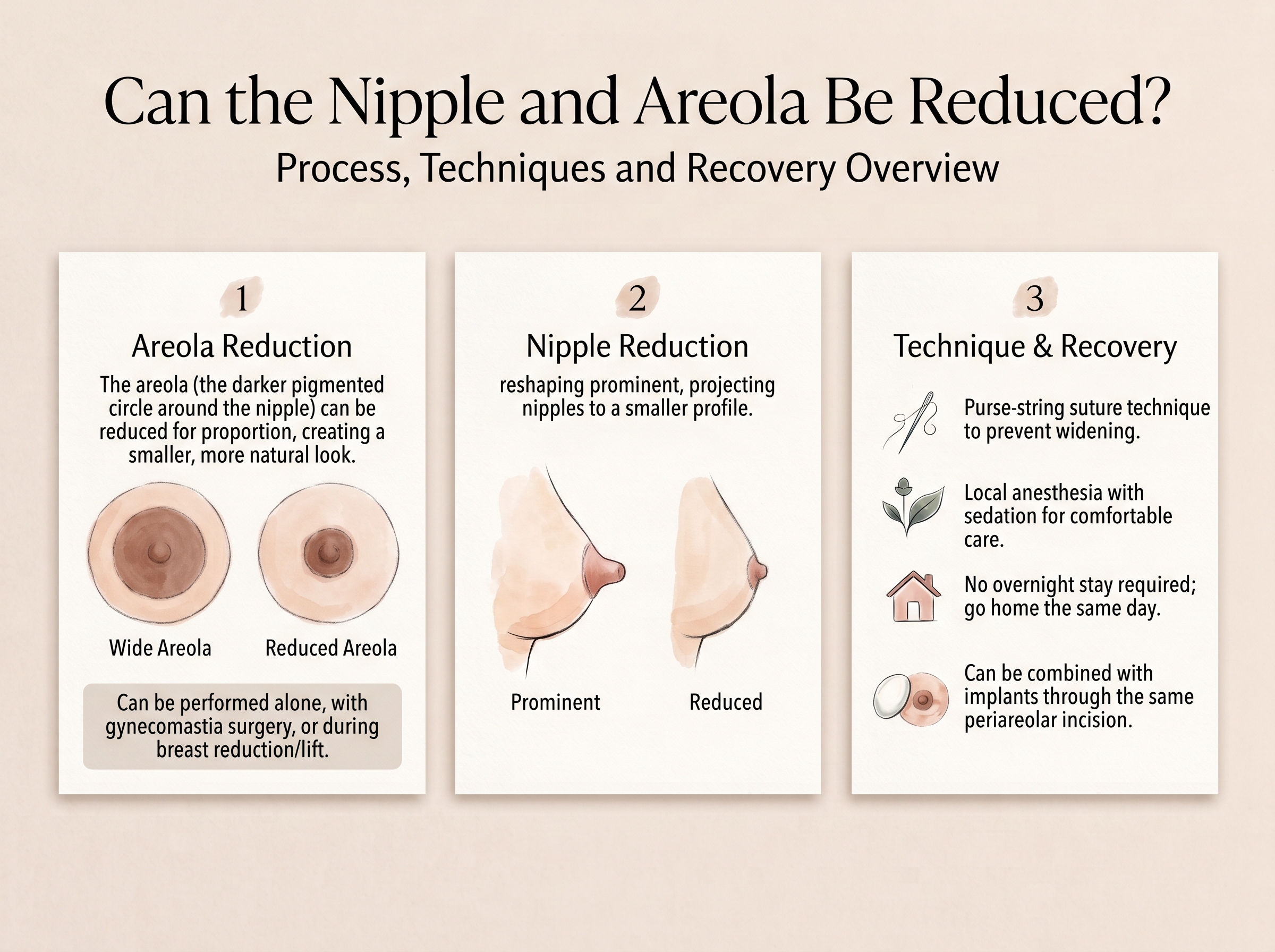
In everyday language, patients often use the term “nipple” to describe the entire central area of the breast. Anatomically, however, this region consists of two different structures. The projecting central part is the nipple, while the darker circular area surrounding it is the areola.
Some women and men are bothered mainly by a large areola, while others are concerned about a nipple that is too large, long, or prominent. These concerns can be assessed separately, and when appropriate, both areas can be treated during the same procedure.
A large areola may simply be a natural anatomical feature. In some patients, it may become more noticeable after pregnancy, breastfeeding, weight changes, or changes in breast tissue over time. Some patients also seek treatment because the areola remains larger than they would like after previous breast reduction, breast lift, or gynecomastia surgery.
If the overall breast shape does not require further correction, the nipple and areola region can sometimes be treated on its own.
What Is a Normal Areola Size?
There is no single ideal areola size that applies to everyone. Breast volume, chest width, nipple anatomy, and overall body proportions should all be considered together.
In my surgical practice, I generally use an areola diameter of approximately 4 cm in women and 3 cm in men as a reference during planning. However, these measurements are not fixed aesthetic rules. For example, an areola that is too small may look unnatural on a larger breast.
The aim is therefore not to make the areola as small as possible, but to create a proportion that looks more balanced with the breast or chest.
How Is Areola Reduction Performed?
During areola reduction, the desired new areola diameter is first marked. A circular ring of excess pigmented skin around the areola is then removed, and the remaining areola is joined to the surrounding skin.
One of the points I pay particular attention to in this operation is reducing the tendency of the areola to widen again over time.
A circular scar is exposed to outward tension from the surrounding tissues. For this reason, I place a permanent purse-string suture around the areola. This suture helps support the circumference of the areola and may reduce the risk of postoperative widening.
However, wound healing varies from person to person, so it is not possible to guarantee that the surgically created diameter will remain exactly the same throughout life.
Can Areola Reduction Be Performed Without a Breast Lift?
Yes.
In some patients, the breast shape, volume, and nipple position are satisfactory, but the areola is simply wider than desired. In these cases, an isolated areola reduction may be performed without breast lift surgery.
If breast sagging is also present, reducing the areola alone may not fully address the aesthetic concern. In such cases, a breast lift may be a more appropriate option.
Can Areola Reduction Be Performed After Previous Breast Surgery?
Yes. Some patients seek areola reduction after having had previous breast surgery.
Examples include women who feel that the areola remains too wide after breast reduction or breast lift surgery, men who are unhappy with the nipple-areola size after gynecomastia surgery, or patients whose areola has gradually widened again over time.
In previously operated breasts, existing scars, blood supply to the nipple-areola complex, and the details of the previous surgical technique should all be taken into account when planning revision surgery.
Can Areola Reduction Be Combined With Breast Implants?
Yes, in suitable patients the two procedures can be performed during the same operation.
Some patients seek breast augmentation but are also concerned about the size of the nipple-areola region. When the surgical plan is appropriate, the breast implant can be placed through an incision around the areola, while the areola diameter is reduced during the same procedure.
This may allow implant placement and areola reduction to be performed through the same surgical approach rather than creating an additional incision elsewhere.
However, this technique is not suitable for every patient. The areola diameter, breast tissue thickness, implant size, breast shape, and overall surgical goals should all be assessed together.
What Is Nipple Reduction?
In some patients, the main concern is not the width of the areola but the size or projection of the nipple itself.
Both women and men may seek treatment because the nipple is:
- too wide,
- too long,
- or overly prominent under clothing.
Nipple reduction is different from areola reduction. During this procedure, excess nipple tissue is carefully reduced to create a smaller shape that is more proportionate to the breast or chest.
I usually perform nipple reduction under sedation and local anaesthesia, and hospital admission is generally not required.
When planning surgery, preserving nipple sensation and blood supply is important. In patients who may wish to breastfeed in the future, the surgical technique should also be selected with this in mind.
Can Nipple and Areola Reduction Be Performed Together?
Yes.
If a patient has both a wide areola and a large or prominent nipple, both areas can be treated during the same procedure.
Some patients benefit from areola reduction alone, others from nipple reduction alone, and some from a combination of both procedures.
The important first step is to determine whether the main concern is areola diameter, nipple size, or the overall shape of the breast.
Anaesthesia and Hospital Stay
I generally perform isolated areola reduction and nipple reduction under sedation and local anaesthesia.
General anaesthesia is therefore usually unnecessary, and most patients do not need to stay in hospital. They can usually return home on the same day.
If the procedure is combined with breast augmentation, breast lift, or another breast operation, the type of anaesthesia and hospital stay will depend on the main surgery being performed.
Does Areola Reduction Leave a Scar?
The scar after areola reduction is positioned around the border between the areola and the surrounding breast skin.
The natural colour transition between the areola and the surrounding skin may help the scar become less noticeable over time. However, as with any surgical procedure, completely scar-free surgery is not possible.
The final appearance of the scar depends on individual wound healing, skin type, smoking, and the amount of tension on the scar.
Can the Areola Become Wider Again?
Yes, some widening can occur over time after areola reduction.
Tension from the surrounding breast skin and tissues may contribute to this. For this reason, in my practice I use a permanent purse-string suture around the areola to help resist outward tension.
Pregnancy, breastfeeding, significant weight changes, and changes in breast tissue over time may also affect areola size.
Conclusion
The size of the nipple and areola region can be corrected either as an isolated procedure or together with other breast surgery.
In some patients, reducing the darker areola alone is enough. In others, the nipple itself may also need to be reduced. Areola widening that remains after previous breast reduction, breast lift, or gynecomastia surgery can also be treated.
In suitable patients undergoing breast augmentation, the implant may be placed through the areolar incision while the areola is reduced during the same operation.
The goal is not simply to make the nipple or areola smaller, but to create a natural proportion between the nipple, areola, and overall breast volume, while also trying to maintain the new areola size as reliably as possible over time.