GLP-1 Medications (Ozempic®, Mounjaro®) and Facial Sagging: What Is “Ozempic Face”?
In recent years, GLP-1 medications, particularly Ozempic®, Mounjaro®, Wegovy®, and Zepbound®, have become widely used in the treatment of obesity and type 2 diabetes. Thanks to their effectiveness in promoting weight loss, millions of people worldwide have benefited from these medications.
However, as rapid weight loss occurs, some individuals begin to notice changes such as:
- “My face looks hollow.”
- “I’ve lost volume in my cheeks.”
- “I suddenly look older.”
- “My face has started to sag.”
These concerns have led many patients to seek advice from plastic surgeons and facial rejuvenation specialists.
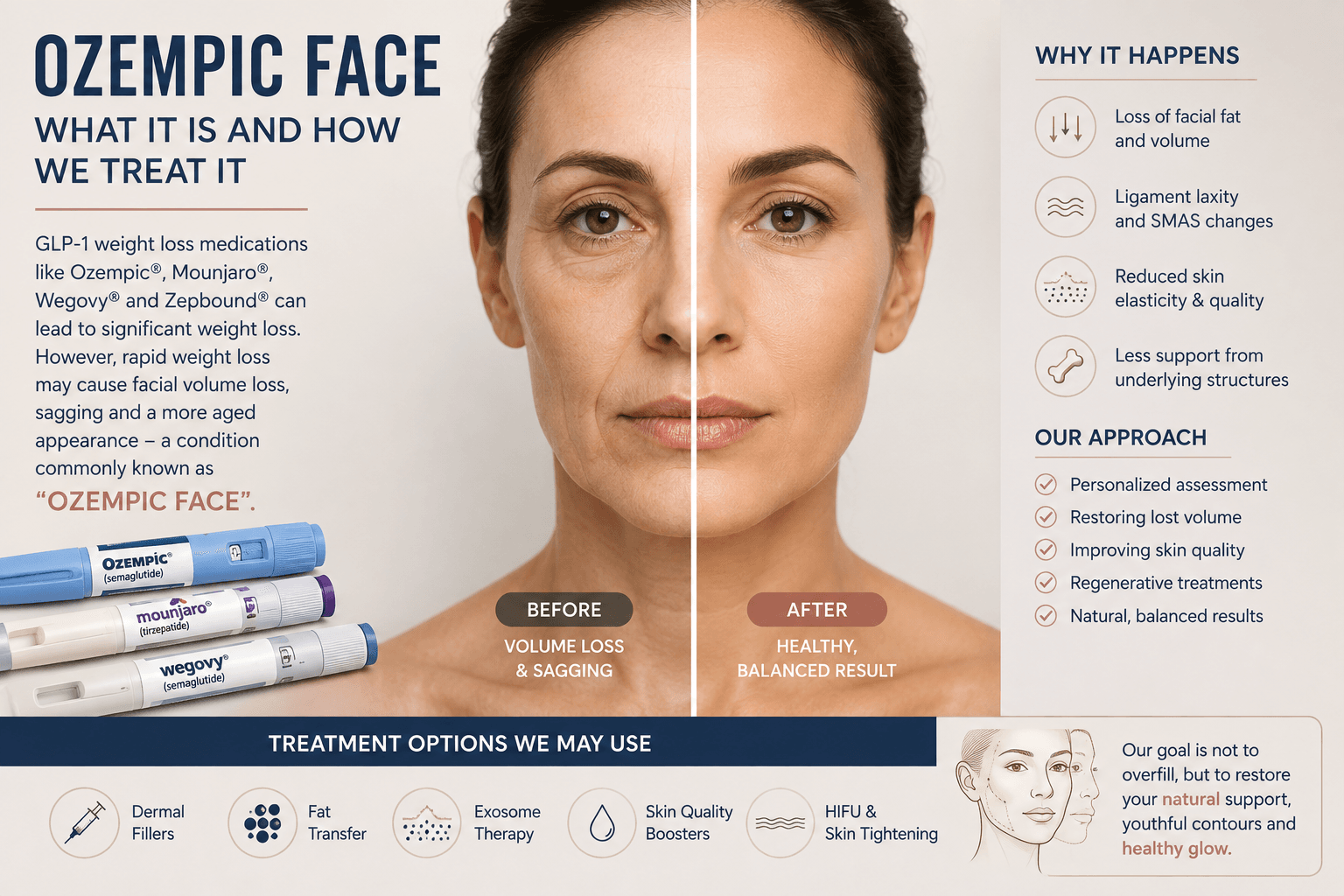
This condition has become widely known as “Ozempic Face.” Contrary to popular belief, it is not caused by the medication directly damaging the skin. Instead, it is primarily the result of rapid weight loss, which reduces facial fat volume and makes existing signs of facial aging more noticeable.
Why Does Ozempic Face Occur?
Our face is much more than just skin.
A youthful facial appearance depends on the balance between:
- the skin,
- subcutaneous fat,
- retaining ligaments,
- the SMAS (Superficial Musculoaponeurotic System),
- facial muscles,
- and the underlying facial skeleton.
During rapid weight loss, the natural facial fat pads shrink. As this supporting volume decreases, facial contours may appear hollow, and age-related changes become more visible.
For this reason, Ozempic Face should not simply be considered “fat loss.” Instead, rapid weight loss often reveals underlying facial aging that was previously less noticeable.
Who Is More Likely to Develop Ozempic Face?
Not everyone experiences the same degree of facial change.
Ozempic Face tends to be more noticeable in people who:
- are over the age of 40,
- lose a significant amount of weight in a short period,
- naturally have low facial fat volume,
- already have early signs of facial aging.
How Is Ozempic Face Treated?
The goal of treatment is not to overfill the face.
Our philosophy is to restore lost facial support while maintaining natural facial proportions.
Depending on each patient’s needs, treatment options may include:
- hyaluronic acid dermal fillers,
- facial fat grafting,
- exosome therapy,
- regenerative treatments to improve skin quality,
- skin-tightening procedures such as HIFU.
The most appropriate treatment depends on the degree of facial volume loss, skin quality, age, and the patient’s aesthetic goals.
Does Every Patient Need Fat Grafting?
No.
Facial fat grafting can provide natural, long-lasting volume restoration in selected patients. However, not every patient with Ozempic Face requires fat transfer.
Some patients achieve excellent results with limited dermal fillers alone, while others may benefit more from regenerative treatments that improve skin quality.
Treatment should always be tailored to the individual.
Can Ozempic Face Be Prevented?
It is not always possible to completely prevent facial changes associated with rapid weight loss. However, the process can often be managed more effectively.
We generally recommend that patients:
- avoid losing weight too rapidly whenever possible,
- maintain adequate protein intake,
- continue resistance training,
- seek assessment before facial volume loss becomes severe.
Early intervention may reduce the need for more extensive facial rejuvenation procedures later on.
Conclusion
Ozempic Face is primarily the result of facial volume loss caused by rapid weight loss, making existing signs of aging more apparent. In most cases, the medication itself is not the direct cause. Rather, the facial changes reflect the effects of significant weight loss on facial anatomy.
With a careful assessment, these changes can often be successfully managed through individualized treatment plans. The goal is not to change your face, but to restore its natural support, maintain facial harmony, and preserve a youthful, refreshed appearance.
For more detailed information about dermal fillers, HIFU, exosome therapy, and other nonsurgical options that may be considered for facial volume loss and skin changes after significant weight loss, you can visit our Nonsurgical Treatments page.