Tummy Tuck (Abdominoplasty) in Turkey
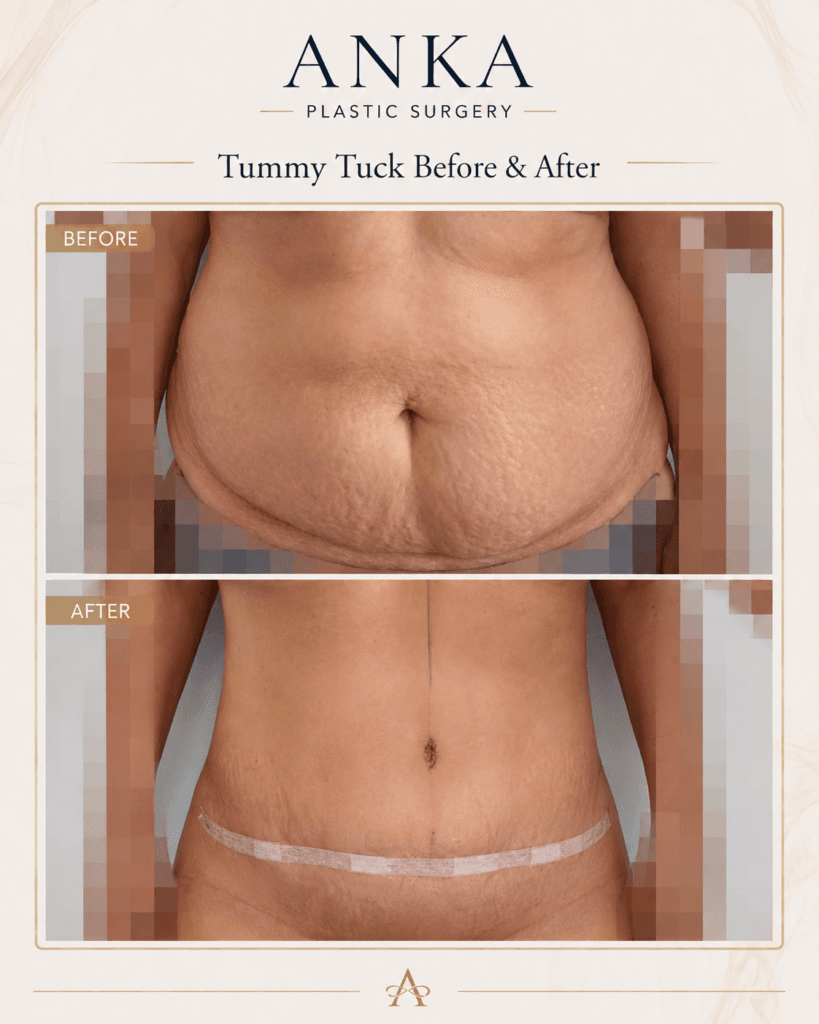
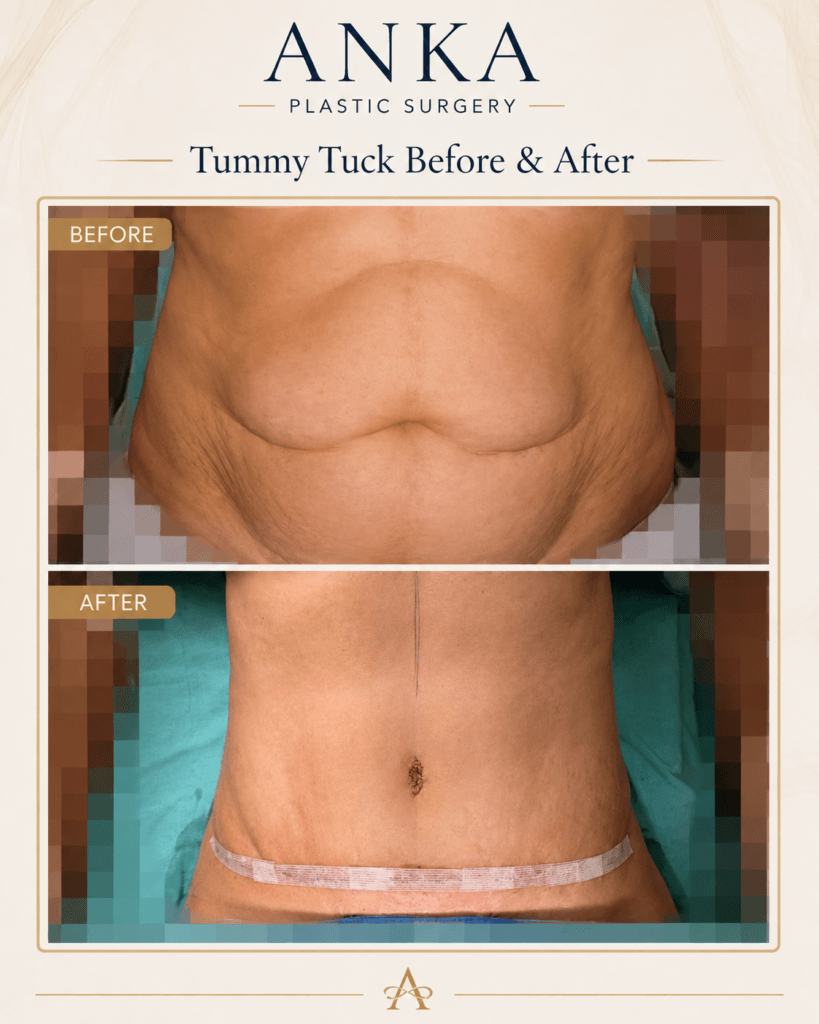
Pregnancy, significant weight changes and ageing can affect the abdomen in several ways. In addition to localised fat, patients may develop loose skin, weakening or separation of the abdominal muscles and changes in the overall body contour.
Diet and exercise can help reduce excess fat, but they cannot remove significant loose skin or repair separated abdominal muscles.
A tummy tuck, also known as abdominoplasty, is a surgical procedure designed to remove excess skin and fat, repair the abdominal wall when necessary and reshape the abdomen.
The aim is not simply to create a flatter abdomen, but to achieve a natural body contour that is in balance with the waist and surrounding areas.
Not every patient has the same type of abdominal deformity. Some have loose skin limited to the lower abdomen, while others have laxity affecting the entire abdominal wall. After major weight loss, bariatric surgery or substantial weight reduction with GLP-1 treatments, skin excess may be considerably more extensive.
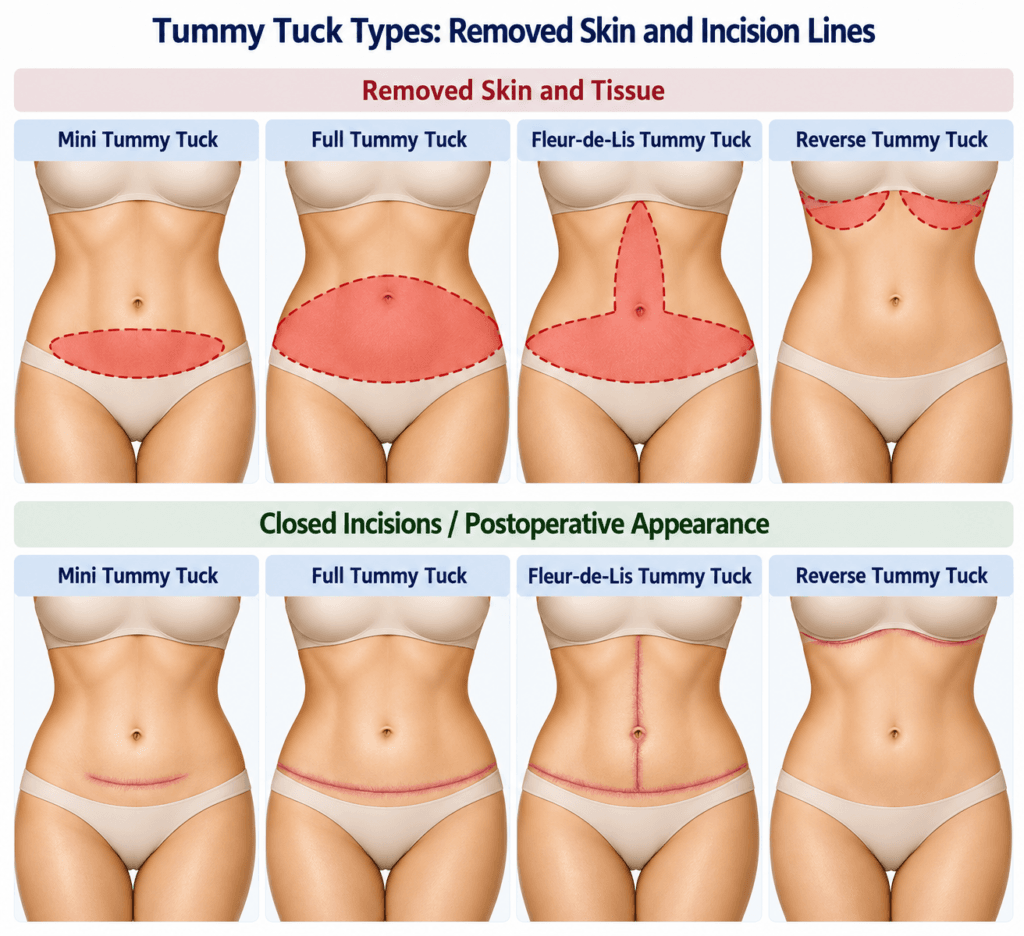
For this reason, Anka Plastic Surgery does not use the same tummy tuck technique for every patient. Depending on the individual anatomy, treatment may involve a mini tummy tuck, full tummy tuck, Fleur-de-Lis abdominoplasty or reverse abdominoplasty.
Our Approach at Anka Plastic Surgery
We do not regard abdominoplasty as a single standard operation. The most appropriate technique is selected according to the location of excess skin, the condition of the abdominal muscles, fat distribution and the patient’s overall anatomy. The aim is not to perform the smallest possible operation, but the operation that best addresses the underlying deformity.
Who Is Suitable for a Tummy Tuck?
Tummy tuck surgery may be considered in patients with:
- abdominal muscle separation after pregnancy,
- loose abdominal skin that does not improve with diet and exercise,
- excess skin after significant weight loss,
- widespread skin laxity following bariatric surgery,
- loose skin after major weight loss with GLP-1 treatments,
- localised skin excess in the lower abdomen,
- or significant changes in the abdomen and waist contour.
A tummy tuck is not a weight-loss procedure.
The most suitable candidates are generally patients who have reached, or are close to, a stable target weight and are able to maintain it over time.
Mini Tummy Tuck
A mini tummy tuck is a more limited form of abdominoplasty and is most suitable for patients whose excess skin is mainly located below the belly button, while the upper abdomen remains relatively unaffected.
During surgery, excess skin is removed from the lower abdomen. The scar is generally shorter than with a full tummy tuck and, in many patients, the belly button does not need to be repositioned.
A mini tummy tuck may be suitable after pregnancy or weight changes when the deformity is limited to the lower abdomen.
If loose skin extends above the belly button or there is significant abdominal muscle separation, a full tummy tuck may provide a more appropriate correction.
Full Tummy Tuck
A full tummy tuck is used when loose skin affects both the upper and lower abdomen or when there is significant weakening or separation of the abdominal muscles.
Excess skin and fat are removed and the abdominal wall is reshaped.
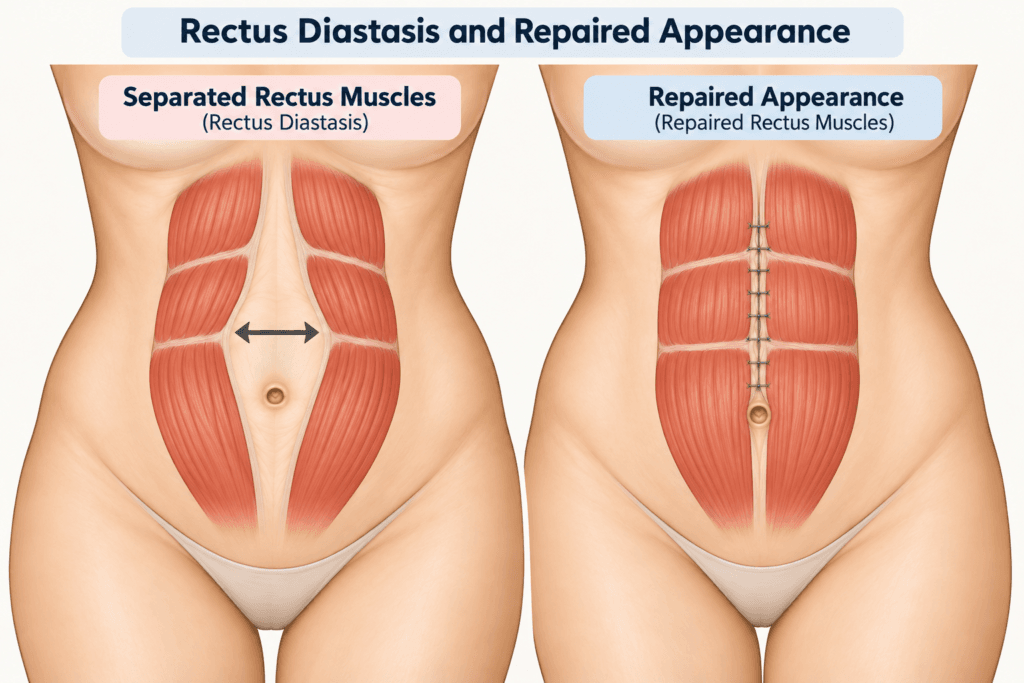
If diastasis recti is present, the abdominal muscles can be repaired during the same operation.
The belly button itself is preserved, but because the surrounding skin is repositioned, it is brought through the newly tightened abdominal skin and reshaped in its natural anatomical position.
The goal is not only to create a flatter abdomen, but also to restore a balanced relationship between the abdomen, waist and surrounding body contours.
Abdominal Muscle Separation (Diastasis Recti)
The rectus abdominal muscles normally run close together along the midline.
Pregnancy and major changes in abdominal volume can cause these muscles to separate. This condition is known as diastasis recti.
Patients may notice that the abdomen continues to project forwards despite weight loss or exercise, and some describe a feeling of weakness in the abdominal wall.
During tummy tuck surgery, when appropriate, the rectus muscles are brought closer together along the midline to support the abdominal wall and restore them towards their anatomical position. This repair can help reduce the forward bulging appearance of the abdomen and may also create an “internal corset” effect, contributing to a more defined waistline. Liposuction or removal of excess skin alone does not correct diastasis recti.
Fleur-de-Lis Tummy Tuck
After major weight loss, excess skin may develop not only vertically but also across the width of the abdomen.
In these patients, a conventional tummy tuck may not remove enough of the loose skin.
A Fleur-de-Lis abdominoplasty can be considered when there is significant excess skin in both directions.
In addition to the horizontal incision along the lower abdomen, a vertical incision is made along the midline. This allows excess skin to be removed both vertically and horizontally.
Fleur-de-Lis abdominoplasty may be particularly useful in selected patients who have:
- undergone bariatric surgery,
- lost a substantial amount of weight,
- developed significant skin laxity after GLP-1 weight-loss treatment,
- or have marked horizontal laxity across the abdomen.
The additional vertical scar is an important consideration.
However, in patients with extensive skin excess, this technique can provide significantly greater improvement in abdominal contour than a conventional tummy tuck alone.
Our Approach at Anka Plastic Surgery
Fleur-de-Lis abdominoplasty is not used routinely. It is reserved for patients whose excess skin cannot be adequately corrected with a conventional tummy tuck. In these cases, the additional scar must be balanced against the potential improvement in body contour.
Reverse Tummy Tuck
Most tummy tuck procedures address loose skin predominantly in the lower abdomen.
However, in a small group of patients, the main problem is excess skin in the upper abdomen, while the lower abdomen remains relatively well preserved.
In these cases, a reverse abdominoplasty may be considered.
The incision is usually positioned within the fold beneath the breasts, and the excess upper abdominal skin is lifted upwards and removed.
Reverse abdominoplasty is used only in carefully selected patients and should not be considered a routine alternative to a conventional tummy tuck.
Can Liposuction Be Combined with a Tummy Tuck?
Yes. A tummy tuck and liposuction are different procedures, but they can complement each other.
A tummy tuck removes loose skin and, when necessary, repairs the abdominal wall. Liposuction can be used at the same time to reduce localised fat deposits around the waist, flanks or back and help create a more balanced body contour.
In suitable patients, waist liposuction may be added to abdominoplasty.
If there is also significant fat accumulation around the sides of the back, back liposuction may be considered during the same operation, provided this remains appropriate within safe surgical limits.
Liposuction is not necessary in every patient. The areas treated and the amount of fat removed are determined according to the patient’s fat distribution, skin quality and overall surgical plan.
Our Approach at Anka Plastic Surgery
We do not assess the abdomen in isolation. In suitable patients, shaping the waist and surrounding areas can help create a more natural transition between the abdomen and the rest of the torso.
Preparing for Tummy Tuck Surgery
Successful abdominoplasty begins with appropriate patient selection and surgical planning.
Before surgery, the patient’s general health, weight stability, previous pregnancies and operations, medications and smoking history are reviewed.
If significant further weight loss is expected, or pregnancy is planned in the near future, postponing surgery may be more appropriate.
Smoking and electronic tobacco products can impair circulation and wound healing. Patients are therefore advised to stop using them for the period recommended by their surgical team.
Blood-thinning medication, supplements and other treatments are also reviewed before surgery.
How Is Tummy Tuck Surgery Performed?
Tummy tuck surgery is performed under general anaesthesia in a fully equipped hospital.
The exact surgical plan depends on the type and extent of the abdominal deformity.
Depending on the procedure, surgery may involve:
- removal of excess skin and fat,
- repair of the abdominal muscles when necessary,
- reshaping of the belly button during a full tummy tuck,
- and liposuction of the waist or back in selected patients.
The incision is planned while the patient is standing so that the scar can be positioned as low as reasonably possible and usually concealed by underwear or swimwear.
Surgery generally takes approximately 2.5 to 5 hours. The duration may be longer if liposuction or additional procedures are performed at the same time.
Most patients stay in hospital for the first night and are discharged the following day if their condition is satisfactory.
Recovery After a Tummy Tuck
Tightness, swelling, bruising and discomfort are expected during the early recovery period.
Patients are encouraged to begin short walks soon after surgery. Early mobilisation supports circulation and helps reduce the risk of blood clots.
Because the abdominal skin initially feels tight, patients may naturally walk slightly bent forwards during the first few days. Posture gradually becomes more upright as the tissues relax.
A compression garment is worn for the period recommended by the surgical team.
Patients with desk-based work can often return within approximately 2–3 weeks.
Light exercise can gradually be introduced as healing progresses, while strenuous exercise and activities that strongly engage the abdominal muscles are usually postponed for around 6 weeks.
Swelling continues to decrease over the following months and the abdominal contour gradually becomes more defined. Scar maturation may continue for up to a year.
Risks of Tummy Tuck Surgery
As with any surgical procedure, tummy tuck surgery carries potential risks.
These may include:
- bleeding or haematoma,
- infection,
- seroma,
- wound-healing problems,
- noticeable or widened scarring,
- temporary changes in skin sensation,
- asymmetry,
- and, rarely, deep vein thrombosis.
Smoking, circulation problems, certain medical conditions and more extensive surgical procedures may increase the risk of wound-healing complications.
Early mobilisation and, where appropriate, preventive medication may be used to reduce the risk of blood clots.
Tummy Tuck Scars
A tummy tuck leaves a permanent scar.
The incision is positioned as low as reasonably possible so that it can usually be concealed beneath underwear or swimwear.
During the first few months, the scar may appear pink or more noticeable. It gradually softens and fades as it matures.
Scar maturation may continue for approximately 12 months.
Silicone gel, silicone sheets or other scar treatments may be recommended at the appropriate stage of healing. Protecting new scars from direct sun exposure is also important.
The final appearance of the scar varies according to individual skin characteristics and wound healing.
Combining Tummy Tuck with Other Body Contouring Procedures
In suitable patients, tummy tuck surgery can be combined with other aesthetic procedures.
One of the most common combinations is abdominoplasty with breast surgery, including:
This combination is often referred to internationally as a Mommy Makeover.
Other procedures such as waist or back liposuction, arm lift or thigh lift may also be considered as part of a body contouring plan.
However, not every patient is suitable for combined surgery.
Overall health, operating time, the extent of surgery and safety considerations determine which procedures can reasonably be performed during the same operation.
Tummy Tuck Cost
The cost of tummy tuck surgery varies according to the surgical plan.
Factors that may affect the overall cost include:
- mini or full tummy tuck,
- Fleur-de-Lis or reverse abdominoplasty,
- additional waist or back liposuction,
- additional procedures performed during the same operation,
- and the required hospital stay.
For international patients, a preliminary assessment can often be carried out using photographs before travelling to Istanbul.
After the surgical plan has been established, the team can provide detailed information regarding treatment costs and, where applicable, accommodation and transfer arrangements.
Frequently Asked Questions
Can I become pregnant after a tummy tuck?
Yes. A tummy tuck does not prevent pregnancy.
However, pregnancy stretches the abdominal wall and skin again and may therefore affect the surgical result.
For this reason, when possible, abdominoplasty is usually planned after future pregnancy plans have been completed.
What happens if I gain or lose weight after a tummy tuck?
Significant weight changes can affect the result.
Weight gain may lead to new fat accumulation, while substantial weight loss may cause further skin laxity.
Maintaining a relatively stable weight helps preserve the result over time.
Can a tummy tuck repair a hernia?
Some abdominal wall hernias may be repaired during the same operation.
Whether this is appropriate depends on the type and location of the hernia and may require imaging or assessment together with a general surgeon.
Are tummy tuck results permanent?
The skin and tissue removed during surgery do not grow back in the same way.
The improvement in abdominal contour can therefore last for many years.
However, pregnancy, significant weight changes and the natural ageing process can alter the abdomen again over time. Maintaining a stable weight and healthy lifestyle can help preserve the result.