
Thread Lift: Who Is It Suitable For, What Are Its Limitations, and Why Is It Not a Routine Treatment at Anka?
A thread lift is a minimally invasive procedure designed to support mildly lax facial tissues by repositioning them with specially designed threads placed beneath the skin. Systems such as Aptos, French Lift and similar suspension threads fall within this category.
These treatments are often presented as a non-surgical alternative for patients who do not wish to undergo facelift surgery and who have only mild facial laxity.
At Anka Plastic Surgery, however, thread lifting is not considered a routine facial rejuvenation treatment.
One reason for this selective approach is that some patients who have undergone thread lifting elsewhere present with problems such as skin dimpling, asymmetry, palpable or visible threads, infection, or loss of lifting effect over time.
For this reason, we believe thread lifting should be assessed not simply as a “non-surgical” or “easier” option, but in terms of the amount of correction it can realistically provide, its durability and its potential complications.
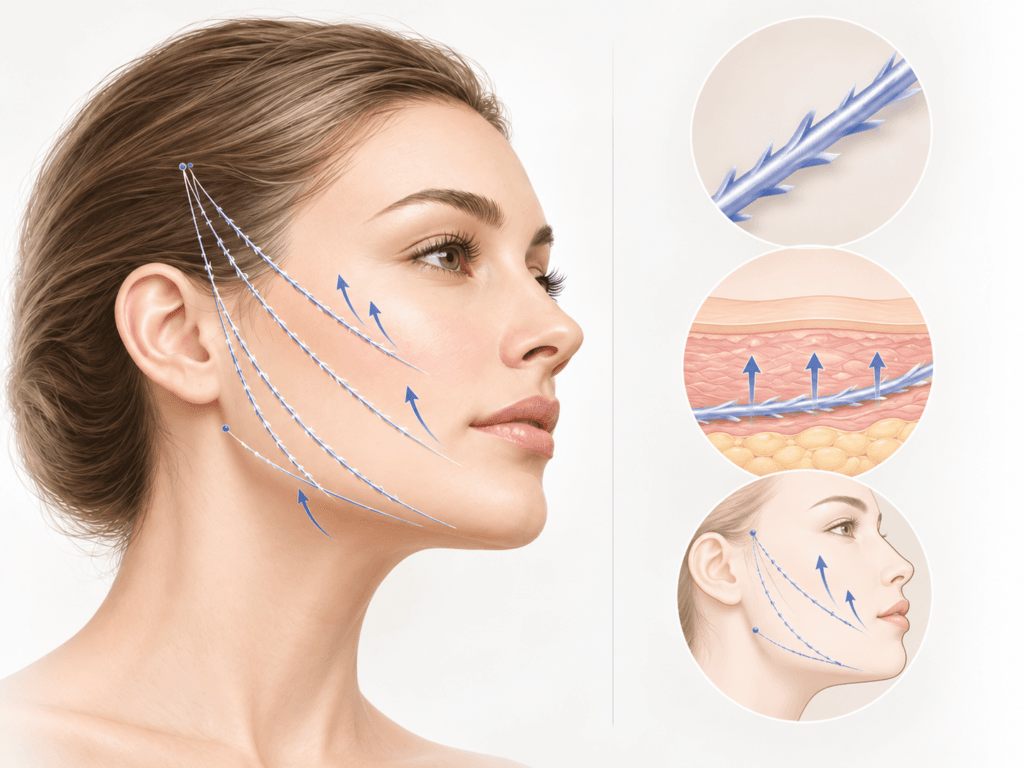
How Does a Thread Lift Work?
The aim of a thread lift is to provide mechanical support to mildly descended facial tissues.
Special threads are inserted beneath the skin and are designed to engage the soft tissues, creating a lifting effect in a selected direction.
The degree of improvement may vary depending on:
- the type of thread used,
- the patient’s skin and soft tissue characteristics,
- the degree of facial laxity,
- the direction of suspension,
- and the technique used.
Unlike facelift surgery, thread lifting does not involve direct mobilisation and repositioning of the deeper facial tissues. As a result, the degree of lifting that can be achieved is generally more limited.
Why Do We Not Routinely Use Pre-Manufactured Thread Systems?
Systems such as Aptos, French Lift and other suspension threads can produce satisfactory results in appropriately selected patients.
However, in our clinical practice, we have also assessed patients who developed problems after thread lift procedures performed elsewhere.
These have included:
- skin dimpling or irregularity,
- facial asymmetry,
- palpable threads beneath the skin,
- threads becoming visible or approaching the skin surface,
- infection,
- an undesirable direction of pull,
- and reduction of the lifting effect over time.
This does not mean that such complications occur in every patient. However, we believe patients should understand both the potential benefits and the limitations of the procedure before deciding to undergo treatment.
For this reason, pre-manufactured suspension thread systems are not used routinely at Anka Plastic Surgery.
Is a Thread Lift Permanent?
A thread lift should not be considered as durable as a surgical facelift.
Facial tissues continue to change over time as part of the natural ageing process, and the supporting effect of the threads may gradually decrease.
The duration of the result can therefore vary considerably between patients.
In patients with moderate or advanced facial laxity, a thread lift may provide insufficient correction, and facelift surgery may offer a more predictable and longer-lasting result.
Who May Be Suitable for a Thread Lift?
Thread lifting may be considered in carefully selected patients who have:
- mild facial laxity,
- no significant excess skin,
- realistic expectations,
- and a preference to avoid a more extensive surgical procedure.
Patients with prominent jowls, significant neck laxity, substantial excess skin or advanced tissue descent are less likely to achieve a meaningful result from thread lifting alone.
What Is Our Approach at Anka Plastic Surgery?
In selected patients seeking a limited lifting effect, a more controlled surgical suspension technique may occasionally be considered instead of a standard pre-manufactured thread system.
This may involve a small incision within the hair-bearing scalp and suspension of the tissues with surgical sutures.
This is not a procedure we perform routinely.
The decision is based on the patient’s facial anatomy, degree of tissue descent, soft tissue quality and expectations.
The aim is not to find a way to perform a thread lift in every patient, but to determine which treatment is most appropriate for the actual anatomical problem.
What Are the Risks of Thread Lifting?
Temporary swelling, bruising, tenderness and a feeling of tightness may occur after treatment.
Less commonly, possible complications include:
- asymmetry,
- skin dimpling or contour irregularity,
- palpable threads,
- migration of the thread towards the skin surface,
- infection,
- early loss of suspension,
- or an undesirable direction of tissue pull.
Even when the initial result is satisfactory, the tissues may gradually descend again over time.
Thread Lift, HIFU, Fillers or Facelift Surgery?
These treatments address different aspects of facial ageing and should not be regarded as interchangeable alternatives.
HIFU may be considered in patients with early skin laxity where the main aim is to improve skin firmness.
Hyaluronic acid fillers or fat grafting may be more appropriate when volume loss is a major component of facial ageing.
Thread lifting may provide a limited lifting effect in carefully selected patients with mild tissue laxity.
Facelift surgery allows the skin and deeper facial tissues to be repositioned more directly and can provide a greater degree of correction in patients with more significant sagging.
The most appropriate treatment should therefore be chosen according to the underlying anatomical problem rather than simply whether the patient wishes to avoid surgery.
Thread Lift vs Facelift Surgery
A thread lift and a surgical facelift do not provide the same degree of correction.
With thread lifting, facial tissues are supported using suspension threads.
During facelift surgery, the skin and deeper facial tissues can be directly repositioned.
For patients with more pronounced facial or neck laxity, facelift surgery generally provides a stronger and more predictable lifting effect.
Simply preferring a non-surgical treatment does not necessarily mean that a thread lift will be the most appropriate option.
Our Approach to Thread Lift Treatments
At Anka Plastic Surgery, thread lifting is not regarded as a routine facial rejuvenation procedure.
Because of the limited degree of lifting that can be achieved, the possibility of loss of effect over time and the complications we have seen in patients treated elsewhere, we take a selective approach.
In patients with mild laxity who do not wish to undergo facelift surgery, limited suspension techniques may occasionally be considered after careful assessment.
However, in patients with significant facial and neck laxity, we explain clearly that a thread lift cannot provide the same degree of correction as a surgical facelift.
Our starting point is not “Which procedure can we perform?”, but rather “What is causing the patient’s facial ageing, and which treatment addresses that problem most appropriately?”.